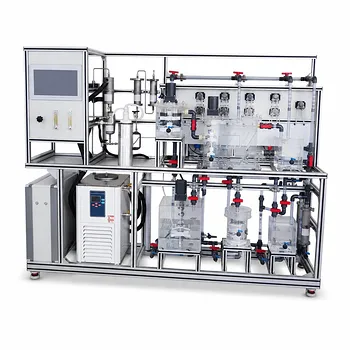
The secret to effective Clean-in-Place (CIP) in a bioprocess pilot plant lies not in the chemicals, but in the plumbing.
The reactor and all associated piping are engineered for complete gravity drainage—every wetted surface sloped so that process fluids and cleaning solutions drain entirely after each step. The system eliminates dead legs, crevices, and sharp bends, which would otherwise harbor microbes or soil. Components that tend to foul or scale, such as heat exchangers, are selected to be easily disassembled for manual inspection alongside automated CIP cycles.
In bioprocess pilot plants, CIP effectiveness hinges on a drainage-first design philosophy: all wetted surfaces must drain freely by gravity, and any pocket where liquid could pool must be engineered out. This approach prevents cross‑contamination but imposes real‑world trade‑offs—like increased downtime and larger reactor volumes—that shape both equipment design and scheduling decisions.
The Core Principle: Gravity Drainage Is Non‑Negotiable
Why Residual Liquids Are the Enemy
Even a thin film of nutrient‑rich broth or diluted cleaning agent can become a breeding ground for microorganisms. Leftover water droplets in a crevice can dilute the next batch or create localized corrosion. Free‑draining design ensures that after each CIP phase, the system is intrinsically dry, removing the substrate that contamination needs to grow.
Designing Piping Slopes and Layouts
Piping must be installed with a minimum slope—typically 1–2%—directed toward a low‑point drain. Every segment is pitched so that liquid flows naturally to the drain valve without pooling. Manifolds are arranged so that flow paths are uninterrupted and the entire network drains completely when the main drain is opened.
Eliminating Dead Legs and Crevices
A dead leg is any section of piping where fluid can stagnate because flow does not fully sweep it. The rule of thumb is the 6‑D rule: any branch must be no longer than six times its internal diameter. By minimizing these stagnant zones and avoiding abrupt corners, the system leaves nowhere for soil to hide, and CIP chemicals can reach every surface with turbulent flow.
Valve Selection: Why Diaphragm Valves Dominate
How Diaphragm Valves Support Drainage and Cleanability
Diaphragm valves are the preferred choice in hygienic pilot plants. Their body is smooth and self‑draining when installed at the correct angle. The flexible diaphragm completely isolates the process fluid from the valve mechanism, eliminating the crevices found in ball or gate valves. After cleaning, no liquid remains trapped inside the valve cavity.
Avoiding Trapped Volumes with Other Valve Types
Traditional globe or butterfly valves often create small annular spaces or dead volumes that drain incompletely. In a pilot plant, every connection point is a potential contamination risk; using valves that minimize internal cavities—or mounting them so that the cavity drains toward the vessel—is essential to maintaining a CIP‑ready state.
Heat Exchangers and Other Critical Components
Plate Heat Exchangers: Cleanability and Inspectability
Plate heat exchangers are favored because they can be opened and visually inspected after a CIP cycle. Their flat plates and narrow gaps are designed for turbulent flow, which enhances cleaning. However, if scaling is anticipated, the ability to disassemble the unit and manually brush plates is just as important as the automated wash.
Dealing with Scaling: Disassembly and Manual Cleaning
In processes where protein buildup or mineral scale is inevitable, no amount of CIP can replace a visual check. The pilot plant design must allow for quick disassembly of critical components—like sensors, sparger tubes, and heat exchanger plates—so operators can confirm cleanliness and remove stubborn deposits before the next batch.
The CIP Cycle Sequence and Its Drainage Demands
Why Each Step Must End with Complete Draining
A typical educational pilot‑plant CIP cycle includes alternating alkaline washes, acid washes, and rinses. After every single step—high‑pressure spray, alkaline wash, rinse, acid wash, deionized water rinse—the system must drain entirely. Leaving any fluid behind mixes chemistries, dilutes the next solution, or leaves residues that can react and corrode surfaces.
How Drainage Design Affects Cycle Efficiency
Fast, complete drainage reduces the total CIP time. If the piping is poorly sloped or valves retain liquid, operators must extend drain phases or add extra rinse cycles to compensate. Efficient gravity drainage therefore directly lowers the non‑productive time between batches and helps maintain a tighter turnaround.
Understanding the Trade‑offs
Downtime and Equipment Utilization: The Hidden Cost
A bioreactor never achieves 100% utilization because a significant portion of its cycle is consumed by CIP and SIP (Sterilization‑in‑Place). In many pilot‑plant scenarios, cleaning and sterilization steps can eat up half the total cycle time, dropping effective equipment utilization to 50%. This is the price paid for the meticulous drainage and cleaning design that ensures sterility.
Reactor Sizing Implications: Why You Might Need a Larger Vessel
To meet a given annual production target despite low utilization, the design volume of the reactor often must be doubled to compensate for non‑productive time. Educational pilot plants use this constraint to teach how auxiliary operations directly influence capital cost and scheduling—a critical business lesson wrapped in an engineering detail.
The Flexibility‑vs.‑Cleanability Balance
A research pilot plant may need to accommodate many different process configurations. Every modification must preserve the drainage philosophy. Sometimes, this means sacrificing a bit of operational convenience—for instance, avoiding a handy but uncleanable T‑piece—to maintain the overarching goal of foolproof CIP.
Making the Right Choice for Your Pilot Plant Design
- If your primary focus is sterility assurance and cross‑contamination prevention: Insist on a piping layout with a minimum 1% slope, zero dead legs, and diaphragm valves installed to self‑drain. Combine this with regular manual inspection of heat exchangers and sensors.
- If your primary focus is process efficiency and maximizing throughput: Optimize drain times by using generously sized drain lines and fast‑opening drain valves. Accept that some components will need scheduled disassembly and factor that downtime into your overall equipment sizing.
- If your primary focus is flexibility for research and educational purposes: Start with a drainage‑first backbone (sloped piping, hygienic components) and train operators to understand the “why” behind each cleaning step. Use the inherent downtime as a teaching moment on the real‑world trade‑offs between cleanliness and utilization.
An intelligently drained pilot plant doesn’t just clean faster—it makes contamination the exception, not the uncertainty, and teaches everyone who works with it that in bioprocessing, the way fluids leave the system is just as important as how they enter.
Summary Table:
| Design Element | CIP Requirement | Practical Impact |
|---|---|---|
| Gravity Drainage | 1–2% slope towards low-point drain | Prevents liquid accumulation and microbial growth |
| Dead Legs | Adherence to the 6-D rule | Eliminates stagnant zones where soil can hide |
| Valves | Self-draining diaphragm valves | Avoids internal cavities and trapped volumes |
| Heat Exchangers | Easily disassembled plates | Allows manual scrubbing and visual inspection |
Elevate Your Practical Training with LABPARK Pilot Plants
Designing effective Clean-in-Place (CIP) systems is a critical skill for the next generation of bioprocess engineers. LABPARK offers advanced Educational and Vocational Unit Operations Pilot Plants tailored for universities, research institutes, and enterprises.
Our systems span chemical engineering, bioprocess & biotech, and environmental & water treatment, providing hands-on experience with industry-standard sanitary piping, self-draining diaphragm valves, and modular configurations.
Help your students and researchers master real-world bioprocessing challenges. Contact our experts at LABPARK today to explore our pilot plant solutions!
Related Products
- Fixed-Bed Chemical Reaction and Gas Dust Tar Removal Unit Operations Pilot Plant
- Bio-fermentation Ethanol Production Practical Training Unit Operations Pilot Plant
- Internal Circulation Gradient Free Catalytic Reaction Educational Pilot Plant
- Tubular Reactor Flow Characteristics Determination Educational Unit Operations Pilot Plant
- Natural Product Extraction Unit Operations Training Pilot Plant
People Also Ask
- When to transition from PID to adaptive control in pilot plants? Key process indicators.
- How do deviations in estimating latent heat impact pilot plant thermal systems? Avoid hardware mis-sizing.
- Why Compare Predicted and Experimental Excess Enthalpy? Key to Accurate Pilot Plant Scale-up
- How to study gasification in pilot plants? Compare exit gas composition & efficiency
- Why Use PTFE & Hastelloy in Chemical Pilot Plants? Prevent Corrosion & Ensure Safety