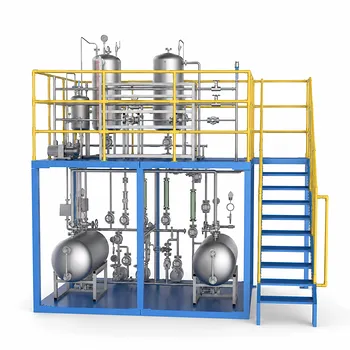
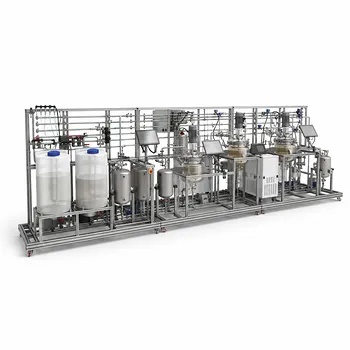
A distillation pilot plant isolates acetaldehyde from reactor by-products through a carefully sequenced chain of unit operations: an absorber, a light-ends stripper, and a fractional distillation column. This multi-stage approach tackles the reality that reaction mixtures contain compounds with an extremely wide boiling range—from gases like methyl chloride (-24.2°C) to high-boiling acetic acid (118°C)—and differing solubility in water. Students and researchers operate these units to directly observe how each step exploits a different physical property, turning a complex mixture into high-purity acetaldehyde.
The demonstration uses a water absorption tower to capture water-soluble acetaldehyde from the gas stream, then a distillation column to strip away light impurities, and finally a fractional column to isolate acetaldehyde from water and heavy ends. By running the pilot plant, operators learn to interpret real-time temperature profiles, reflux ratios, and vapor-liquid equilibrium, exactly as they would in an industrial setting.
The Three-Stage Separation Process
The acetaldehyde purification sequence is a textbook example of layered separation logic. Each unit targets a specific cut of the mixture, rather than trying to do everything in a single column.
Stage 1: Absorption Scrubs Out the Aldehyde
Reactor off-gas often contains acetaldehyde mixed with non-condensable lights and inerts. The pilot plant demonstrates that water absorption is the most practical first step.
Because acetaldehyde is highly soluble in water, the gas is contacted with a water stream in a packed or tray absorption column. The acetaldehyde transfers into the liquid phase, while the insoluble gases—such as methyl chloride and ethyl chloride—pass through and are vented. This step delivers a dilute aqueous acetaldehyde solution, bypassing the need to condense a very low-boiling mixture.
Stage 2: The Light-Ends Column Strips Volatile Impurities
The aqueous solution now contains dissolved acetaldehyde plus any remaining low-boiling by-products that were co-absorbed.
The pilot plant routes this liquid to a light-ends distillation column. Here the process benefits from the huge boiling-point difference: methyl chloride boils at -24.2°C, ethyl chloride at 12.3°C, while acetaldehyde boils at 20.8°C. By operating with an appropriate reflux ratio, the column concentrates these light impurities in the overhead stream, leaving an acetaldehyde-rich bottom product that still contains water and heavier compounds.
Stage 3: Fractional Distillation Achieves Final Purity
The final step is the heart of the demonstration. The bottoms from the light-ends column feed a fractional distillation column that separates acetaldehyde from water and high-boiling by-products like acetic acid (boiling point 118°C).
Because acetaldehyde boils at only 20.8°C and water at 100°C, the column can produce high-purity acetaldehyde overhead. The bottom product is an aqueous waste stream containing acetic acid and other heavies. Operators adjust the reflux ratio, observe the column temperature profile, and verify composition through on-line sensors or sampling—all critical skills for process control.
Visualizing Vapor-Liquid Equilibrium in Real Time
One of the most valuable aspects of a unit operations pilot plant is that it makes vapor-liquid equilibrium (VLE) tangible. Unlike a simulator, the glass or instrumented columns let students see what happens when a separation boundary shifts.
Reading the Temperature Profile
Every tray or packed section has a thermocouple. In the fractional column, you’ll see a flat temperature zone near 20.8°C in the rectifying section if acetaldehyde purity is high. A sudden jump to 100°C in the stripping section indicates the transition to water.
By changing the boil-up rate or reflux, students directly observe how the profile moves and how that affects product composition. This offers an unmistakable lesson in sensitivity and steady-state operation.
Understanding Reflux Ratio Trade-Offs
The pilot plant is designed to vary the reflux ratio easily. Turning up reflux improves purity but increases energy consumption and reduces throughput. Operators collect data to find the economic optimum—a classic chemical engineering exercise.
Educational Design of the Pilot Plant
The acetaldehyde sequence is often built as a modular skid, using transparent columns and comprehensive sensors. This design intentionally reinforces the multi-stage logic.
Trainable Unit Ops in a Compact Space
Though the primary reference describes a three-column arrangement, the principles can be compressed into a single skid with column switching or by running campaigns. Some facilities even split a tall column into two in series to handle ceiling-height constraints, exactly as described in the supplementary references for vacuum distillation. This allows the same fundamental learning without sacrificing safety or realism.
Bridging Batch and Continuous Mindsets
Even though the acetaldehyde demonstration is primarily continuous, the pilot plant can teach batch distillation logic when the feed composition varies. For example, during start-up, the column may operate under total reflux to stabilize before product withdrawal begins. The supplementary examples of batch distillation with intermediate cuts and recycling highlight how students gain a deeper appreciation for cut-point decisions—a skill directly transferable to the initial stabilization of the aldehyde column.
Understanding the Trade-offs
No separation train is without compromises. The acetaldehyde pilot plant reveals several key trade-offs that students must navigate.
Water Usage and Wastewater Treatment
The absorption step uses significant water. While it elegantly separates acetaldehyde from gases, it generates a large aqueous stream that eventually must be treated or disposed of. The pilot plant illustrates how a pure process stream can create a downstream utility burden.
Equipment Complexity vs. Single-Column Schemes
A three-step process requires three vessels, pumps, and control loops. Would a single, more sophisticated column be simpler? The pilot plant shows that, for this mixture, the wide boiling range would demand an exceptionally tall column and could risk thermal degradation of heavies. The multistage approach reduces the column height and energy load, but at the cost of increased capital and operational complexity.
Sensitivity to Feed Composition Fluctuations
If the reactor gas contains variable amounts of methyl chloride or ethyl chloride, the light-ends column must be continually adjusted. The pilot plant demonstrates how a disturbance in the absorption step cascades downstream, teaching the importance of instrumentation and advanced control in integrated processes.
Limits of Pilot-Scale Fidelity
While the pilot plant replicates the thermodynamics faithfully, it cannot reproduce the exact hydrodynamics of an industrial column (e.g., weeping, flooding at full scale). This gap is a known educational trade-off, which instructors mitigate by pairing pilot-plant runs with rigorous simulation.
Making the Right Choice for Your Learning Goals
How you configure and operate the acetaldehyde separation pilot plant depends on the educational or research objective.
- If your primary focus is mastering VLE and column profiling: Run the fractional distillation step independently, varying the feed composition and reflux ratio while recording the full temperature profile. This isolates the core distillation learning from absorption and stripping complexity.
- If your primary focus is process integration and plant-wide control: Operate the complete three-stage sequence, introducing disturbances in the reactor gas feed and water flow. Study how the light-ends column dampens fluctuations before they reach the final column.
- If your primary focus is comparing separation technologies: Replace the fractional column with a batch distillation setup or even a membrane module to benchmark energy consumption and purity. The supplementary references describe azeotropic and extractive configurations that can be adapted to aldehyde mixtures, reinforcing the concept that no single separation method is always best.
- If your primary focus is safety and handling of low-boiling, flammable materials: Prioritize the absorption step and the light-ends column. Demonstrate proper venting, purging, and the dangers of accumulating methyl chloride in closed systems.
By aligning the pilot plant exercise with a clear goal, the acetaldehyde purification becomes more than a recipe—it becomes a platform for deep process understanding.
Summary Table:
| Stage | Unit Operation | Primary Function | Target Separations / Outputs |
|---|---|---|---|
| Stage 1 | Water Absorption Tower | Captures soluble acetaldehyde from gas | Vents insoluble gases; yields dilute aqueous solution |
| Stage 2 | Light-Ends Stripper | Removes volatile impurities | Strips out low-boiling methyl/ethyl chloride |
| Stage 3 | Fractional Distillation Column | Isolates final pure product | Yields high-purity acetaldehyde overhead; separates water/heavies |
Bridge the Gap Between Theory and Industrial Practice with LABPARK
Hands-on experience with complex multi-stage separation is vital for training the next generation of process engineers. LABPARK provides premium Educational and Vocational Unit Operations Pilot Plants in chemical engineering, bioprocess & biotech, and environmental & water treatment tailored specifically for universities, research institutes, and enterprises.
Our highly instrumented, modular distillation pilot plants allow students and researchers to safely analyze real-time vapor-liquid equilibrium (VLE), interpret temperature profiles, and optimize reflux ratios in a controlled environment.
Ready to elevate your laboratory's capabilities? Contact LABPARK today to discuss your custom project requirements.
Related Products
- Continuous Sieve-Plate Distillation Pilot Plant for Unit Operations Laboratory Education
- Multi-Modal Distillation Unit Operations Training Pilot Plant
- Green Anhydrous Ethanol Purification Extractive Distillation Unit Operations Training Pilot Plant
- Dual-Mode Rectification Pilot Plant for Practical Training Unit Operations
- Ethyl Acetate Synthesis Unit Operations Pilot Plant for Practical Training
People Also Ask
- How can real-time carbon number prediction improve distillation pilot plants? Optimize control.
- How does catalyst water concentration affect distillation pilot plant design? Key separation train choices.
- Why is vacuum operation capability an essential feature for a distillation unit operations pilot plant? Unlock Efficiency
- What are the primary reflux ratio control strategies? Master Distillation Unit Operations
- How to select the right activity coefficient model (Wilson, NRTL, UNIQUAC) for distillation pilot plants?