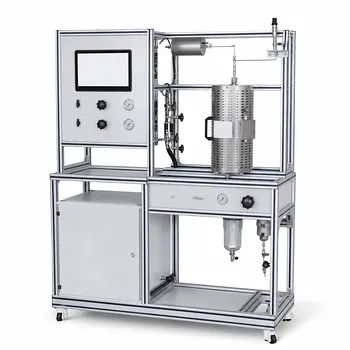
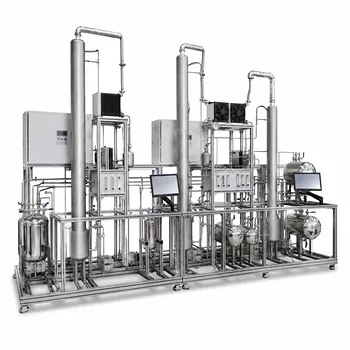
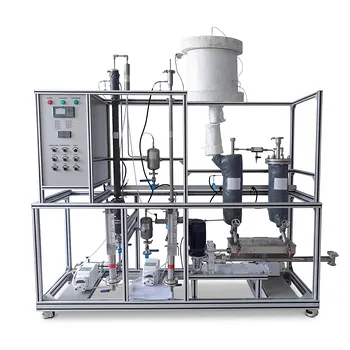
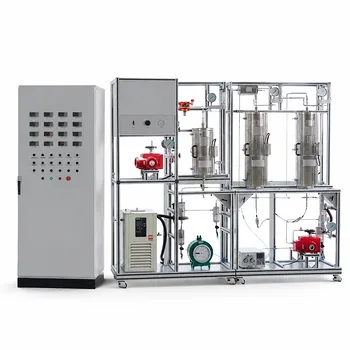
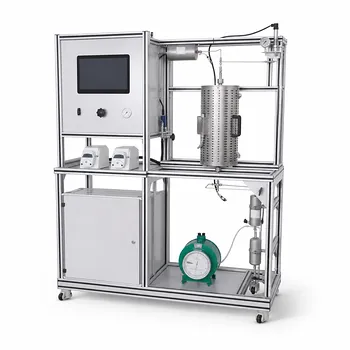
Reactive distillation for MTBE synthesis in a pilot plant is configured as a single column divided into three distinct zones. A rectifying section sits at the top, a catalyst‑packed reaction section occupies the middle, and a stripping section handles the bottom separation. The catalyst – typically spherical acid‑resin beads – cannot be dumped directly because their low voidage would choke vapor‑liquid flow; instead, the catalyst is encased in glass fiber cloth or stainless steel mesh bags and loaded into the reaction zone to ensure proper contact, prevent bypass, and allow simultaneous reaction and separation.
Configuring a pilot reactive distillation column for MTBE means first zoning the column into rectifying, reaction, and stripping sections, then addressing the core packing challenge: the solid catalyst must be immobilized in permeable bags that create enough void space to avoid flooding while still delivering sufficient residence time. The choice of bag material and the way the bags are formed into structured modules directly control mass transfer, pressure drop, and heat integration – all of which determine whether the pilot run genuinely reflects the intensified process.
The Three‑Zone Column Architecture
Why a Middle Reaction Zone?
In MTBE synthesis, isobutene (from a mixed C4 stream) reacts reversibly with methanol over an acid resin to form MTBE. The reaction equilibrium is limited, so the product must be removed from the reaction zone as it forms. Locating the catalyst bed between a rectifying section and a stripping section allows volatiles like unreacted C4s to move upward while the heavier MTBE product is drawn downward, continuously shifting the equilibrium toward higher conversion.
The Role of the Rectifying Section (Top)
This section acts as a C4‑refining zone. Unreacted isobutene and other light hydrocarbons (butanes, butenes) rise through the column. The rectifying section provides the necessary fractionation to reject any methanol that might otherwise escape overhead, returning it to the reaction zone. In a pilot plant, this is where you would see temperature profiles that confirm a sharp separation between light ends and the reacting liquid.
The Role of the Stripping Section (Bottom)
Below the reaction zone, the stripping section purifies the MTBE product. Any excess methanol that travels downward is vaporized and sent back up, while high‑purity MTBE leaves as the bottom stream. The reboiler at this section also leverages the exothermic heat of reaction: the reaction itself partially vaporizes the liquid, reducing external energy input – a classic demonstration of heat integration.
Catalyst Packing: From Beads to Bags to Bales
The Inherent Flow Problem with Loose Beads
Spherical resin catalysts for MTBE are tiny – typically 0.3 to 1.0 mm in diameter. If poured loosely into the column, they form a dense, low‑void‑fraction bed that dramatically restricts countercurrent flow. Liquid downcomer flooding and vapor channeling become inevitable, making stable operation impossible. This is the fundamental reason simple dumping fails in a pilot reactive distillation column.
Bagging as the Standard Pilot Solution
The practical fix is to pre‑pack the catalyst into permeable envelopes. In pilot‑scale operations, these bags are fabricated from:
- Glass fiber cloth: Chemically inert, resistant to the mildly acidic environment, and lightweight. Excellent for educational setups because you can visually inspect the catalyst.
- Stainless steel mesh: Offers higher mechanical strength and better heat conduction, helping to distribute the exothermic reaction heat more evenly across the packing.
The bags are then either rolled into cylindrical bales or folded into structured modules that mimic the geometry of corrugated sheet packings. This creates large, predictable void channels for vapor upflow and ample surface area for liquid downflow, achieving the two‑phase countercurrent contact essential for catalytic distillation.
Preventing Flooding While Ensuring Residence Time
The bag‑based packing morphology directly influences two critical hydraulic parameters:
- Flooding point: The open architecture of bagged modules keeps pressure drop low, enabling higher vapor and liquid throughput before the column floods. The pilot plant’s pressure sensors and differential pressure transmitters become key diagnostic tools here.
- Liquid holdup and residence time: The catalyst bags must hold enough liquid – but not too much – so that the methanol‑isobutene mixture has adequate contact time with the acid sites. Over‑packing the reaction zone or using bags that are too tight can create stagnant pockets, leading to hot spots or by‑product formation.
Aligning Temperature and Pressure with the Catalyst Window
The bag material also helps stabilize the operating window where reaction kinetics and vapor‑liquid equilibrium overlap. For MTBE, typical column conditions are around 60–80 °C and moderate pressure (a few bar) to keep isobutene in liquid phase. Glass fiber and stainless steel both tolerate these temperatures without degrading, and the bags’ open structure allows the exothermic heat to vaporize the liquid mixture directly, maintaining a near‑isothermal profile in the reaction zone – a valuable teaching point for energy integration.
Common Pitfalls and Trade‑offs
While bagging solves the flow problem, pilot‑plant designers must watch for these drawbacks:
- Mass transfer resistance: The cloth or mesh adds a diffusion barrier. If the bag weave is too fine or the packing is compressed, reactant molecules may not reach the inner catalyst beads quickly enough, lowering the apparent reaction rate.
- Channeling and maldistribution: Poorly assembled bags can shift during operation, creating uneven flow paths. This often shows up as temperature striations across a column cross‑section.
- Catalyst deactivation and replacement: Bagged catalysts are easier to remove than a dumped bed, but if the bags tear, resin fines can clog downstream pumps and valves. Periodic inspection of bag integrity is essential.
- Scale‑up liability: What works in a glass pilot column with bagged catalyst may not translate directly to an industrial catalytic distillation column that uses proprietary structured packings (like Katapak‑S). The pilot setup teaches the principle, but the physical packing geometry differs, so students should understand the conceptual link rather than treating the bagged configuration as a direct industrial replica.
Making the Right Choice for Your Pilot Plant Goals
The exact configuration and packing strategy you pick depends on what you want the pilot plant to demonstrate.
- If your primary focus is demonstrating process intensification and equilibrium shifting: Use a three‑zone column with bagged catalyst in the middle, feed the mixed C4‑methanol stream at the top of the reaction zone, and collect MTBE bottoms. This shows the classic Le Chatelier‑driven yield boost.
- If you want to study hydraulic performance and flooding limits: Opt for stainless steel mesh bags formed into rigid bales, and instrument the column with multiple differential pressure cells. Vary the liquid and vapor loads to map the flooding curve and teach students about capacity constraints.
- If the goal is to test different feed locations or operating pressures: Choose glass fiber bags for easier reconfiguration. You can quickly reposition the bags or add extra thermocouples to capture the temperature profile response when feed is moved from the rectifying to the stripping section.
- If the pilot plant is primarily a teaching tool: Emphasize the heat integration story. Bag the catalyst, run the column at total reflux initially, and have students measure how the reboiler duty drops once reaction starts – a vivid proof of how exothermic heat drives distillation.
A well‑configured MTBE reactive distillation pilot plant, with catalyst thoughtfully packed into permeable bags, turns a complex intensified process into an observable, measurable, and highly instructive system that bridges reaction engineering and separation science.
Summary Table:
| Column Zone / Aspect | Main Function in MTBE Synthesis | Key Packing & Operating Considerations |
|---|---|---|
| Rectifying Zone (Top) | Refines unreacted C4s; rejects methanol | Fractionates light ends; returns methanol to reaction zone. |
| Reaction Zone (Middle) | Houses acid-resin catalyst for synthesis | Catalyst must be bagged (glass fiber/SS mesh) to prevent column flooding. |
| Stripping Zone (Bottom) | Purifies MTBE; vaporizes excess methanol | Recovers high-purity MTBE product and utilizes reaction heat. |
| Catalyst Packing | Immobilizes solid catalyst beads | Permeable bags balance vapor-liquid flow and target residence time. |
Scale Up Your Chemical Engineering Training with LABPARK
Are you looking to demonstrate advanced process intensification like reactive distillation in your laboratory?
LABPARK provides state-of-the-art Educational and Vocational Unit Operations Pilot Plants in chemical engineering, bioprocess & biotech, and environmental & water treatment. Tailored for universities, research institutes, and enterprises, our systems deliver hands-on learning, robust instrumentation, and reliable scaling data to bridge the gap between theory and industrial practice.
Contact our specialists today to configure the perfect pilot plant for your curriculum or research needs!
Related Products
- Multi-Functional Special Distillation Educational Pilot Plant
- Multi-Modal Distillation Unit Operations Training Pilot Plant
- Multi Functional Membrane Crystallization Educational Unit Operations Pilot Plant
- Ethyl Acetate Synthesis Unit Operations Pilot Plant for Practical Training
- Carbon Dioxide Hydrogenation Methanol Synthesis Educational Unit Operations Pilot Plant
People Also Ask
- Why does simple distillation yield higher efficiency than flash distillation? Key thermodynamic differences.
- Why is the acentric factor important in pilot plants? Fluid property prediction.
- How Batch vs Continuous Configuration Affects Distillation Pilot Plant Versatility & Footprint
- How to Verify Distillation Boundary Lines & Composition Regions with Pilot Plants
- How does double temperature difference control improve distillation pilot plants? Stabilize purity.