Constant-temperature boiling while two immiscible liquid phases coexist—and a rising boiling point once the mixture becomes homogeneous—is the critical signature of liquid-phase immiscibility on a phase diagram. In a heterogeneous azeotropic distillation pilot plant, this behavior directly dictates the column’s temperature profile, the need for a decanter, and the exact moment phase separation in the still pot has ended.
Liquid-phase immiscibility appears as a horizontal liquidus line on a binary temperature–composition diagram. The heterogeneous azeotrope forms where the vapor curve touches this flat boundary, producing a constant distillation temperature. In the pilot plant, this means the pot temperature stays rock-steady while two liquids remain in contact with the vapor phase; the temperature begins to climb only after the more volatile component has fully evaporated, signaling a transition to a single liquid phase.
How Immiscibility Appears on a Phase Diagram
The Horizontal “Flat” Liquidus Line
When two liquids exhibit strong positive deviations from Raoult’s law, they may refuse to mix across a certain composition range. On a binary phase diagram, this liquid-phase splitting is shown as a horizontal line that extends over the immiscible composition region at a fixed temperature.
This is not a typical boiling point curve. Instead, it represents a three-phase condition: two conjugate liquid phases (L₁ and L₂) plus the vapor phase (V). The system’s overall composition can vary across that flat segment, yet the boiling temperature remains constant.
The Heterogeneous Azeotrope Intersection
A heterogeneous azeotrope appears exactly where the vapor composition curve intersects this horizontal liquidus line. At that singular point, the vapor composition equals the net liquid composition—despite the fact that two distinct liquid layers exist below.
The key visual: the vapor curve “touches” the flat liquidus line. That intersection gives the azeotropic composition and the constant boiling temperature. The primary reference clarifies that the system boils at a single, unchanging temperature as long as two liquid phases are present.
Why the Temperature Does Not Rise (Until It Does)
As distillation proceeds, the vapor continuously removes material. The overall pot composition drifts. However, while both liquid phases coexist, the phase rule restricts the degrees of freedom—temperature remains fixed. Only when the more volatile component has been sufficiently depleted, and the second liquid phase disappears, does the mixture become homogeneous.
At that moment, the remaining liquid leaves the horizontal tie-line and enters the single-phase liquid region. The boiling point then begins to rise, tracking the normal vapor–liquid equilibrium curve. This transition is sharp and easily observable.
How This Dictates Heterogeneous Azeotropic Distillation Operation
Constant Temperature Boiling as an Operational Marker
In a pilot plant, the pot temperature serves as a live monitor of phase behavior. As long as the pot contents remain in the two-liquid region, the thermometer reads a constant, plateau temperature. Researchers use this plateau to identify when the heterogeneous azeotrope is actively governing the boil.
Once the lighter component has been boiled out, the plateau ends abruptly. The pot temperature starts increasing. This shift is the real-time signal that the mixture is now homogeneous, and the distillation has entered a different regime. Students and operators can correlate the temperature profile directly with the phase diagram’s horizontal segment.
The Critical Role of the Decanter
The condensed overhead vapor from a heterogeneous azeotropic column does not form a single layer—it splits into two liquid phases upon cooling. As the supplementary references point out, this requires the pilot plant to include a decanter (a gravity phase separator) in the reflux loop.
One liquid phase, usually richer in the target component, may be returned as reflux. The other phase, richer in the entrainer or the second component, can be withdrawn as product or sent to further recovery. Without a decanter, the two-phase distillate cannot be properly split, and the separation advantage is lost. The pilot plant’s hydraulic design—including settling time, weir height, and interface control—directly depends on the immiscibility behavior shown on the phase diagram.
Leveraging the Azeotrope for Separation
A heterogeneous azeotrope is not just a barrier; it is an opportunity. Because the distillate naturally phase-separates on condensation, you can move “across” the azeotropic composition by removing one of the liquid phases.
For example, in a water-ethanol-benzene system, the ternary azeotrope carries water overhead; the condensate splits into a water-rich layer and a benzene-rich layer. Removing the water layer effectively depletes water from the column, allowing nearly anhydrous ethanol to be drawn from the bottom. The supplementary reference confirms that this arrangement demands a decanter to achieve reflux control and product withdrawal simultaneously.
Understanding the Trade-offs
Sensitivity to Feed Composition
The flat liquidus region exists only within a specific composition window. If the feed composition lies outside that window, the mixture enters the column as a single liquid phase. In that case, the two-liquid behavior never appears in the pot, and the expected temperature plateau will not materialize.
Operators must verify, from the phase diagram, that the intended feed falls within the miscibility gap at the distillation pressure. A slight shift in solvent ratio or impurity can push the system outside the heterogeneous zone, nullifying the decanter’s purpose.
Decanter Design and Emulsion Risks
A decanter works on density difference and settling time. In laboratory pilot plants, tight liquid–liquid dispersions can form, leading to slow or incomplete phase separation. If the decanter fails to deliver a clean split, reflux composition drifts, and the constant-temperature plateau may waver—misleading the operator about phase transitions.
Pilot plant instructors often demonstrate how agitation, trace surfactants, or incorrect temperatures can break the horizontal line behavior, highlighting the gap between theoretical diagrams and real fluid dynamics.
Column Pressure and Temperature Link
The phase diagram is drawn at a constant pressure (usually atmospheric). In a pilot plant, pressure fluctuations—from heat input changes or column flooding—shift the liquidus line and the azeotropic point. The constant-temperature plateau might then slope slightly or occur at an unexpected value. Students must learn to correlate the observed plateau with the expected one, using pressure corrections from the VLE data.
Making the Right Choice for Your Pilot Plant Goal
Whether you are teaching or researching, match your operational strategy to the phase diagram’s immiscibility information.
- If your primary focus is demonstrating heterogeneous azeotropic behavior: Run the column with a feed inside the immiscible region. Watch for the temperature plateau and confirm that the condensate splits into two clear layers in the decanter. Use the plateau’s end to time the switch from total reflux to product withdrawal.
- If your primary focus is separating a mixture that forms a heterogeneous azeotrope: Ensure your pilot plant includes a decanter and that the solvent-to-feed ratio places the overall composition squarely on the flat liquidus line. Monitor pot temperature continuously—the moment it begins to rise, the heterogeneous zone has been passed, and further boiling risks losing the separation advantage.
- If your primary focus is studying the dynamic transition from two-liquid to one-liquid regime: Operate with a feed near the edge of the miscibility gap. Record the temperature and sampling time as the plateau breaks. Use the phase diagram to predict exactly at which remaining pot composition the second liquid phase should vanish.
Understanding how a horizontal line on a phase diagram translates into a living, breathing temperature profile in your pilot plant transforms an abstract thermodynamic concept into a practical, real-time control tool—and that is the core of mastering heterogeneous azeotropic distillation.
Summary Table:
| Key Phenomenon | Phase Diagram Representation | Pilot Plant Operational Impact |
|---|---|---|
| Immiscibility Gap | Horizontal liquidus line (constant T) | Steady temperature plateau in the still pot |
| Heterogeneous Azeotrope | Vapor curve intersects liquidus line | Overhead vapor condenses into two distinct liquid phases |
| Homogeneous Transition | Departure from the flat tie-line | Sharp rise in boiling temperature signaling phase change |
| Phase Separation | Two-phase envelope | Dictates decanter design, settling time, and reflux control |
Master Azeotropic Distillation with LABPARK Pilot Plants
Bridge the gap between thermodynamic theory and practical operations. LABPARK provides state-of-the-art Educational and Vocational Unit Operations Pilot Plants in chemical engineering, bioprocess & biotech, and environmental & water treatment tailored for universities, research institutes, and enterprises.
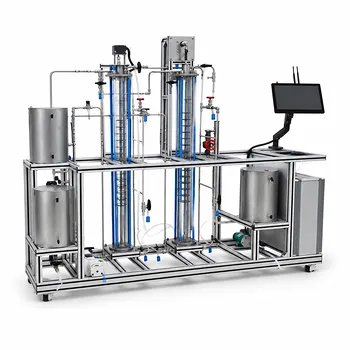
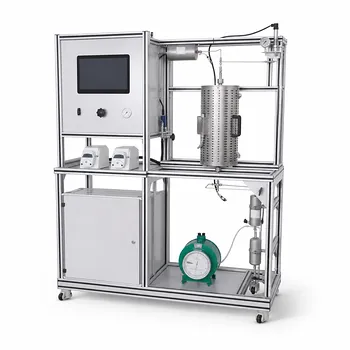
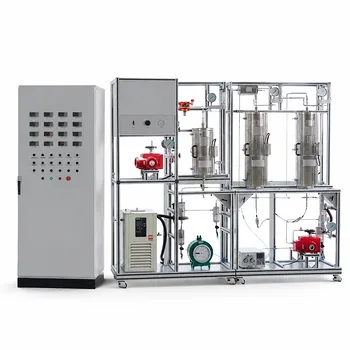
Our custom-engineered distillation pilot plants feature precise temperature monitoring and integrated decanter systems, enabling students and researchers to visualize phase transitions and master complex separations in real-time.
Ready to elevate your laboratory's training and research capabilities? Contact LABPARK today to find the perfect pilot plant solution for your needs!
Related Products
- Multi-Functional Special Distillation Educational Pilot Plant
- Continuous Sieve-Plate Distillation Pilot Plant for Unit Operations Laboratory Education
- Ethyl Acetate Synthesis Unit Operations Pilot Plant for Practical Training
- Green Anhydrous Ethanol Purification Extractive Distillation Unit Operations Training Pilot Plant
- Green Anhydrous Ethanol Refining Practical Training Pilot Plant
People Also Ask
- Why does simple distillation yield higher efficiency than flash distillation? Key thermodynamic differences.
- Why is the acentric factor important in pilot plants? Fluid property prediction.
- How Batch vs Continuous Configuration Affects Distillation Pilot Plant Versatility & Footprint
- How to Integrate Spectroscopy in Distillation Pilot Plants for Advanced Process Control
- How to Estimate Distillation Pilot Plant Tray Efficiency? O'Connell's Correlation Guide