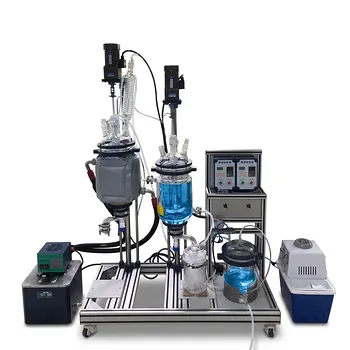
The key to transforming desalination pilot plants from mere hardware demonstrations into powerful learning laboratories lies in one often-overlooked concept: thermodynamic non-ideality. Understanding activity and osmotic coefficients allows students and researchers to move beyond ideal-solution assumptions. They can then quantitatively predict and control membrane scaling, salt rejection, and chemical precipitation—the very phenomena that determine real-world desalination and water treatment performance. Applying these coefficients with models such as Pitzer or Debye-Hückel bridges abstract thermodynamics and hands-on pilot operation, equipping teams to diagnose, optimize, and innovate.
While ideal-solution approximations simplify calculations, they fail completely in the high-salinity, high-ionic-strength streams typical of desalination and industrial water treatment. Teaching and researching activity and osmotic coefficients in pilot plants gives engineers the quantitative tools to foresee scaling, determine reverse osmosis pressure requirements, and calculate true chemical dosing—turning trial-and-error into first-principles process design.
The Thermodynamic Reality of Saline Solutions
Why Ideal Assumptions Break Down in Water Treatment
Real aqueous electrolyte solutions contain dissociated ions that interact strongly, especially in the concentrated feeds of desalination plants. Activity coefficients (such as the molality-based γ, molarity-based y, or mole fraction‑based f) quantify how much the “effective concentration” of a species deviates from its measured concentration.
At high ionic strength (I), these deviations become so large that ideal‑solution calculations misjudge solubility limits and reaction driving forces. Ignoring non‑ideality leads to underestimating precipitation risks and over‑ or under‑dosing expensive chemicals.
The Role of the Osmotic Coefficient in Reverse Osmosis
The osmotic coefficient (φ) directly links the real osmotic pressure of a solution to its ideal value. In reverse osmosis, the applied pressure must exceed the feed stream’s osmotic pressure to force water through the membrane.
If osmotic coefficients are neglected, the required feed pressure is miscalculated. That error cascades into poor energy‑efficiency estimates and incorrect membrane selection, undermining pilot-plant research and student learning about system optimization.
From Equations to Pilot Plant Insights
Predicting Membrane Fouling and Scaling
When students measure ion concentrations and temperature in a pilot plant, they can calculate ionic strength and feed those values into semi‑empirical models like Debye‑Hückel (using constants A, B, and ion‑size parameters s) or the more robust Pitzer model. These models generate activity coefficients that predict the saturation index of sparingly soluble salts.
With this approach, a learner moves from simply observing a fouled membrane to forecasting when and where scaling will begin. In research, that same capability supports the design of pre‑treatment strategies that protect expensive membranes.
Optimizing Chemical Dosing and Ion Exchange
In processes like chemical precipitation or heavy‑metal removal, the effective concentration of the precipitating agent depends on its activity, not its molarity. Activity‑based calculations reveal the true driving force for ion‑exchange equilibria, preventing the common pitfall of under‑ or over‑feeding reactants.
Pilot‑plant exercises that couple these calculations with real‑time turbidity or conductivity data teach a critical skill: how to translate a thermodynamic prediction into a pump setting. Researchers likewise use the same framework to minimize sludge production while meeting discharge limits.
Bridging Theory and Operation with Computational Models
Modern pilot plants are increasingly paired with thermodynamic databases that implement the Pitzer model for high‑salinity streams. When students input pilot‑plant conditions into such tools and compare predicted osmotic coefficients with observed pressures or fluxes, they internalize the cause‑and‑effect relationship between solution chemistry and process performance.
This integration prepares future engineers to operate industrial desalination arrays and to troubleshoot underperformance using first principles, not guesswork.
Understanding the Trade‑offs and Limitations
Model Complexity vs. Practical Applicability
The Pitzer model handles concentrated multi‑component electrolytes well, but it requires an extensive set of temperature‑dependent interaction parameters that may not be available for every emerging contaminant. In a teaching setting, students must learn to judge when this complexity is warranted and when a simpler Debye‑Hückel approximation suffices for weak electrolytes or low‑salinity waters.
Over‑reliance on a single model without such judgment can lead to analysis paralysis or, conversely, to dangerous extrapolation beyond a model’s validated range.
The Limits of Current Predictive Models
Even advanced models can struggle with the complex speciation of multi‑valent ions, organic‑inorganic mixtures, or the dynamic pH changes along a membrane channel. Activity coefficients alone do not capture kinetic factors, such as crystal growth rates or the mechanical scouring of a fouling layer.
A pilot plant, therefore, remains essential as a reality check—it grounds the thermodynamic picture in physical evidence, revealing when a prediction is incomplete. Teaching this boundary helps researchers maintain a productive humility about purely computational simulations.
Making the Right Choice for Your Teaching or Research Goal
Your focus will determine which thermodynamic depth and toolset bring the most value.
- If your primary focus is hands‑on operator training: Emphasize the osmotic coefficient and its direct link to required pump pressure. Use simple Debye‑Hückel calculations to show why higher salinity demands more energy, and let operators see that relationship in the pilot plant’s data.
- If your primary focus is process optimization research: Deepen the work with the Pitzer model and computational databases to predict scaling indices and ion‑exchange equilibria across a wide range of temperatures and concentrations, directly validating those predictions against pilot‑plant permeate quality.
- If your primary focus is curriculum design for environmental engineering: Sequence the learning so that students first measure ideal behavior (dilute streams), then confront a high‑salinity failure, then discover how activity and osmotic coefficients explain the discrepancy—cementing the “why” behind non‑ideality before introducing the mathematical tools.
Anchoring pilot‑plant education in the rigorous language of activity and osmotic coefficients transforms a routine desalination experiment into a masterclass in practical thermodynamics—empowering the next generation of water‑treatment experts to design, not just operate.
Summary Table:
| Thermodynamic Concept | Key Models / Parameters | Pilot Plant Application |
|---|---|---|
| Activity Coefficient ((\gamma), (y), (f)) | Debye-Hückel, Pitzer model | Predicts saturation index, scaling thresholds, and optimal chemical dosing. |
| Osmotic Coefficient ((\phi)) | Osmotic pressure equations | Calculates actual required feed pressure, preventing membrane underperformance. |
| Ionic Strength ((I)) | Concentration of dissociated ions | Serves as the critical input for calculating activity deviations in high-salinity feeds. |
Bring Advanced Thermodynamic Research to Life
Bridge the gap between molecular theory and industrial reality with LABPARK. We provide premium Educational and Vocational Unit Operations Pilot Plants in chemical engineering, bioprocess & biotech, and environmental & water treatment tailored for universities, research institutes, and enterprises.
Ready to upgrade your lab's hands-on capabilities? Contact LABPARK today to find the perfect pilot plant solution for your curriculum or research goals!
Related Products
- Electrochemical Water Treatment Educational Unit Operations Pilot Plant
- Multi-Modal Distillation Unit Operations Training Pilot Plant
- Multimodal Absorption and Desorption Pilot Plant for Unit Operations Training
- Dual-Mode Rectification Pilot Plant for Practical Training Unit Operations
- Green Anhydrous Ethanol Purification Extractive Distillation Unit Operations Training Pilot Plant
People Also Ask
- What design features do educational electrochemical pilot plants utilize to manage gas liberation and water loss?
- How can unit operations pilot plants show lead-acid concentration vs state of charge? Real-time monitoring guide.
- How do educational electrochemical pilot plants scale up electrolysis? Master industrial engineering.
- How to Estimate Sulfate in Water Treatment Pilot Plant Deposits: Gravimetric Guide
- How can foaming be managed during steam generation experiments in water treatment unit operations pilot plants? Tips