Understanding phase equilibria and Gibbs energy minimization isn't just academic theory—it's the blueprint for your pilot plant’s control system.
It transforms your pilot plant from an expensive trial-and-error exercise into a precision instrument. By applying models like the associated solution and multiple sublattice models, you can mathematically predict how non-ideal mixtures will separate, react, and distribute across phases. This allows you to feed your process simulator with accurate activity coefficients and phase compositions directly derived from Gibbs energy minimization, rather than relying on rough estimates. The result is a dramatic reduction in startup time and a clear, physics-based roadmap for scaling up.
While the surface need is predicting phase splits, the deep need is risk elimination in process scale-up. These thermodynamic models give you a predictive digital twin of your pilot plant, letting you foresee and prevent operational failures—from clogged molten salt lines to column flooding—before they physically happen.
The Computational Core: Linking Models to Phase Behavior
Your primary goal is to map out the equilibrium state of a complex, real chemical mixture. The associated solution and multiple sublattice models are your most robust tools for doing this when dealing with severe non-ideality.
Decoding the Associated Solution Model
This model tackles mixtures where molecules clump together to form short-lived "associates" or complexes. Think of carboxylic acids forming dimers in the vapor phase.
By accounting for these chemical associations, the model correctly calculates the true number of species in solution. Gibbs energy minimization then dictates how these species distribute. Without this, your predicted boiling points for a distillation column could be wildly inaccurate, leading to failed separation.
Understanding the Multiple Sublattice Model
This model is essential for solid and ionic phases, such as molten salts or alloys. It envisions the crystal structure not as a single entity, but as interlocking "sublattices" for different ions.
For example, in a KCl-CaCl2-ZnCl2 salt system, it predicts the precise liquidus surface temperature. This is not just a phase diagram; it is an operational command. It defines the single, non-negotiable temperature boundary above which your entire pilot plant’s heat transfer fluid loop must operate to avoid catastrophic solidification.
The Unifying Principle: Minimizing Gibbs Energy
Both models are formalisms; they feed the same prime directive: the total Gibbs energy of the system must be at its global minimum at equilibrium.
An algorithm tests countless combinations of phase fractions and compositions. It finds the unique state where the chemical potential of every component is equal across all phases. This single calculation gives you the final answer—your pilot plant’s theoretical operating envelope.
From Theory to Tangible Pilot Plant Advantage
A pilot plant is a physical hypothesis test. These models are how you formulate a winning, data-driven hypothesis before flipping the switch.
Drastically Reducing Experimental Startup Time
The primary reference's core promise is eliminating trial-and-error. A distillation column has an infinite number of reflux ratio, feed stage, and pressure combinations.
Gibbs energy minimization pinpoints the feasible set. Your process simulator, armed with accurate model parameters, predicts the exact temperature profile and composition on each tray. This converts chaotic initial runs into a focused validation exercise, saving weeks of expensive pilot-plant rental and operator time.
Calibrating Semi-Empirical Models with Real Data
Your simulator likely uses NRTL or UNIQUAC models with estimated binary interaction parameters—these are notorious sources of uncertainty.
The supplementary references highlight the critical feedback loop here. You run your pilot plant at a steady state predicted by your initial thermodynamic model. You then analytically sample the vapor and liquid streams. The resulting real-world data is pure gold, allowing you to regress and dramatically improve the accuracy of those binary interaction parameters, creating a self-calibrating digital twin.
Defining the "Safe Operating Window" for Non-Traditional Fluids
For specialized applications like molten salt heat transfer, phase behavior is a safety and reliability metric. The supplementary materials make this concrete.
If your Gibbs energy calculation shows a liquidus temperature of 230°C for your KCl-CaCl2-ZnCl2 blend, your safe turndown limit is not a guideline; it’s a hard floor. Operating below this threatens localized solidification, pump cavitation, and expensive pipe damage. The model also predicts activities, helping you mitigate corrosive chemical attack on expensive alloy heat exchangers.
Benchmarking Reactor Performance Against Ideality
For reactive systems, the Gibbs energy minimum provides the ultimate benchmark: the chemical equilibrium state. Consider a methanation reactor.
The supplementary references note that by calculating the equilibrium product yield (where ΔrG = 0), you get a theoretical ceiling for conversion. Comparing your actual pilot plant reactor yield against this thermodynamic maximum instantly quantifies all kinetic, mass-transfer, and mixing limitations. This single comparison logically directs your next move—changing the catalyst or redesigning the distributor.
Understanding the Trade-Offs
These models are powerful, but their application in the dynamic environment of a pilot plant is not without risk. Trust but verify is the only responsible approach.
The Pitfall of "Garbage In, Garbage Out"
The thermodynamic models are only as good as their parameters. The associated solution model, for instance, requires equilibrium constants for the association reactions.
If these constants come from a pure databank estimation without experimental validation, your predictions can be dangerously wrong. The model will confidently output results that don’t reflect reality. The parameter base, not the math, is the weak link.
Bridging Thermodynamics and Kinetics
A Gibbs energy minimization calculation is a final-state predictor. It is stubbornly ignorant of time.
A pilot plant distillation column will never reach 100% equilibrium on every tray. Efficiency matters. A model might predict a 99.9% pure distillate composition, but your 20-tray column might only achieve the equivalent of 14 equilibrium stages. The thermodynamic model provides the target; you must supply the engineering judgment on how closely you can approach it.
The Challenge of Phase Detection
Knowing that a solid phase should form is a standard Gibbs energy minimization output. Knowing that it has formed in your opaque, high-temperature pipe is solely an operational challenge.
This gap between prediction and direct observation means you must instrument the plant to validate the calculations. A predicted precipitation boundary must be verified with inline viscometry or temperature-sensing arrays, not taken on faith.
Making the Right Choice for Your Goal
Apply these principles to your pilot plant program with a clear focus on your specific development phase.
- If your primary focus is conceptual design: Use the full predictive power of associated solution and sublattice models to map the theoretical operational boundaries. Center your initial pilot plant test matrix on validating these hard limits.
- If your primary focus is process optimization and de-bottlenecking: Don't just run the plant; use it to recalibrate your models. Focus on running a targeted set of steady-state experiments specifically designed to regress the binary interaction parameters in your NRTL or UNIQUAC models for maximum profit.
- If your primary focus is new fluid validation (e.g., molten salts, ionic liquids): Your thermodynamic model is your safety analysis. The predicted liquidus surface and phase boundaries dictate the mandatory heating, tracing, and emergency shutdown protocols from day one.
- If your primary focus is reacting systems: Use the Gibbs energy calculation to decouple thermodynamic and kinetic limitations. Always benchmark your experimental conversion against the equilibrium limit to diagnose the true bottleneck.
A pilot plant is only as strategic as the physical and mathematical principles that guide it. By enforcing the laws of thermodynamics on your experiments from the very first calculation, you replace educated guesses with a rigorous scientific trajectory from molecule to market.
Summary Table:
| Thermodynamic Concept / Model | Core Mechanism | Practical Pilot Plant Application |
|---|---|---|
| Associated Solution Model | Accounts for molecular clustering / chemical associations | Predicts accurate separation boundaries for non-ideal distillation. |
| Multiple Sublattice Model | Models interlocking crystal structures in solid/ionic phases | Defines strict temperature floors to avoid line/pump solidification. |
| Gibbs Energy Minimization | Identifies phase equilibrium at the global energy minimum | Establishes the safe operating envelope and benchmarks max reactor yield. |
Bridge the Gap Between Thermodynamic Theory and Physical Operation
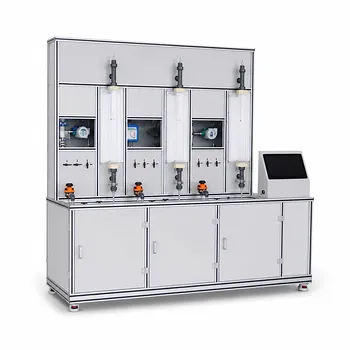
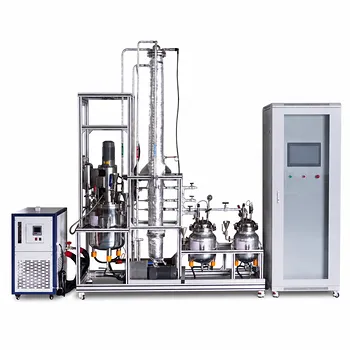
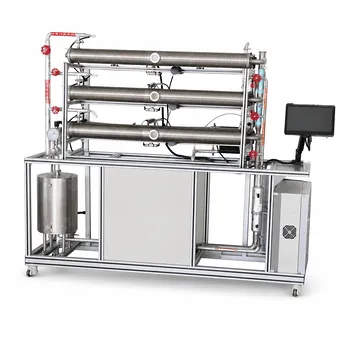
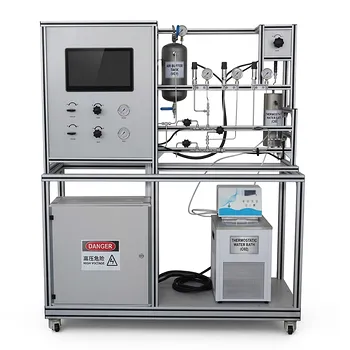
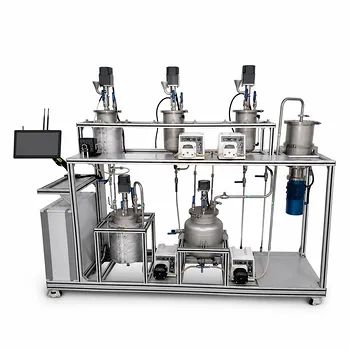
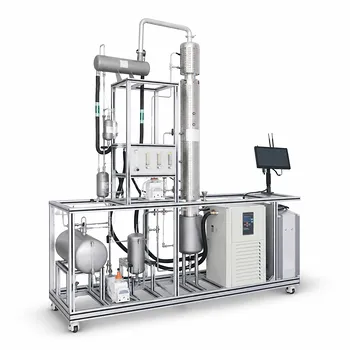
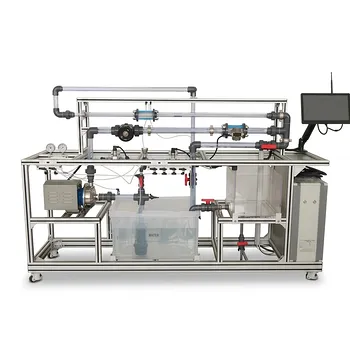
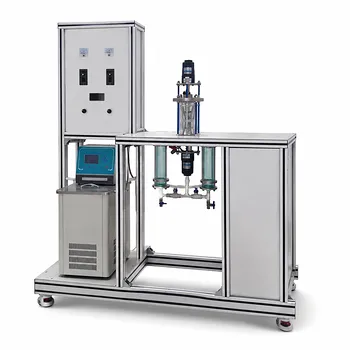
At LABPARK, we help universities, research institutes, and enterprises turn complex process models into predictable, high-performing physical systems. We specialize in providing premier Educational and Vocational Unit Operations Pilot Plants in chemical engineering, bioprocess & biotech, and environmental & water treatment.
Our pilot plants are engineered to help you validate thermodynamic simulations, eliminate scale-up risks, and provide students or researchers with hands-on control experience.
Ready to elevate your training and research capabilities? Contact LABPARK today to find the perfect pilot plant solution for your facility!
Related Products
- Ternary Liquid-Liquid Equilibrium Educational Pilot Plant
- Two Phase Flow Pattern Velocity Resistance Measurement Educational Pilot Plant
- Carbon Material Thermal Pretreatment Multiphase Separation Educational Pilot Plant
- Rising and Falling Film Evaporation Educational Unit Operations Pilot Plant
- Tubular Reactor Flow Characteristics Determination Educational Unit Operations Pilot Plant
People Also Ask
- Why is precise temperature control necessary in LLE experiments? Ensure accurate pilot plant data
- How do pilot plants explain ternary phase diagrams? Bridge thermodynamic theory and practice
- How are ternary phase diagrams and LLE data applied in extraction experiments? Optimize Pilot Plant Scale-up
- How to Validate BIPs for LLE Pilot Plants? Steps to Align Simulations with Reality
- How Do Selectivity & Distribution Coefficients Influence LLE Pilot Plant Solvent Choice?