A temperature sensor can only tell you what it "feels"—and what it feels is defined entirely by the Zeroth Law of Thermodynamics. This law establishes the very concept of temperature as a property that two systems share when they’re in thermal equilibrium. In a pilot plant, a thermocouple or RTD becomes the “third system” that must reach equilibrium with the process fluid. Every decision about sensor placement, thermowell design, and calibration hinges on this one principle—ensuring the sensor’s temperature equals the process temperature, without distortion.
The Zeroth Law governs temperature measurement by mandating thermal equilibrium between a sensor and the process. In pilot plants, this foundational rule guides instrument design for fast, reliable equilibration and dictates calibration procedures against known temperature standards. Without it, no thermometer would produce a meaningful reading.
The Zeroth Law as the Foundation of Thermometry
What the Zeroth Law Actually Tells Us
The Zeroth Law states that if two systems are each in thermal equilibrium with a third system, they are in thermal equilibrium with each other. In practice, this makes temperature a measurable quantity. A sensor can be that “third system” with a known temperature, and if it reaches equilibrium with your process, you know both share the same value.
Why This Matters for a Pilot Plant Sensor
When you slip a thermocouple into a reactor or a distillation column, the sensor isn’t measuring the fluid directly. It’s measuring its own physical property—like electrical resistance or voltage—that changes with its own temperature. Only after the sensor and the fluid reach thermal equilibrium does that reading represent the true process temperature. Without this law, you’d have no justification for trusting the number on the display.
Practical Implications for Instrument Design
Sensor Placement and Thermowells
The path to equilibrium is governed by heat transfer. Designers must ensure good thermal contact between the sensor and the fluid. A thermowell protects the sensor, but it adds thermal mass and an extra layer of conduction—so it must be thin, of a conductive material, and inserted far enough into the stream. The goal is to let the sensor “look” like the fluid as quickly and faithfully as possible.
Material Selection and the Law of Intermediate Metals
For thermocouples, the supplementary references highlight a related principle: the law of intermediate metals. When you extend thermocouple leads with copper wires, you introduce a new conductor. Yet the total thermoelectric voltage remains unchanged as long as both connection points are at the same temperature. This is what lets you route signals to control panels without corrupting the equilibrium-driven measurement. It reinforces that the Zeroth Law concept—shared temperature between points—is the underlying safety net.
Insulation and System Boundaries
Heat loss or gain from the environment breaks the equilibrium. That’s why proper insulation around the sensor and its connection points is critical. If the thermowell acts as a fin that radiates heat, the sensor sees a lower temperature than the fluid. The design must minimize such thermal “leaks,” keeping the sensor boundary as close to an isolated equilibrium with the process as possible.
The Zeroth Law in Calibration Procedures
Creating Known Thermal Equilibrium States
Calibration relies on creating a reference system whose temperature is known with absolute certainty. A calibration bath—a stirred liquid at a precisely controlled temperature—plays the role of the “second system.” The sensor is immersed and allowed to equilibrate. Because of the Zeroth Law, we know that when electrical output stabilizes, the sensor’s temperature equals the bath’s temperature.
Standard Resistance-Temperature Tables
Once equilibrium is established, the sensor’s output is compared against standardized tables. For example, a Pt100 RTD has a base resistance R₀ of 100.00 Ω at 0°C and should read approximately 138.50 Ω at 100°C. A Cu50 RTD shows 50.00 Ω at 0°C and 60.70 Ω at 50°C. These tables are the distillation of countless equilibrium measurements—they are the practical face of the Zeroth Law.
Determining and Applying Offset Corrections
In a pilot plant calibration, you measure the actual resistance at a known equilibrium temperature, then note any deviation from the standard table. That deviation becomes an offset or scaling correction loaded into the transmitter. You’re essentially telling the system, “When you see this output, that’s this temperature,” and that link is only valid because the original reference was a true equilibrium state.
Understanding the Trade-offs
Response Speed vs. Measurement Stability
A bare-bead thermocouple in direct fluid contact reaches equilibrium almost instantly but is fragile and prone to corrosion. A thick, protective thermowell increases safety and chemical compatibility but adds thermal lag. In a fast-moving reaction, a sensor that cannot equilibrate quickly enough reports a delayed and inaccurate temperature—defeating the purpose of the Zeroth Law.
Immersion Depth vs. Flow Disturbance
To guarantee the sensor “feels” the fluid and not the pipe wall, you need sufficient immersion depth. However, inserting a probe too far into a small-diameter line disturbs flow patterns, potentially affecting the process itself. It’s a design compromise between obtaining a true equilibrium reading and maintaining the process you’re measuring.
Calibration Frequency and Drift
Sensors drift over time due to oxidation, metal migration, or thermal cycling. Regular calibration against known reference points is the only way to re-anchor the measurements to the Zeroth-Law-defined truth. But calibration takes time and requires removing sensors from operation—a trade-off between accuracy and uptime.
Making the Right Choice for Your Pilot Plant
Your sensor design and calibration strategy must align with your specific operational goals.
- If your primary focus is fast, dynamic response: Choose a low-mass, bare-element thermocouple or thin-film PRT and accept that physical protection must come from external shielding, not thick thermowells.
- If your primary focus is long-term accuracy and stability: Invest in a well-characterized Pt100 RTD, use a properly designed thermowell with adequate immersion length, and recalibrate it frequently against traceable fixed-point baths.
- If your primary focus is a harsh chemical or high-pressure environment: Prioritize a robust thermowell material and a sheathed sensor, then correct for the added lag in your control system rather than sacrificing safety.
- If your primary focus is cost-effective educational demonstration: Use simple thermocouples with extension wires and emphasize the calibration procedure—having students witness the stabilization in an ice bath teaches the Zeroth Law more powerfully than any lecture.
The Zeroth Law is not just an abstract lecture topic; it is the silent rule that makes every digital readout meaningful. Whether you’re sizing a reactor cooling jacket or verifying a student’s heat balance, you’re depending on a sensor that has reached thermal equilibrium with your process—and that trust is built entirely on a law so fundamental that it had to be named zero.
Summary Table:
| Instrumentation Aspect | Zeroth Law Application | Trade-off / Key Challenge |
|---|---|---|
| Thermowell Design | Promotes rapid heat transfer to achieve true thermal equilibrium | Sensor response speed vs. physical protection |
| Sensor Calibration | Equilibrates sensor with standard reference baths (e.g., Pt100) | Calibration accuracy vs. operational downtime |
| Sensor Placement | Minimizes environmental thermal leaks for pure equilibrium | Immersion depth vs. process flow disturbance |
Optimize Your Pilot Plant's Precision with LABPARK
Achieving accurate thermodynamic measurements is critical for both research validation and hands-on training. LABPARK provides state-of-the-art Educational and Vocational Unit Operations Pilot Plants in chemical engineering, bioprocess & biotech, and environmental & water treatment.
Tailored specifically for universities, research institutes, and enterprises, our systems feature industry-standard temperature sensors and instrumentation designed to ensure reliable, Zeroth-Law-compliant measurements.
Ready to upgrade your lab's capabilities? Contact our engineering experts today to find the perfect pilot plant solution for your facility!
Related Products
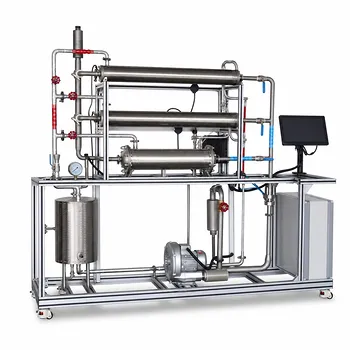
- Comprehensive Heat Transfer Coefficient Determination Educational Unit Operations Pilot Plant
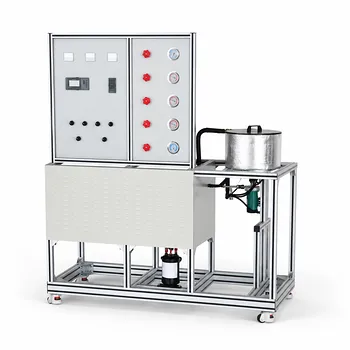
- Educational Compression Refrigeration Performance Determination Unit Operations Pilot Plant
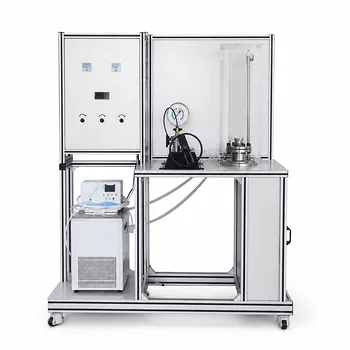
- Carbon Dioxide PVT Curve Determination Educational Unit Operations Pilot Plant
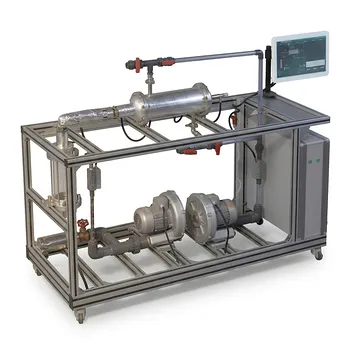
- Shell and Tube Heat Exchanger Heat Transfer Coefficient Determination Educational Pilot Plant
- Bernoulli Equation Demonstration Unit Operations Pilot Plant
People Also Ask
- When is ε-NTU preferred over LMTD in pilot plants? Predict heat exchanger performance without iteration.
- How do unit conversions affect pilot plant calibration? Avoid errors in heat transfer data analysis
- Why is the prevention of scale formation on heat exchanger surfaces a critical learning objective? Key Lessons
- How does thermal conductivity affect pilot plant performance? Optimize heat transfer & accuracy
- What engineering trade-offs must students analyze in a heat transfer pilot plant? Balance performance & cost.