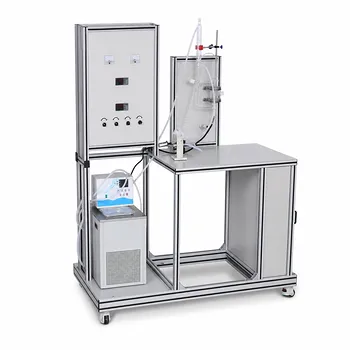
Model selection is not just a simulation step—it is the master variable that dictates your entire experimental validation strategy. The choice between the Jenkins and Gibson-Robinson model and the Marek-Standart model directly determines how accurately a pilot plant’s physical temperature, pressure, and composition data can be reconciled with theoretical predictions. Opting for the simpler Marek-Standart model, which assumes a constant association constant, introduces a systemic bias in systems with associating components (like alcohols or acids), forcing researchers to over-design validation experiments to account for the “missing” non-ideality in the liquid phase. In contrast, the Jenkins and Gibson-Robinson model applies concentration-dependent correction factors, reflecting real molecular behavior much more precisely. By closing the gap between the physical experiment and the simulation, this model reduces the need for conservative over-design in your pilot plant and allows you to design leaner, more incisive experiments that pinpoint true process bottlenecks rather than thermodynamic artifacts.
A thermodynamic model is a hypothesis about how molecules interact at varying concentrations. The core takeaway: Selecting a model that fails to capture concentration-dependent association (like Marek-Standart) forces you to design pilot plant experiments with inflated safety margins and ambiguous data interpretation. An accurate model (like Jenkins and Gibson-Robinson) transforms your pilot plant into a truly self-validating instrument, where deviations in the column are reliable indicators of physical transport limits rather than theoretical error.
The Experimental Workflow: From Data Reconciliation to Physical Insight
The purpose of a pilot plant is to generate data that is trustworthy enough to be scaled up. The thermodynamic model is the lens through which you view this data, and its precision dictates the entire experimental workflow.
The "Self-Validating" Instrument
When the model accurately represents reality, the pilot column becomes a verification tool. You are no longer guessing whether a deviation in measured reflux ratio is due to a faulty model or a real hydraulic limitation.
The Jenkins and Gibson-Robinson framework provides this clarity. By correctly handling the liquid-phase association even at trace concentrations, it ensures that the theoretical number of stages matches the physical separation being observed.
The Trap of "Constant" Assumptions
The Marek-Standart model’s assumption of a composition-independent association constant is its fundamental flaw. In a real distillation, the molecular clustering of acetic acid at the bottom of the column is very different from its behavior at infinite dilution near the top.
Using a model that averages this behavior forces you to treat your experimental data as irreconcilable without hefty fudge factors. The experiment then becomes an exercise in fitting a broken model instead of understanding the process.
Connecting P-T-x-y to Column Profiles
Accurate VLE prediction is the bedrock for matching real-time sensor data. When a student or researcher sees a temperature profile developing down the column, they must be able to map that to a specific vapor-liquid composition.
A model with concentration-dependent correction factors ensures that the activity coefficients (γ) are dynamically correct across every tray. This allows for the precise calculation of the volatility ratio (α), which is the single most critical number for determining separation feasibility.
Linking Thermodynamic Precision to Capital-Intensive Design
The ultimate cost of model imprecision is not theoretical—it is measured in stainless steel, energy consumption, and lost research time. The choice in a pilot plant directly mirrors the economic decisions that will be made for the full-scale plant.
The Volatility Ratio and Capital Cost
The capital cost of separation equipment is highly sensitive to the volatility ratio (α), scaling roughly with (ln α)^-1. In difficult separations where α is close to 1.0—such as near an azeotrope—a tiny error in predicting thermodynamic properties causes a massive error in sizing.
For example, if the Marek-Standart model overestimates non-ideality in an associating system, it might calculate a lower α. This would lead a researcher to specify a column in the pilot plant that is unjustifiably tall, simply to compensate for a thermodynamic ghost.
The Over-Design Cascade
Historically, imprecise thermodynamics forced designers to rely on short-cut methods that required significant over-design. An inaccurate model triggers a cascade: a taller column, a larger reboiler to drive a higher reflux ratio, and a larger condenser to dump the excess energy.
In a research pilot plant, this obscures the true minimum energy requirement of the separation. The experiment ends up measuring the performance of the oversized equipment rather than the intrinsic properties of the chemical mixture.
Pinpointing the Feed Stage and Energy Balance
Correcting for liquid-phase non-ideality is essential for locating the optimal feed tray. The Jenkins and Gibson-Robinson model, by accurately representing the enthalpy of the associating liquid, ensures that the energy balance across the feed stage is physically realistic.
This prevents a common pilot plant failure mode where the simulation says the column should be working at a reflux ratio of 3, but the physical column only separates effectively at a reflux ratio of 5 due to unaccounted-for latent heat effects.
The Associating Mixture Dilemma: Why "Close Enough" Fails
When polar and associating compounds (alcohols, aldehydes, water) are involved, standard activity coefficient models alone aren't enough if they don't address the chemistry of association. This is where the specific choice between the two models becomes critical.
Vapor-Phase Corrections vs. Liquid-Phase Reality
While modified equations of state (like the Soave-Redlich-Kwong) can effectively handle vapor-phase non-ideality, the liquid phase remains the problem child. The liquid phase is where molecular clustering directly reduces the "effective" number of molecules available for vaporization.
The Marek-Standart model treats this clustering as a static property of the molecule. Jenkins and Gibson-Robinson treats it as a dynamic property of the mixture, accounting for the fact that a carboxylic acid molecule immersed in a non-polar solvent associates very differently than one surrounded by its own kind.
Understanding "False Negative" Consistency Checks
Researchers often use Gibbs-Duhem-based consistency tests (like the Herrington area test) to validate their pilot plant data. An oversimplified thermodynamic model can mask real experimental errors or falsely flag good data as bad.
If you are using the Marek-Standart model to reduce your T-x-y data, the model's inherent structural error in the activity coefficient calculation can cause a systematic failure of the area consistency test. This forces you to chase phantom instrumentation errors.
Calibrating with UNIFAC Limitations
When experimental VLE data is missing, researchers estimate parameters using the UNIFAC group contribution method. Fitting these estimated parameters into a rigid model like Marek-Standart limits the accuracy of your simulation from the start.
A more sensitive framework like Jenkins and Gibson-Robinson allows the pilot plant to provide the "final calibration" to the UNIFAC estimates, because the model is structurally capable of adjusting the association term to match the physical measurements.
Understanding the Model Limitations and Trade-offs
No model is universally superior for every system. The choice of a high-precision association model must be weighed against its complexity and the specific phase behavior being studied.
The Complexity-Tractability Trade-off
The Jenkins and Gibson-Robinson model introduces concentration-dependent terms that require iterative computation, making the simulation more complex. The trade-off is tractability versus accuracy. For a simple binary alcohol mixture far from the azeotrope, this added complexity might only yield a marginal 1-2% improvement in tray number prediction. However, for a system involving carboxylic acids or aldehydes at dilute concentrations, the Marek-Standart error can be catastrophic, leading to a grossly incorrect number of stages. The key is to match the model’s resolution to the molecular severity of the problem.
Inability to Predict Phase Splits
It is vital to remember that association models primarily correct for vapor-liquid behavior. If your pilot plant involves a heterogeneous azeotropic distillation or a liquid-liquid extraction unit, neither the Marek-Standart nor the Jenkins and Gibson-Robinson model alone is sufficient.
For systems where the liquid splits into two phases, a model like NRTL is mandatory. Using an association model without immiscibility prediction in a decanter-equipped column leads to a complete failure to model the liquid inventory, making the pilot plant data useless for scale-up.
The Danger of Over-Correction
Applying a high-resolution association model with insufficient or poor-quality binary interaction parameters can be worse than using a simpler model. The model may amplify small experimental errors in the data used for its regression, creating wildly inaccurate activity coefficient derivatives (and thus incorrect driving forces for mass transfer) at the boundaries of the composition range. Your pilot plant data is only as good as the parameters you feed into the model; a sophisticated model magnifies the impact of sloppy parameter estimation.
Making the Right Choice for Your Pilot Plant Campaign
Selecting a model is a strategic decision that sets the scope of your experimental learning. Your choice should be driven by the specific thermodynamic pitfall you are trying to characterize.
- If your primary focus is scaling up a process with strongly associating compounds (e.g., extraction of acetic acid): Insist on using the Jenkins and Gibson-Robinson model or a modern equivalent with concentration-dependent association constants to ensure your pilot plant's energy balance and stage counts are not artifacts of a bad equilibrium constant.
- If your primary focus is an undergraduate demonstration of basic distillation principles using a non-associating, near-ideal mixture: The complexity of advanced association models offers little educational benefit; the standard Wilson equation provides a clean, minimal-deviation framework for matching basic T-x-y curves without computational overhead.
- If your primary focus is testing a separation that could form two liquid phases and involves association: You must use a hybrid approach, likely coupling an NRTL-based phase-split prediction with a vapor-phase association correction, because no single model from the Marek-Standart or Jenkins class can independently solve both problems.
- If your primary focus is model development and publishing new VLE data: You must critically test your experimental data against multiple frameworks, including the Jenkins and Gibson-Robinson corrections, to prove that your consistency tests pass on their scientific merit and not because you selected an overly forgiving model.
The pilot plant is more than a miniature factory—it is a precision instrument for measuring reality. The thermodynamic model you feed it determines whether you will measure the limits of your process or the limits of your ignorance.
Summary Table:
| Thermodynamic Model | Association Constant | VLE Accuracy | Pilot Plant Impact |
|---|---|---|---|
| Jenkins & Gibson-Robinson | Concentration-dependent | High (captures dynamic clustering) | Lean column design, precise energy balances |
| Marek-Standart | Constant (composition-independent) | Low in associating mixtures (e.g., acids) | Over-designed columns, inflated safety margins |
Optimize Your Process Scale-Up with LABPARK
Bridge the gap between thermodynamic simulation and physical reality. LABPARK provides state-of-the-art Educational and Vocational Unit Operations Pilot Plants in chemical engineering, bioprocess & biotech, and environmental & water treatment tailored for universities, research institutes, and enterprises.
Our highly instrumented pilot columns allow you to accurately validate complex VLE models, eliminate costly design margins, and deliver precise, real-world data for researchers and students alike.
Ready to elevate your lab's capabilities? Contact LABPARK today to discover our custom pilot plant solutions!
Related Products
- Continuous Sieve-Plate Distillation Pilot Plant for Unit Operations Laboratory Education
- Multi-Modal Distillation Unit Operations Training Pilot Plant
- Dual-Mode Rectification Pilot Plant for Practical Training Unit Operations
- Binary System Vapor Liquid Equilibrium Data Determination Educational Unit Operations Pilot Plant
- Green Anhydrous Ethanol Purification Extractive Distillation Unit Operations Training Pilot Plant
People Also Ask
- How do distillation pilot plants validate VLE data? Achieve reliable solvent separation scale-up.
- How does catalyst water concentration affect distillation pilot plant design? Key separation train choices.
- Why is the column performance diagram critical? Optimize distillation pilot plant safety & efficiency.
- How can real-time carbon number prediction improve distillation pilot plants? Optimize control.
- How to select the right activity coefficient model (Wilson, NRTL, UNIQUAC) for distillation pilot plants?