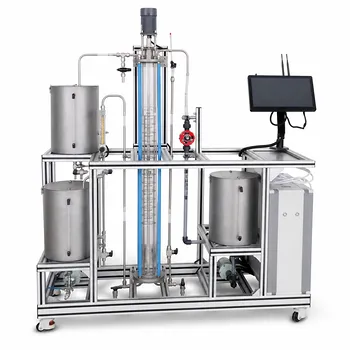
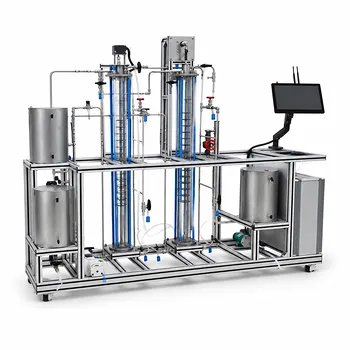
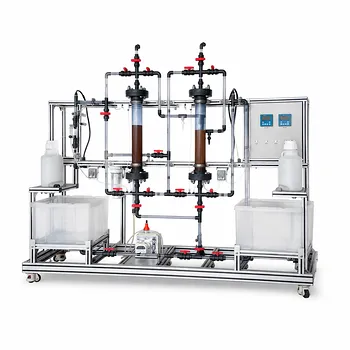
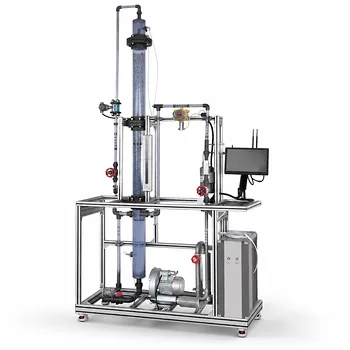
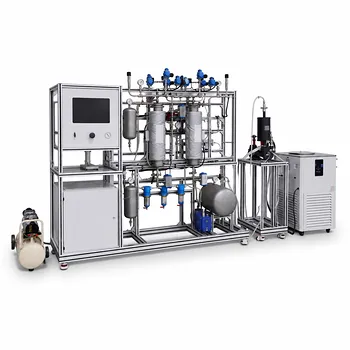
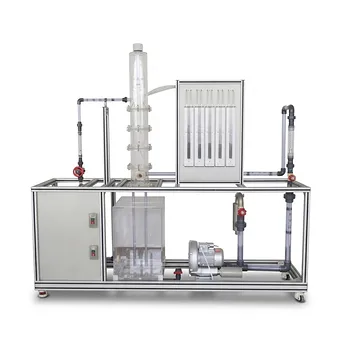
The reflux ratio is the master dial that directly governs the balance between a distillation pilot plant’s upfront design (capital cost) and its ongoing energy bill (operating cost). Selecting a value too close to the minimum reflux ratio (Rmin) demands an infinite number of stages, while operating at total reflux produces zero product. The optimum reflux ratio is therefore chosen empirically between 1.1 and 2.0 times Rmin—a narrow window that minimizes the combined cost of utility consumption and equipment depreciation.
The optimum reflux ratio is not a single number; it’s the precise crossover point where the pilot plant’s capital cost (column height and number of stages) and operating cost (reboiler steam and condenser cooling water) are jointly minimized. In fixed-height educational and research columns, this sweet spot typically falls between 1.1 and 1.5 times Rmin, where you get the best separation without overwhelming the physical hardware.
How the Reflux Ratio Shapes the Two Major Costs
The Direct Link Between Reflux and the Number of Stages
At the minimum reflux ratio (Rmin), the operating line touches the equilibrium curve at a pinch point. The driving force for mass transfer vanishes, and you would need infinite theoretical stages to achieve the target separation. This renders the column height and capital cost impractically large.
As you increase the reflux ratio above Rmin, the required number of stages falls dramatically at first. You can use a shorter column or fewer plates to reach the same purity. This is the capital-cost saving you gain by raising R. However, the decline in required stages follows a diminishing-returns curve: beyond a certain point, each incremental increase in R saves very few additional stages.
The Energy Penalty of a Higher Reflux Ratio
Raising the reflux ratio means sending more liquid back down the column. This increases the internal vapor and liquid traffic in both the rectifying and stripping sections. To sustain this higher internal flow, the reboiler must deliver more heat duty, and the condenser must remove more heat. The result is a near‑linear rise in operating cost—steam, cooling water, and electricity.
In a pilot plant, this trade-off is extremely visible. Doubling the reflux ratio can more than double the reboiler steam consumption, even if it reduces theoretical stage demand by only 15–20%. Because pilot plants often run long experimental campaigns, these energy costs can become the dominant economic factor.
Why Pilot Plants Refine the Rule to 1.1–1.5 × Rmin
Fixed Physical Hardware Constrains Your Lower Limit
Unlike a design‑from‑scratch scenario, a pilot plant has a fixed number of physical trays or a fixed packed height. If you select a reflux ratio too close to Rmin, the required number of theoretical stages may exceed what the column physically contains. You will simply not meet the target product purity—no matter how long you operate.
The practical lower bound for many educational and research columns is 1.1–1.2 × Rmin. Below this, the demanded separation outruns the physical stages and the column’s height equivalent to a theoretical plate (HETP) becomes an insurmountable barrier.
Flooding and Hydraulic Limits Cap the Upper Bound
Increasing reflux pushes the column’s internal vapor and liquid rates higher. If you raise R too aggressively, the column will flood. Liquid is unable to drain properly, pressure drop spikes, and separation collapses. In a pilot plant with a given column diameter and tray/packing design, you cannot simply crank up reflux without risking a flood condition. That forces a cap to the safe operating reflux ratio—often around 1.5–2.0 × Rmin depending on the hydraulics.
The Need for a Meaningful Product Rate
A higher reflux ratio also means that less of the overhead vapor is withdrawn as distillate product. If the purpose of the pilot run is to collect samples for analysis or to simulate a continuous production scenario, operating at a very high R can reduce the net product flow to a trickle. This is particularly detrimental in educational settings where students need to measure steady‑state distillate rates and perform material balances. The optimum must therefore respect a minimum practical product rate.
Understanding the Trade-offs
The Diminishing Return on Stage Reduction
Once the reflux ratio exceeds about 1.5 × Rmin, the curve of required theoretical stages flattens. You pay a steep energy penalty for a negligible reduction in column height. In a pilot plant that is already built, you cannot realize this capital saving—the column height is fixed. So paying for energy above this point simply wastes utilities with no separation benefit.
The Purity Ceiling Is Also Set by Mass Balance
No matter how high you set the reflux ratio, the distillate purity has a hard ceiling dictated by the overall material balance: xD,max ≤ (F·xF)/D. Even at total reflux (infinite R), you cannot violate this constraint. Over‑refluxing cannot overcome a poor design choice in feed rate or column diameter.
The Hidden Trap of Over‑Simulation
In process simulators, you can set any reflux ratio and neglect flooding or column hydraulics. The Erbar–Maddox correlation will happily predict a miniscule number of stages at R = 2.0 × Rmin. But when that same condition is attempted on a physical pilot plant, the column may flood or fail to hold a stable temperature profile. The real column’s hydraulics and stationary internals always impose limits that the simulation doesn’t show—making the 1.1–1.5 range the safe, experimentally validated sweet spot.
Making the Right Choice for Your Pilot Plant Distillation
After selecting an operating reflux ratio based on the principles above, you can tailor the pilot plant’s performance to specific learning or research goals.
- If your primary focus is demonstrating the pinch point concept: Start at Rmin and slowly increase R while students monitor the temperature profile and purity. Use 1.1–1.2 × Rmin to show how a small buffer immediately makes the required stages physically achievable.
- If your primary focus is minimizing energy consumption for a given column: Operate as close as possible to the lower bound (1.1–1.2 × Rmin) while still meeting the purity target. This directly links reflux choice to reboiler steam and cooling water costs.
- If your primary focus is maximizing distillate purity in a fixed‑stage column: Increase R gradually within the safe hydraulic window (usually up to 1.5–1.6 × Rmin), but stop as soon as the purity gains plateau. Adding more reflux beyond that point only burns utilities.
- If your primary focus is training operators on flood prevention: Deliberately push R beyond the design limit while reducing the feed rate, and use the column’s pressure drop sensors to demonstrate incipient flooding—a vivid example of why the upper optimum matters.
Selecting the optimum reflux ratio is the single most teachable moment in a pilot plant distillation experiment, because it compresses the entire capital‑versus‑operating‑cost story into one adjustable knob.
Summary Table:
| Reflux Ratio Range | Stage Requirement (CAPEX) | Energy Consumption (OPEX) | Operational Impact in Pilot Plants |
|---|---|---|---|
| At Minimum ($R_{min}$) | Infinite (impractical height) | Minimum | Target purity cannot be met due to fixed physical stages |
| Optimum ($1.1–1.5 \times R_{min}$) | Moderately low | Balanced & manageable | Safe operation, optimal separation, and avoids flooding |
| High ($> 1.5 \times R_{min}$) | Diminishing returns (flat curve) | Extremely high (costly) | High flooding risk, and drastically reduced product yield |
Bring Industrial Reality to Your Lab with LABPARK
Are you looking to enhance hands-on learning and research efficiency? LABPARK provides premium Educational and Vocational Unit Operations Pilot Plants in chemical engineering, bioprocess & biotech, and environmental & water treatment for universities, research institutes, and enterprises.
Our distillation pilot plants are engineered to help students and researchers easily master complex operations—from analyzing reflux ratios to managing column hydraulics.
Contact LABPARK today to discover how our robust, tailored pilot plants can elevate your lab's educational value and research capabilities.
Related Products
- Continuous Sieve-Plate Distillation Pilot Plant for Unit Operations Laboratory Education
- Multi-Functional Special Distillation Educational Pilot Plant
- Multi-Modal Distillation Unit Operations Training Pilot Plant
- Continuous Batch Extractive Distillation Educational Pilot Plant
- Dual-Mode Rectification Pilot Plant for Practical Training Unit Operations
People Also Ask
- How to select the right activity coefficient model (Wilson, NRTL, UNIQUAC) for distillation pilot plants?
- What are the primary reflux ratio control strategies? Master Distillation Unit Operations
- Why is vacuum operation capability an essential feature for a distillation unit operations pilot plant? Unlock Efficiency
- How does catalyst water concentration affect distillation pilot plant design? Key separation train choices.
- How can real-time carbon number prediction improve distillation pilot plants? Optimize control.