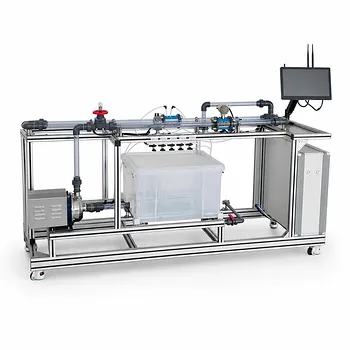
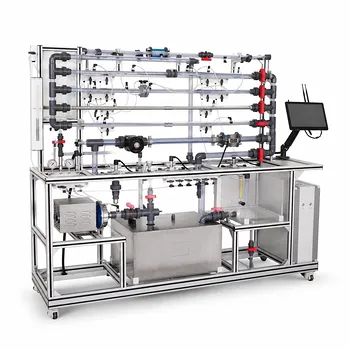
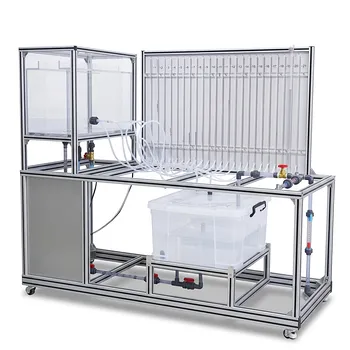
The answer lies in the Froude number. In a hydraulics teaching flume, a disturbance—like a ripple from a probe or a change in channel geometry—can only travel upstream if the flow velocity ($V$) is slower than the wave celerity ($C$). When $V < C$, the disturbance’s absolute speed against the flow is positive, and it propagates upstream. When $V > C$, the flow overwhelms the wave, preventing any upstream information transfer. A permanent obstruction in such supercritical flow creates a visible standing oblique wave whose angle directly reveals the local velocity.
The fundamental control on upstream disturbance propagation is the ratio $V/\sqrt{gy}$, known as the Froude number. Subcritical flows ($Fr < 1$) allow upstream communication; supercritical flows ($Fr > 1$) do not. This relation turns a simple flume into a direct, visual demonstration of critical flow principles.
The Physics of Disturbance Propagation
Wave Celerity: The Speed of Information
Surface waves in shallow water move at a celerity $C \approx \sqrt{gy}$, where $g$ is gravity and $y$ is the water depth. This speed is independent of the flow velocity—it is the wave’s velocity relative to the water.
Think of celerity as the “speed of information.” Any change in depth or energy must travel at this speed. If the water is moving, the absolute speed of that information is $C - V$ upstream and $C + V$ downstream.
Flow Velocity vs. Celerity: The Defining Ratio
When $V < C$, the absolute upstream speed $C - V$ is positive. A wave created at a point can run against the current, altering upstream water levels and surface profiles. This is subcritical flow, governed by downstream control.
When $V > C$, the upstream speed $C - V$ becomes negative. The wave is simply washed downstream. No hydraulic information can travel backward, so the flow is completely dictated by upstream conditions. This is supercritical flow, where disturbances cannot influence the flow upstream of their origin.
The Standing Wave: When Disturbances Can’t Go Upstream
A permanent obstruction—like a sidewall contraction or a sluice gate pier—in a supercritical stream generates a stationary oblique wave. Since the disturbance cannot move upstream, it piles up into a steady diagonal front.
The angle $\beta$ this front makes with the flow direction follows $\sin\beta = \sqrt{gy}/V$. Students can measure this angle directly with a protractor or image analysis, then solve for $V$. It is a powerful way to connect a geometric observation to the underlying fluid dynamics.
Demonstrating the Principle in a Teaching Flume
Creating Subcritical and Supercritical Flows
Teaching flumes often include a sluice gate or a weir that transitions flow through critical depth. Upstream of the gate, flow is typically deep and slow, so $V < \sqrt{gy}$—subcritical. Immediately downstream, the water accelerates and shallows, pushing $V$ above $\sqrt{gy}$—supercritical.
Students can drop a dye streak or perturb the surface with a ruler. In the subcritical zone, dye swirls upstream; in the supercritical zone, it streaks straight downstream with no backward influence.
Measuring the Angle to Determine Velocity
In the supercritical reach, inserting a sharp obstacle like a thin metal vane creates an oblique standing wave. The wave angle $\beta$ is easily visible from above.
Using $\sin\beta = \sqrt{gy}/V$ and measuring $y$ with a point gauge, students compute $V$ without a flow meter. This reinforces the concept that the flow velocity and depth are mathematically locked together through the Froude number.
Understanding the Trade-offs and Limitations
The Linear Wave Assumption
The relation $C = \sqrt{gy}$ assumes small-amplitude waves in shallow water. In a flume with significant surface curvature or highly non-uniform flow, the celerity can deviate, introducing error into the $\sin\beta$ calculation.
Students must verify that depth changes are gradual and that wave amplitude near the obstacle is modest. Otherwise, nonlinear effects distort the angle and the velocity estimate.
Permanent vs. Transient Disturbances
A teaching flume is excellent for showing steady-state oblique waves, but the theory also applies to transient waves, like a sudden gate closure. The same Froude number criterion governs whether the surge travels upstream.
One limitation: when flow is very close to critical ($V \approx C$), even tiny perturbations can generate large surface undulations, making a clean steady wave difficult to maintain. This transition zone is a fertile ground for discussion but requires extra care in demonstration.
How to Apply This to Your Flume Experiment
The relationship between flow velocity and wave celerity is more than a derivation—it’s a diagnostic tool. Here’s how to target your learning objectives:
- If your primary focus is identifying flow regime: Create a local surface disturbance. If ripples expand in all directions including upstream, the flow is subcritical. If they form a downstream-pointing V, the flow is supercritical.
- If your primary focus is measuring flow velocity without a meter: Place a slender obstacle in a steady supercritical reach and measure the oblique wave angle and local depth. Use $\sin\beta = \sqrt{gy}/V$ to compute velocity.
- If your primary focus is explaining the physical meaning of the Froude number: Frame it as the ratio of flow speed to wave speed. The $Fr=1$ threshold is the exact point where the current moves as fast as a shallow-water wave—no upstream information can travel.
Once your students see a standing wave frozen at an angle, the invisible boundary between subcritical and supercritical flow becomes tangible, grounding the math in direct observation.
Summary Table:
| Flow Regime | Velocity vs. Celerity | Froude Number ($Fr$) | Upstream Propagation? | Visual Characteristic |
|---|---|---|---|---|
| Subcritical | $V < C$ | $Fr < 1$ | Yes | Ripples travel upstream; downstream control |
| Critical | $V = C$ | $Fr = 1$ | Stationary | Waves stand still relative to the source |
| Supercritical | $V > C$ | $Fr > 1$ | No | Waves wash downstream; oblique standing waves form |
Bring Complex Fluid Dynamics to Life in Your Lab
Are you looking to enhance hands-on learning and research capabilities in fluid mechanics and hydraulics? LABPARK provides premium Educational and Vocational Unit Operations Pilot Plants in chemical engineering, bioprocess & biotech, and environmental & water treatment for universities, research institutes, and enterprises.
Our advanced teaching flumes and pilot plants make abstract concepts like critical flow, Froude numbers, and wave propagation tangible for students and researchers alike.
Ready to upgrade your laboratory equipment? Contact LABPARK today to discuss your custom project requirements and request a detailed quote!
Related Products
- Two Phase Flow Pattern Velocity Resistance Measurement Educational Pilot Plant
- Fluid Reynolds Number Demonstration Educational Unit Operations Pilot Plant
- Centrifugal Pump Performance and Orifice Flowmeter Calibration Educational Pilot Plant
- Plate Column Hydrodynamics Tray Demonstration Educational Pilot Plant
- Two-Dimensional Fluidization Hydrodynamics Educational Pilot Plant for Unit Operations Training
People Also Ask
- How to update chemometric calibration models in pilot plants? Best practices for process engineers.
- Why Correct Sig Figs & Rounding Matter in Educational Pilot Plants: Ensure Data Accuracy
- How can educational pilot plants be used to teach process safety and risk assessment in chemical engineering curricula?
- How does nuclear yield inefficiency translate to chemical engineering education? Optimize kinetics with pilot plants.
- How to identify two-phase gas-liquid flow patterns? Master fluid dynamics with pilot plants