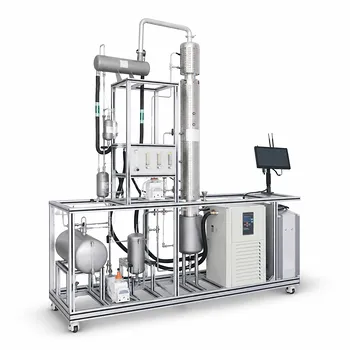
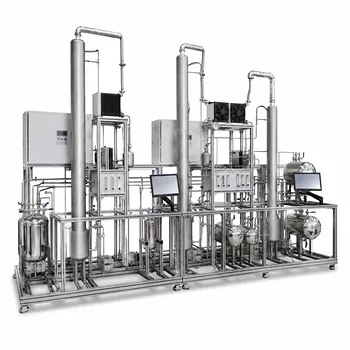
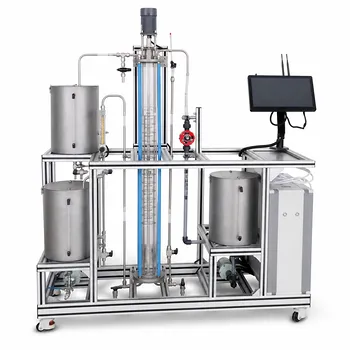
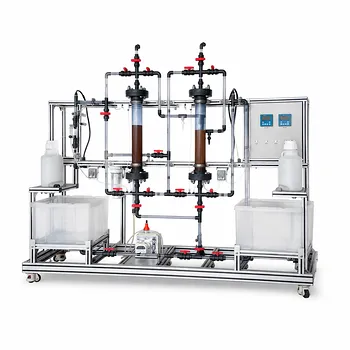
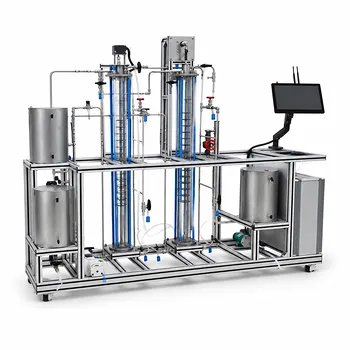
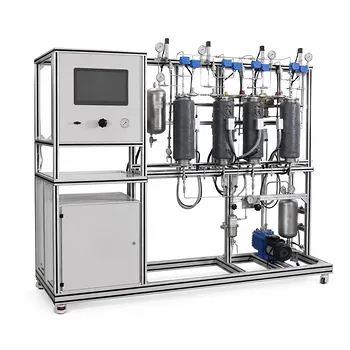
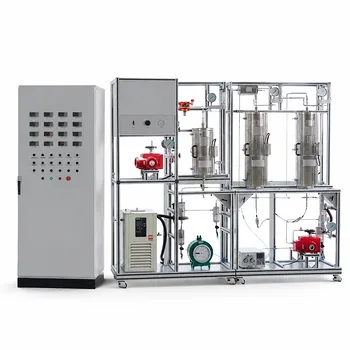
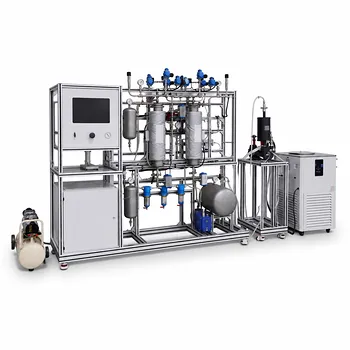
The four-column distillation train for 1,2-dichloroethane is a deliberate sequence of azeotropic, atmospheric, vacuum, and recovery stages—each designed to strip out a specific class of impurity. It answers the surface question of “how it operates” by removing water with an azeotrope, cutting light and heavy ends, and then clawing back product from heavy residue. For a pilot plant, this setup is a powerful comprehensive teaching platform: it forces students to master azeotropic separation, vacuum system control, reflux management, and quality‑specification policing in one integrated loop.
The 1,2-dichloroethane purification train uses a dewatering tower (water‑rich azeotrope), a light‑ends column, a vacuum‑operated heavy‑ends column, and a recovery tower. In an educational pilot plant, this sequence teaches fractional distillation, azeotropic principles, vacuum operation, and tight purity control—empowering students to connect thermodynamic theory with hands‑on process troubleshooting and optimization.
How the Four‑Column Distillation Sequence Operates
Step 1: The Dewatering Tower – Removing Water and Light Azeotrope Formers
Raw 1,2‑dichloroethane (1,2‑EDC) inevitably carries dissolved water and light organic contaminants.
Water alone is not easily separated by simple distillation because it forms a low‑boiling azeotrope with 1,2‑EDC.
The dewatering tower exploits this behavior: the overhead vapor is a water‑rich azeotropic mixture that boils below the boiling point of pure 1,2‑EDC.
By controlling the reflux ratio and the top‑column temperature, the operator can concentrate water and the lightest impurities in the distillate.
The bottom stream from this first column is dried 1,2‑EDC, already meeting a critical purity target of water < 10 µL/L.
This step also removes light components that would otherwise interfere in the downstream light‑ends column, making the entire train more predictable.
Step 2: The Light‑Ends Removal Tower – Polishing the Volatile Fraction
The dried 1,2‑EDC from the dewatering tower still contains low‑boiling organic impurities that slipped through or were introduced in the reaction.
A dedicated light‑ends column operates at slightly elevated temperatures, with the overhead vapor enriched in these lighter components.
The column’s role is to cut the light ends precisely, sending them out the top while leaving a high‑purity 1,2‑EDC side‑stream or bottoms stream.
Here the educational pilot plant comes to life: students can measure temperature profiles, take liquid and vapour samples, and compare actual operating lines with McCabe‑Thiele predictions.
They learn to adjust reflux to trade off light‑ends rejection against product losses, directly observing how real‑world hydrodynamics—like tray weeping or entrainment—cause deviations from ideal equilibrium.
Step 3: The Heavy‑Ends Removal Tower – Vacuum Distillation of High‑Boiling Impurities
Many heavy impurities in the process (chlorinated oligomers, metal‑bearing residues) have high boiling points.
At atmospheric pressure, the reboiler duty needed to vaporise them could thermally degrade the 1,2‑EDC or cause fouling.
Applying a vacuum lowers the boiling points of all components, enabling the separation at mild temperatures.
The pilot‑plant heavy‑ends column runs under vacuum, and the overhead product is purified 1,2‑EDC meeting the full purity specification, including iron < 0.3 µL/L.
Students learn to control vacuum pumps, monitor absolute pressure with manometers or electronic sensors, and understand how vacuum affects relative volatility and tray hydraulics.
This step is the gateway to teaching non‑ambient distillation operation: pressure‑drop measurement across packing or trays, the risk of vacuum‑induced flooding, and the importance of leak‑tight systems.
Step 4: The Recovery Tower – Extracting the Final Product from Heavy Residue
The heavy‑ends column bottom is not waste; it still contains a significant amount of 1,2‑EDC entrained with true heavies.
A recovery tower processes this heavy residue, operating under milder conditions than the vacuum column to strip out the last traces of product.
The recovered 1,2‑EDC is recycled back to the light‑ends or heavy‑ends column, boosting overall material efficiency.
For students, this tower illustrates economic imperatives of distillation: recovery steps are common in industrial plants to minimise product loss.
It also provides a chance to study how a column’s operating line changes when feed composition is heavily skewed toward heavy components, reinforcing the concept of the (q)‑line in McCabe‑Thiele analysis.
Teaching Objectives the Sequence Fulfills in a Pilot Plant
Integrating Fractional Distillation Theory with Multi‑Column Reality
A four‑column train naturally teaches the golden rule for multi‑component mixtures: separating (n) components generally requires (n-1) columns.
Though 1,2‑EDC purification is not a simple direct or indirect sequence, it still shows students how columns can be arranged in a logical process flow—dewatering first to protect downstream equipment, light removal next, then heavy removal under a different pressure regime.
Students run the pilot plant, collect temperature and composition data, and construct McCabe‑Thiele diagrams for each column.
They see that actual tray efficiency (Murphree efficiency) deviates from the ideal because of real‑world factors like vapour‑liquid contact time, tray design, and froth height.
The hands‑on activity cements the link between abstract vapor‑liquid equilibrium (VLE) curves and the physical column’s performance.
Mastering Azeotropic and Vacuum Separation Techniques
The dewatering column is a perfect introduction to azeotropic distillation.
Students observe that the azeotrope’s composition is pressure‑dependent and that without this trick, simple fractional distillation would fail to bring water below the specification.
They can experiment with reflux ratios to see how the azeotropic overhead composition shifts, deepening their understanding of why industrial processes often rely on exploitation of azeotropes.
The heavy‑ends vacuum column teaches pressurised operation and safety—sub‑atmospheric pressures demand tight control, proper venting, and a mindset of “never open while hot under vacuum.”
It also anchors lessons on boiling point depression and the Clausius‑Clapeyron equation in a practical context, making thermodynamics tangible.
Developing Process Control and Purity‑Specification Skills
The sequence demands strict final purity targets: water and iron at trace levels.
Students must manipulate reflux ratios, column temperatures, and pressure drops to meet these specs, which teaches them that distillation is not just about separation—it’s about precision.
They learn to use process analyzers, sample ports, and temperature indicators to make data‑driven decisions in real time.
This is where the pilot plant becomes a true operations‑training tool.
Flooding, weeping, and entrainment become visual and measurable phenomena, and students quickly understand that column hydraulics—not just equilibrium—drive reliable operation.
Common Pitfalls and Trade‑offs in the Educational Setup
Energy Intensity and Operating Cost
The four‑column train is energy‑hungry: each reboiler and condenser consumes utility resources.
In an educational setting, this can limit the frequency or duration of experiments, forcing instructors to balance thorough teaching with operating budget.
Safety and Containment of Hazardous 1,2‑Dichloroethane
1,2‑EDC is toxic and potentially carcinogenic.
The pilot plant must have advanced ventilation, leak detection, and strict standard operating procedures.
Teaching with this chemical adds a layer of safety discipline, but may also distract from the core distillation principles if not managed carefully.
Limited Applicability to Other Separation Challenges
While the train excels at teaching azeotropic and vacuum distillation, it does not illustrate pressure‑swing adsorption, reactive distillation, or extractive distillation.
It also omits the challenges of separating close‑boiling isomers (like a C2 splitter for ethene/ethane).
Students may need supplementary experiments to complete their unit‑operations education.
Scale‑up Misconceptions
Pilot‑plant columns often use small‑scale tray or packing internals that behave differently from industrial columns.
Students may mistakenly assume that flooding limits and tray efficiencies scale linearly, so instructors must explicitly discuss scale‑up factors and non‑linear hydrodynamic effects.
Making the Right Choice for Your Educational Goals
Your decision to use the 1,2‑dichloroethane distillation sequence should be guided by the specific skills your curriculum aims to build.
- If your primary focus is teaching azeotropic and vacuum distillation: Use this sequence exactly as designed. It gives students direct experience with water‑EDC azeotrope behaviour and vacuum‑column control.
- If your goal is to cover multi‑component separation logic (direct vs. indirect sequences): Supplement the train with a separate binary‑mixture distillation experiment to illustrate the (n-1) rule and sequencing trade-offs.
- If you need to maximise hands‑on process control skills: Run the plant with varying feed compositions and let students see how the recovery tower’s duty changes when heavy‑ends load spikes—this reinforces economic recovery principles.
- If safety or toxicity concerns are paramount: Consider a less hazardous analogue, but recognise that the azeotropic dewatering and vacuum steps are most authentically taught with the real chlorocarbon system.
A well‑instrumented pilot plant that mirrors this four‑column train transforms abstract distillation theory into a confident, practical skill set—exactly what every chemical engineer needs before stepping into an industrial control room.
Summary Table:
| Distillation Stage | Separation Goal | Key Operating Principle & Targets |
|---|---|---|
| 1. Dewatering Tower | Removes water and light azeotrope formers | Azeotropic distillation; targets water < 10 µL/L |
| 2. Light-Ends Tower | Polishes and cuts volatile organic impurities | Fractional distillation; teaches McCabe-Thiele and reflux control |
| 3. Heavy-Ends Tower | Removes high-boiling impurities (e.g., chlorinated oligomers) | Vacuum distillation to lower boiling points; targets iron < 0.3 µL/L |
| 4. Recovery Tower | Extracts residual product from heavy waste stream | Product recovery stripping; teaches plant material efficiency & economics |
Bring Industrial-Scale Distillation Expertise to Your Laboratory
Are you looking to enhance hands-on engineering education and research capabilities? LABPARK provides state-of-the-art Educational and Vocational Unit Operations Pilot Plants in chemical engineering, bioprocess & biotech, and environmental & water treatment.
Specifically designed for universities, research institutes, and enterprises, our pilot plants bridge the gap between thermodynamic theory and real-world industrial operations—giving your students and team members the practical troubleshooting skills they need.
Contact LABPARK today to discuss how our custom pilot plant solutions can elevate your educational and research goals!
Related Products
- Multi-Modal Distillation Unit Operations Training Pilot Plant
- Multi-Functional Special Distillation Educational Pilot Plant
- Continuous Sieve-Plate Distillation Pilot Plant for Unit Operations Laboratory Education
- Continuous Batch Extractive Distillation Educational Pilot Plant
- Dual-Mode Rectification Pilot Plant for Practical Training Unit Operations
People Also Ask
- How can energy balance equations for condensers & reboilers be validated experimentally? Guide
- How does catalyst water concentration affect distillation pilot plant design? Key separation train choices.
- What are the primary reflux ratio control strategies? Master Distillation Unit Operations
- How can real-time carbon number prediction improve distillation pilot plants? Optimize control.
- Why is vacuum operation capability an essential feature for a distillation unit operations pilot plant? Unlock Efficiency