Passive mixing in microfluidics is a persistent challenge, but the comparison between a staggered herringbone mixer (SHM) and a simple open channel delivers an immediate, intuitive lesson in mass transfer. In a standard non-grooved microchannel, fluid streams remain largely distinct, and mixing relies solely on slow molecular diffusion. The SHM, by contrast, uses oblique grooves to twist the flow into helical paths, rapidly stretching and folding the fluid interface. The result is a dramatic reduction in the channel length required for complete mixing — from 100 cm in a plain channel to just 1 cm with an SHM at the same Péclet number.
The SHM exemplifies how introducing engineered geometric anisotropy can convert a diffusion-limited process into a chaotic advection-driven one. In chemical engineering education, this comparison becomes a powerful vehicle to teach core principles of interfacial area generation, residence time distribution, and the scaling of transport phenomena in miniaturized systems.
Unpacking the Mixing Mechanisms
The Limitation of a Plain Microchannel
In a standard rectangular microchannel, the low Reynolds numbers typical of microfluidics guarantee purely laminar flow. There are no turbulent eddies, and fluid layers slide past each other in parallel.
Mixing therefore depends entirely on Fickian diffusion. At the high Péclet numbers (Pe > 10⁴) common in many processes, the time for molecules to traverse the channel width far exceeds the fluid residence time.
This forces an impractically long channel to achieve homogeneity. A 100 cm path might be needed to reach a uniform concentration, making integrated unit operations infeasible.
How the SHM Disrupts the Laminar State
The SHM’s oblique grooves — arranged in a staggered, herringbone pattern — create an anisotropic flow resistance. The fluid experiences higher resistance along the groove direction, pushing it to twist and recirculate.
This action generates transverse velocity components that repeatedly stretch and fold the fluid interface. The result is a helical flow with chaotic advection, where fluid elements follow divergent trajectories and the interfacial area grows exponentially.
Within 1 cm of channel length, the same Pe=10⁴ mixture that required 100 cm in a plain channel becomes fully blended. The mixing efficiency no longer scales with the square root of time but accelerates dramatically through dynamic reorganization.
The Core Educational Message: Mass Transfer Mastery
When students compare the two designs side-by-side, they witness a direct manifestation of mass transfer enhancement. The plain channel teaches the baseline: diffusion-limited mass transfer with a predictable, slow evolution of concentration profiles.
The SHM demonstrates how subtle geometric modulation can decouple mixing from diffusion. The key lesson is that interfacial area generation — not just diffusion coefficients — dominates performance in laminar microsystems.
Students also grasp the concept of a compact process intensification. A 100 cm “lab-on-a-chip” is impractical; a 1 cm mixer integrates seamlessly into a realistic unit operation.
Significance for Chemical Engineering Lab Training
Transforming Abstract Theories into Measurable Reality
Mass transfer and fluid mechanics often remain abstract when taught only through equations. A microfluidic experiment comparing SHM and plain channels gives students a tangible, visual demonstration.
They can use microscopy or colorimetric reactions to observe the mixing interface evolve. The staggering difference in mixing length becomes a quantitative and qualitative proof point.
The lab bridges the gap between the dimensionless Péclet number and real-world process design, reinforcing how geometry controls performance at the microscale.
Introducing the Mindset of Process Intensification
Modern chemical engineering emphasizes smaller, faster, and more efficient unit operations. The SHM vs. plain channel experiment is an ideal gateway to this mindset.
Students learn that process intensification is not about brute force but about intelligent geometry. A simple floor patterning reduces a mixing unit from a benchtop coil to a chip-scale footprint.
This insight directly connects to industrial applications like continuous-flow synthesis, high-throughput screening, and point-of-care diagnostics where space and reagent consumption are paramount.
Understanding the Trade-offs
Fabrication Complexity and Cost
A plain microchannel can be produced with a simple straight channel mold, often using low-cost techniques like soft lithography with a single-layer photoresist. The SHM requires a multi-step or more precise lithographic process to define the slanted grooves with the correct asymmetry and stagger.
For an educational lab, this adds cost and preparation time. Instructors must balance the educational value against the manufacturing burden, possibly by reusing master molds or purchasing pre-fabricated devices.
Pressure Drop Considerations
The transverse flows and recirculation zones in an SHM introduce additional hydraulic resistance. For a given flow rate, the pressure drop across the SHM will be higher than in a plain channel of the same dimensions.
Students can quantify this trade-off by measuring pressure sensors or calculating theoretical resistance. This teaches an important engineering lesson: mixing enhancement comes at the cost of pumping energy.
Limited Applicability at Very Low Péclet Numbers
At extremely low Pe (e.g., Pe < 10²), diffusion may already be sufficient over short distances, and the SHM’s complex geometry adds no substantial benefit. In fact, the extra fabrication effort may not be justified.
Labs can design experiments to explore this boundary, showing students when chaotic mixers are necessary and when simpler designs suffice, reinforcing a systems-thinking approach.
Making the Right Choice for Your Lab Curriculum
The decision to use an SHM comparison depends on the learning objectives and available resources. Here is how to align the experiment with your course goals.
- If your primary focus is teaching mass transfer fundamentals: Use both the SHM and plain channel in a single lab session. Highlight the mixing length difference and have students calculate the effective dispersion coefficient for each design.
- If your primary focus is process intensification and microscale unit operations: Center the lab entirely on the SHM, tasking students with optimizing groove depth, angle, or staggering pattern to minimize mixing length under fixed pressure constraints.
- If your primary focus is fabrication skills and design iteration: Challenge advanced students to create their own micromixer geometries — starting from a plain channel and evolving toward a patterned design — and measure the improvement, closing the loop between design, manufacturing, and testing.
By framing the SHM not as a curiosity but as a core lesson in how geometry dictates transport, you prepare students to think like process designers for the micro-scale future of chemical engineering.
Summary Table:
| Feature | Plain Microchannel | Staggered Herringbone Mixer (SHM) |
|---|---|---|
| Mixing Mechanism | Pure molecular diffusion | Chaotic advection (stretching & folding) |
| Mixing Length (Pe=10⁴) | ~100 cm | ~1 cm |
| Flow Resistance | Low (standard laminar flow) | High (due to grooves & recirculation) |
| Fabrication Complexity | Low (single-layer mold) | Moderate to High (multi-step patterning) |
Bring Advanced Unit Operations into Your Curriculum
Ready to elevate your students' hands-on learning? LABPARK provides premium Educational and Vocational Unit Operations Pilot Plants in chemical engineering, bioprocess & biotech, and environmental & water treatment. Designed specifically for universities, research institutes, and enterprises, our systems transform complex transport phenomena and process intensification theories into tangible, visual experiments.
Contact LABPARK today to explore our customizable pilot plant solutions and upgrade your laboratory training!
Related Products
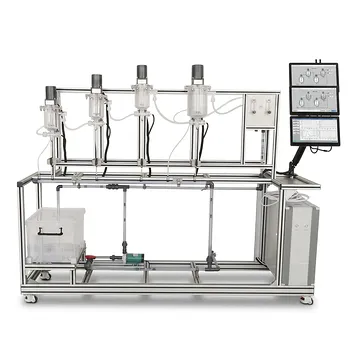
- Multi-Stage Stirred Tanks in Series Residence Time Distribution and Mixing Performance Determination Educational Pilot Plant
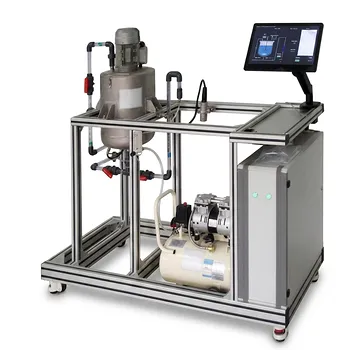
- Agitation and Mixing Educational Unit Operations Pilot Plant
- Multi Functional Catalytic Reaction and Reactor Evaluation Educational Unit Operations Pilot Plant
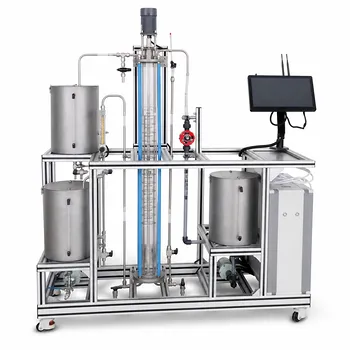
- Educational Rotary Disc Liquid-Liquid Extraction Pilot Plant
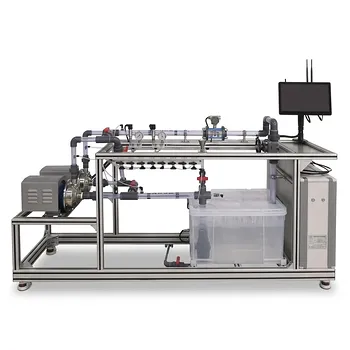
- Centrifugal Pump Performance Determination Educational Unit Operations Pilot Plant
People Also Ask
- How does MRF model impeller rotation in CFD? Key Boundary Conditions Explained
- How can a CSTR pilot plant demonstrate reactor staging? Visualize volume savings.
- How does steady-state multiplicity affect the operation and safety of exothermic reactions within a CSTR pilot plant? - Guide
- What parameters to monitor transitioning from Batch to CSTR? Master Pilot Plant Setup
- Why is temperature regulation via a cooling jacket a critical feature in CSTR pilot plants used for laboratory training?