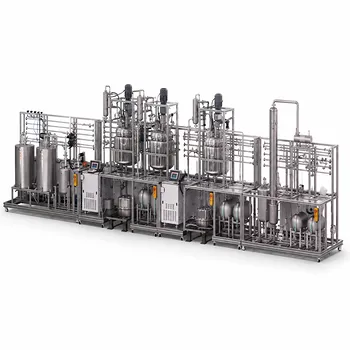
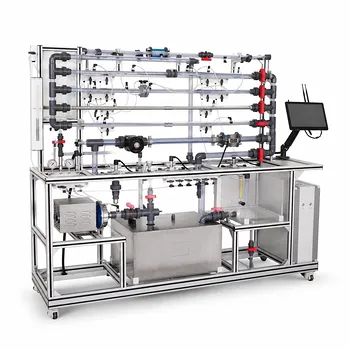
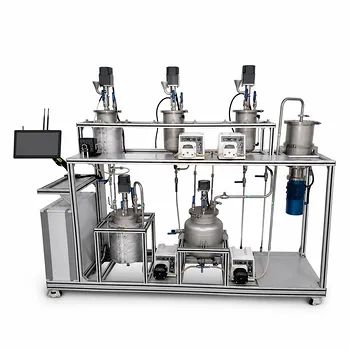
Chemical supply can't flex on demand—but your strategy can. The chemical industry's inelastic supply curve means new production capacity takes years and billions to bring online. Vocational pilot plants directly counter this rigidity by letting you scale processes, train operators, and optimize yields while the full plant is still being built. This parallel path shrinks your time-to-market and gives you the agility to meet market demand before your competitors can even break ground on a new facility.
The long, capital-heavy timelines of chemical plant construction make supply painfully slow to respond. Pilot plants are the strategic lever that lets enterprises decouple process readiness from the construction schedule, turning an industry-wide weakness into a competitive advantage.
The Rigid Reality of Chemical Supply
What an Inelastic Supply Curve Means for Your Business
An inelastic supply curve means that when demand spikes, quantity supplied barely budges in the short term. You can't just "produce more" by pushing a button.
The chemical industry embodies this perfectly. You're dealing with massive, integrated equipment, strict safety regulatory frameworks, and complex chemical processes that cannot be rushed. When the market calls, your existing plant can only do so much.
The Capital Trap and the Time-to-Market Gap
Designing, constructing, and commissioning a new chemical plant is a multi-year capital-intensive marathon. Each stage—front-end engineering, detailed design, procurement, construction—locks in time and money.
This creates a dangerous gap. While you're waiting for a new facility, competitors or substitute products can capture market share. The supply curve's inelasticity isn't just an economic concept; it's a threat to your revenue.
How Pilot Plants Turn Rigidity into Opportunity
De-risking Scale-Up Before the Mega-Investment
The jump from lab beaker to 10,000-gallon reactor is where careers and budgets go to die. Vocational pilot plants act as a reality check.
They allow chemical engineers to verify design assumptions, calculate accurate mass and energy balances under real flow conditions, and test material compatibility. This isn't just chemistry—it's about discovering whether your process will corrode pipes, create dangerous hot spots, or yield a worthless byproduct before you spend millions on exotic alloys.
Parallel Processing: Train, Optimize, and Build Simultaneously
The most direct way a pilot plant defeats the inelastic supply curve is by overlapping timelines. You don't have to finish building before you start learning.
With a modular pilot plant, you can train your operations team in a simulated industrial environment while the foundations of the main plant are still being poured. You can run continuous optimization experiments on reaction and separation yields. By the time your full-scale plant is mechanically complete, your team and your process are already running at a high level of proficiency.
Enabling Agile Responses to Market Shifts
Market demand doesn't wait for your construction schedule. A vocational pilot plant gives you a limited but real production capability much faster than a full factory.
This allows you to produce qualification samples for customers, build market confidence, and even generate first revenue. More importantly, if a new demand signal emerges, a modular pilot plant can be reconfigured and scaled out far faster than a stick-built mega-plant, giving you a first-mover advantage in a normally slow-moving industry.
Understanding the Trade-offs
Pilot plants are strategic tools, not magic wands. They add their own cost and complexity before you reach full-scale production. The data you gain is essential, but the scale-up is not perfectly linear; what works in a pilot reactor can still bring surprises in a production unit.
Additionally, a pilot plant demands high-caliber talent to be truly effective. Without skilled engineers and vocational trainers who can interpret the data correctly, you are simply miniaturizing your ignorance. The value is only realized if the pilot operation is treated as a core learning asset, not a check-box exercise.
Making the Right Choice for Your Goal
The inelastic supply curve is a permanent feature of the chemical landscape, but your vulnerability to it is a choice. Here is how to align your pilot plant strategy with your primary objective:
- If your primary focus is speed-to-market: Invest in a modular pilot plant immediately to start generating customer samples and process data in parallel with full-scale plant design.
- If your primary focus is risk reduction: Use the pilot plant as a gated decision point, forcing your process to prove its safety, material compatibility, and economic viability before locking in the major capital expenditure.
- If your primary focus is operational excellence: Make the vocational training function a priority, using the pilot plant to build a high-competency startup team that can accelerate the full plant's commissioning curve.
Your supply curve doesn't have to dictate your timeline; with the right pilot plant strategy, your process will be ready long before your concrete cures.
Summary Table:
| Strategic Factor | Traditional Approach | Pilot Plant Strategy |
|---|---|---|
| Time-to-Market | Slow; sequential construction & commissioning | Fast; parallel training, optimization & sampling |
| Capital Risk | High; mega-investment based on lab-scale data | Low; early physical de-risking & process verification |
| Workforce Readiness | Post-construction training causes startup delays | Simultaneous vocational training enables rapid startup |
| Market Agility | Rigid; cannot adapt to sudden demand shifts | Flexible; early sample generation & rapid configuration |
Beat the Rigid Timeline of Chemical Scale-Up with LABPARK
Don't let industry inelasticity stall your growth. LABPARK delivers advanced Educational and Vocational Unit Operations Pilot Plants engineered for chemical engineering, bioprocess & biotech, and environmental & water treatment applications.
We empower universities, research institutes, and enterprises to:
- De-Risk Capital Investments: Validate mass/energy balances and process safety before building full-scale plants.
- Accelerate Workforce Training: Train operators in a safe, simulated industrial environment in parallel with construction.
- Speed Up Time-to-Market: Generate early customer samples and optimize yields long before the concrete cures.
Ready to transform your process development? Contact LABPARK today to request a quote or consultation.
Related Products
- Multi-Reactor Educational Pilot Plant for Reaction Engineering Unit Operations
- Multi Pump Fluid Transport Process Piping Unit Operations Training Pilot Plant
- Fixed Bed Gas Solid Catalytic Reaction Educational Pilot Plant
- Natural Product Extraction Unit Operations Training Pilot Plant
- Ethyl Acetate Synthesis Unit Operations Pilot Plant for Practical Training
People Also Ask
- How do educational unit operations pilot plants address safety and waste management when scaling up?
- How do educational unit operations pilot plants bridge theory and design? Bridge the Engineering Gap
- Why Compare Predicted and Experimental Excess Enthalpy? Key to Accurate Pilot Plant Scale-up
- Why Use PTFE & Hastelloy in Chemical Pilot Plants? Prevent Corrosion & Ensure Safety
- How to study gasification in pilot plants? Compare exit gas composition & efficiency