A lower gaseous-phase Péclet number demands a taller column. The gaseous-phase Péclet number ((Pe_g)) directly quantifies how much axial dispersion—or backmixing—happens in the gas flowing through the column. When (Pe_g) is low, the gas is far from ideal plug flow, and the reduced concentration driving force means you must increase the column height to reach the same conversion. In educational pilot plants, this relationship lets you observe firsthand how fluid dynamics, not just equilibrium, dictate reactor size.
The core takeaway: A low (Pe_g) erodes the mass-transfer driving force along the column, so pilot plant designers must compensate with additional height—or accept lower performance. Understanding this trade-off is the key to both teaching non-ideal flow and generating scale-up-ready data.
How (Pe_g) Defines the Flow Regime in a Gas-Liquid Column
The Physical Meaning of the Gaseous-Phase Péclet Number
The Péclet number is the ratio of advective transport (bulk flow) to dispersive transport (backmixing). For the gas phase in a column of height (H), it is defined as (Pe_g = \frac{U_g \cdot H}{E_g}), where (U_g) is the superficial gas velocity and (E_g) is the axial dispersion coefficient. A high (Pe_g) means convection dominates—gas moves through as a tight plug. A low (Pe_g) means chaotic backmixing prevails, continuously diluting the gas composition.
The Three Operative Ranges for Pilot Plant Design
In practice, the flow behaviour falls into three clear bands that directly inform how you model the reactor:
- (Pe_g < 0.1): Perfectly mixed (CSTR) limit. The entire gas phase is uniform, and the driving force for mass transfer is set by the single exit concentration. This maximises the height required for a given separation or conversion.
- (0.1 < Pe_g < 20): Intermediate dispersion. This is the most instructive regime for pilot plants, where incremental changes in height, velocity, or packing visibly shift conversion. Precise (Pe_g) measurements are critical here because the reactor height must be determined using the axial dispersion model, not simple plug-flow arithmetic.
- (Pe_g > 20): Plug-flow (PFR) limit. Backmixing is negligible; the reactor height needed approaches the theoretical minimum. This is often the target for commercial designs, but a pilot plant operating here may hide the scale-up risks of backmixing.
The Direct Link Between (Pe_g) and Required Column Height
Why Low (Pe_g) Destroys the Driving Force
In a plug-flow column, the gas composition gradually changes from bottom to top, maintaining a strong local driving force. Backmixing disrupts this gradient. Fresh gas entering the bottom immediately blends with already-reacted gas, lowering the effective reactant concentration at the inlet. This dilution propagates upward, reducing the mass-transfer potential at every point. To achieve the same final conversion, the column must be lengthened to re-establish a sufficient total residence time and compensate for the permanently weaker gradient.
Quantifying the Height Penalty in the Axial Dispersion Model
The axial dispersion model directly links (Pe_g) to the required reactor length. For a first-order gas-phase reaction or absorption process, the conversion versus length curve becomes shallower as (Pe_g) decreases. The height penalty relative to ideal plug flow can be expressed through the model’s dimensionless form, where the Damköhler number and (Pe_g) together fix the necessary length. A drop from (Pe_g=20) (quasi-PFR) to (Pe_g=5) can increase the required height by 20–40%, depending on the reaction kinetics. This is not a trivial correction—it’s a design-determining reality.
Practical Design Decisions Controlled by (Pe_g)
Selecting Column Diameter to Stabilise Gas Holdup
Supplementary measurements show that gas holdup becomes independent of column diameter only above 0.15 metres. Below this threshold, wall effects alter bubble behaviour and gas residence time, skewing (E_g) and thus (Pe_g). A pilot plant intended for scale-up studies must use a column diameter larger than 0.15 m to ensure the measured (Pe_g) and required column height are not artefacts of the lab scale.
Using Packing to Manipulate (Pe_g) Without Changing Height
The axial dispersion coefficient (E_g) is strongly influenced by packing type and size. Smaller packings or structured internals break up large-scale eddies, increasing (Pe_g) at a fixed superficial velocity and height. For a given column height, changing from 25 mm Raschig rings to a high-performance structured packing can shift the gas flow from a mixed regime into a near-plug-flow regime, dramatically improving conversion. This is a powerful lever for pilot plant operators: they can study the effect of (Pe_g) by swapping packings while keeping all other dimensions constant.
The Interplay of Gas Velocity and Column Height
Since (Pe_g = U_g \cdot H / E_g), you can increase (Pe_g) either by making the column taller or by raising the gas velocity. However, raising (U_g) also changes gas holdup and pressure drop, and it may push the system into a flooding condition. The design challenge is to find the combination of height and velocity that delivers a target (Pe_g) while staying within the hydraulic operating window. In a pilot plant, systematically varying both parameters teaches the multidimensional nature of scale-up.
Understanding the Trade-offs
Height Versus Operation Costs
A taller column built to overcome a low (Pe_g) works, but it adds capital cost and can increase pressure drop, raising blower or compressor energy consumption. Especially in educational plants where columns are already small, every extra metre of height is a significant decision. Often the smarter design path is to invest in internals that raise (Pe_g), reducing the height requirement.
The Danger of Over-Designing for Plug Flow
Designing a pilot plant to operate at (Pe_g > 20) may seem ideal because it simplifies calculations. But it can create a false sense of security. A commercial-scale column, with larger diameter and different gas distribution, will almost certainly operate in the intermediate (Pe_g) range. A pilot plant that never enters the (0.1 < Pe_g < 20) regime provides no data on the backmixing sensitivity of the process—the very information needed to derisk scale-up.
Holdup Independence Is Not Mixing Independence
Even when column diameter exceeds 0.15 m and gas holdup is constant, the axial dispersion behaviour—and thus (Pe_g)—can still change with gas throughput or liquid load. Designers must measure (Pe_g) (e.g., via tracer pulse experiments) under the exact operating conditions, not infer it from simpler hydraulic parameters alone.
How to Apply This to Your Pilot Plant Project
Your design strategy should be ruthlessly tied to what you need the pilot plant to demonstrate.
- If your primary focus is teaching non-ideal reactor behaviour: Operate deliberately in the intermediate (Pe_g) range (0.1–20). Use a combination of superficial velocity and packing size to create measurable backmixing, and let students quantify the exact height penalty using the axial dispersion model.
- If your primary focus is generating data for industrial scale-up: Choose a column diameter greater than 0.15 m immediately. Design your height and internals so the pilot (Pe_g) matches the expected commercial-scale (Pe_g), even if that requires a taller-than-necessary pilot column.
- If your primary focus is minimising column height while maintaining conversion: Select high-efficiency structured packing that increases (Pe_g) at the design gas velocity. Validate the achieved (Pe_g) experimentally rather than relying on vendor correlations.
- If your primary focus is separating gas-liquid interfacial area effects from axial dispersion effects: Run experiments at two different heights (or gas velocities) that bracket a target (Pe_g) while keeping other mass-transfer parameters constant, isolating the real height-for-dispersion trade.
A pilot plant is not just a smaller reactor—it’s a controlled probe into the physics that will govern the full-scale unit. The gaseous-phase Péclet number is the single most important knob you can turn to ensure those physics are faithfully captured.
Summary Table:
| $Pe_g$ Range | Flow Regime | Impact on Column Height | Design Implications |
|---|---|---|---|
| $< 0.1$ | CSTR Limit (Perfectly Mixed) | Maximum height required | Lowest mass-transfer driving force; uniform gas concentration. |
| $0.1 - 20$ | Intermediate Dispersion | Variable height penalty | Ideal for pilot plants; requires axial dispersion modeling to scale up. |
| $> 20$ | PFR Limit (Plug Flow) | Minimum height required | Negligible backmixing; target for commercial units but hides scale-up risks. |
Optimize Your Reactor Designs with LABPARK
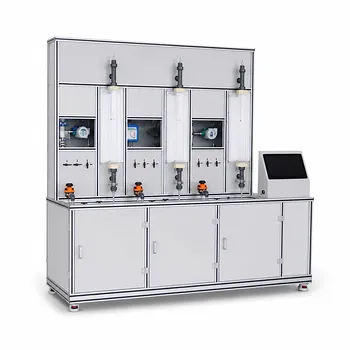
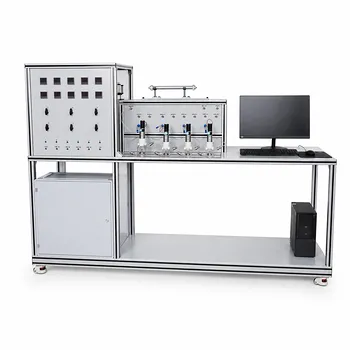
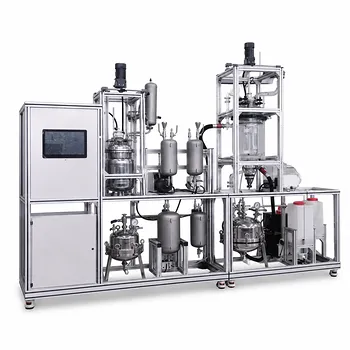
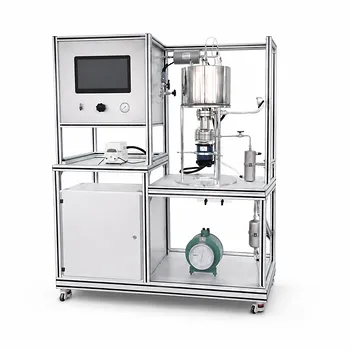
Bridge the gap between fluid dynamics theory and physical scale-up. LABPARK provides premium Educational and Vocational Unit Operations Pilot Plants in chemical engineering, bioprocess & biotech, and environmental & water treatment. Specifically built for universities, research institutes, and enterprises, our systems empower you to accurately study parameters like the Péclet number, validate backmixing models, and train the next generation of engineers.
Ready to elevate your laboratory capabilities? Contact LABPARK today to find the perfect pilot plant solution for your research and training needs!
Related Products
- Fixed-Bed Chemical Reaction and Gas Dust Tar Removal Unit Operations Pilot Plant
- Fixed Bed Gas Solid Catalytic Reaction Educational Pilot Plant
- Fluidized Bed Gas Solid Catalytic Reaction Educational Pilot Plant
- Micro-Scale Gas-Solid Catalytic Reaction Educational Pilot Plant
- Two Phase Flow Pattern Velocity Resistance Measurement Educational Pilot Plant
People Also Ask
- When to transition from PID to adaptive control in pilot plants? Key process indicators.
- How do deviations in estimating latent heat impact pilot plant thermal systems? Avoid hardware mis-sizing.
- Why Compare Predicted and Experimental Excess Enthalpy? Key to Accurate Pilot Plant Scale-up
- How to study gasification in pilot plants? Compare exit gas composition & efficiency
- Why Use PTFE & Hastelloy in Chemical Pilot Plants? Prevent Corrosion & Ensure Safety