Achieving near-perfect thermal contact. For endothermic chemical processes like steam reforming, the reaction rate is limited not by chemistry but by how quickly heat can be delivered to the catalyst. The interleaved microchannel design solves this bottleneck by eliminating the low-efficiency fins found in conventional compact heat exchangers and instead placing the heat source directly inside the reactor structure. By sandwiching reaction channels immediately adjacent to hot heat-exchange channels, heat travels only through a sub-millimeter metal wall, maximizing driving force and enabling rapid catalytic kinetics.
Interleaving removes the thermal bottleneck of low-efficiency fins by embedding the heat source into the reactor backbone itself—turning the entire intervening channel wall into the primary heat transfer surface.
Why Traditional Microchannels Struggle with Endothermic Reactions
The Fin Efficiency Dilemma
Conventional designs often extend heat transfer area with high-aspect-ratio fins.
However, as fin height increases, the temperature of the fin tip drops, reducing the effective heat flux.
For strongly endothermic processes, this inefficiency starves the catalyst of the uniform, intense heat it needs, leading to sluggish reactions and temperature gradients that hurt selectivity.
The Unsolved Proximity Problem
Simply packing more channels still leaves a thermal transport distance.
Heat must diffuse through fin material and fluid films, creating a temperature penalty that grows with the duty.
Interleaving bypasses this entirely by making the distance between hot and cold streams as short as physically possible.
How Interleaving Maximizes Heat Transfer Efficiency
Minimizing the Thermal Transport Path
In an interleaved arrangement, a partially etched metal sheet acts as the shared wall separating reaction and heating channels.
Heat flows directly across this wall without passing through extended fins or intermediate structural layers.
This collapses the conduction distance to the thickness of the etched foil—often less than a few hundred microns—yielding heat transfer coefficients that are orders of magnitude higher than those of finned geometries.
Exploiting the High Surface-to-Volume Ratio
Microchannels already offer enormous surface area per unit volume.
When reaction and heat-exchange channels are interleaved, that entire interfacial area becomes active for heat transfer.
This means the reactor can deliver intense, uniform heat while keeping the overall volume drastically smaller than equivalent shell-and-tube or plate-fin exchangers.
Eliminating the Fin Efficiency Penalty
The direct adjacency of hot and cold streams removes the concept of a separate fin entirely.
The wall itself is the conduction medium, and every square millimeter of it participates at near-isothermal conditions.
No temperature drop along a fin means no loss of driving force; the full temperature potential is available to drive rapid endothermic kinetics.
The Critical Role of Diffusion Bonding
Sealing the Thermal Bridge
Interleaved designs rely on stacks of partially etched metal sheets.
Diffusion bonding fuses these sheets into a monolithic, hermetic block without brazing filler or gaskets.
This creates a continuous metallic pathway with zero additional thermal resistance at the interfaces, preserving the minimal thermal path.
Enabling Integrated Reaction-Heat Exchange
Because the bond is seamless, channels for a hot exothermic stream (e.g., combustion) can be placed side‑by‑side with reforming channels inside the same unit.
No separate heat exchanger piping is needed; the reactor and heat source become one integrated, leak‑tight device.
From Heat Transfer to Process Intensification
Unlocking Near‑Isothermal Operation
With heat delivered at the micro‑scale, temperature profiles can be flattened almost completely.
This allows operators to run endothermic reactions at their kinetic limit without hot spots or cold zones, dramatically shortening residence times—from seconds in conventional reactors to hundredths of a second in an interleaved device.
Compact Coupling of Exothermic and Endothermic Steps
The architecture physically couples, for instance, catalytic combustion and steam reforming within the same diffusion‑bonded stack.
Waste heat is recovered instantly, eliminating nitrogen dilution from combustor flue gas and reducing the overall energy footprint.
The result is a pilot‑plant reactor that integrates multiple unit operations into a single modular block.
Understanding the Trade-offs and Limitations
Flow Distribution and Pressure Drop
Stacking hundreds of parallel microchannels demands careful manifold design to ensure uniform flow.
Mal‑distribution can create local hot or cold spots, partially undermining the benefit of interleaving.
The narrow channels also impose higher pressure drop, increasing parasitic energy losses.
Manufacturing Complexity and Cost
Diffusion bonding and precise chemical etching are high‑precision, capital‑intensive fabrication steps.
This makes interleaved microchannel reactors more expensive per unit of installed heat transfer than conventional finned designs, limiting their use to high‑value, compact applications.
Catalyst Integration and Regeneration
The fixed geometry of bonded stacks makes catalyst loading and replacement more challenging.
For long‑life endothermic processes, catalyst deactivation must be managed within a sealed architecture, often requiring in‑situ regeneration strategies that add operational complexity.
Making the Right Choice for Your Reactor Design
The interleaved approach is a tool of process intensification, not a universal replacement for all heat‑exchange architectures.
- If your primary focus is maximizing heat transfer per reactor volume: The interleaved design delivers extreme thermal compactness, collapsing the conduction path to the metal wall thickness and enabling heat fluxes conventional fins cannot match.
- If your primary focus is precise temperature control for catalyst selectivity: The near‑isothermal profiles achievable with interleaving suppress side reactions and allow you to operate at the kinetic limit, improving product yield.
- If your primary focus is integrating exothermic and endothermic steps: Interleaving physically couples heat sources and sinks inside a single diffusion‑bonded unit, eliminating energy losses from separate exchangers and reducing system complexity.
- If your primary focus is low capital cost or high throughput at minimal pressure drop: A conventional finned compact exchanger may be more economical unless the process benefits of interleaved microchannels outweigh the added fabrication cost.
When extreme heat flux and compactness define success, interleaving the reaction and heat-exchange channels transforms the entire wall into an efficient, zero‑fin‑efficiency thermal bridge—unlocking endothermic kinetics at a scale conventional designs cannot reach.
Summary Table:
| Feature | Traditional Finned Designs | Interleaved Microchannels |
|---|---|---|
| Thermal Path | Longer path through fins & fluid films | Direct, sub-millimeter conduction wall |
| Fin Efficiency | Temperature drops at fin tips | No fins; entire wall is active & isothermal |
| Size & Volume | Larger footprint | Ultra-compact; high surface-to-volume ratio |
| Integration | Separate heat exchangers required | Exothermic & endothermic steps in one block |
Enhance Your Chemical Engineering Research & Training
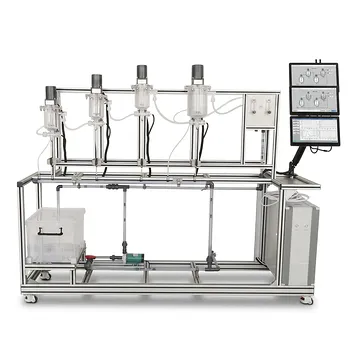
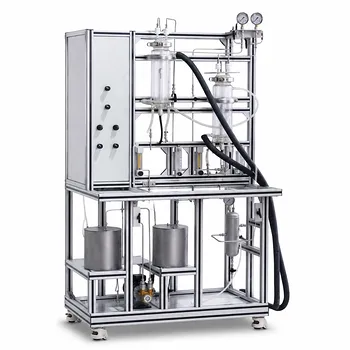
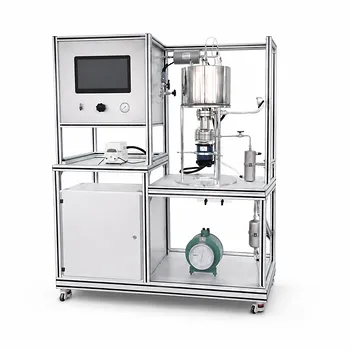
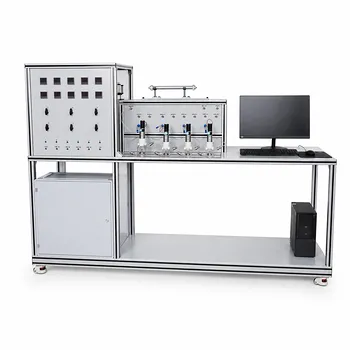
LABPARK delivers high-performance Educational and Vocational Unit Operations Pilot Plants tailored for chemical engineering, bioprocess & biotech, and environmental & water treatment. Designed to meet the precise needs of universities, research institutes, and enterprises, our pilot systems offer the perfect platform to study advanced heat transfer and reaction kinetics.
Contact our engineering experts today to find the ideal pilot plant solution for your lab!
Related Products
- Micro-Scale Gas-Solid Catalytic Reaction Educational Pilot Plant
- Multi-Stage Stirred Tanks in Series Residence Time Distribution and Mixing Performance Determination Educational Pilot Plant
- Photocatalytic Membrane Separation and Degradation Unit Operations Pilot Plant
- Internal Circulation Gradient Free Catalytic Reaction Educational Pilot Plant
- Methane Cracking Educational Unit Operations Pilot Plant
People Also Ask
- Why is a multibed configuration necessary for exothermic reactions? Optimize your pilot plant trajectory.
- Fluidized vs. Fixed Bed Reactors: Comparing Heat & Complexity in Pilot Plants
- Why is thermal management a major challenge in methane oxidative coupling? Reactor Solutions for Pilot Plants
- How does the Mears criterion evaluate transport resistance? Key Guide to Intrinsic Kinetics
- How do reactor pilot plants safely study gas-solid reactions? Master kinetics with thermal & flow control.