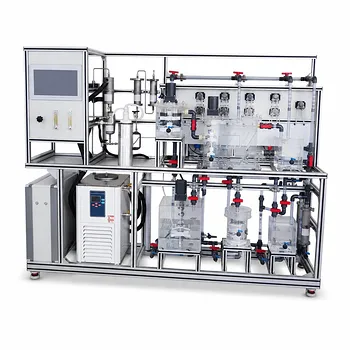
A single number can cost you half of your liquid product.
The K-value — the equilibrium ratio of a component’s vapor fraction to its liquid fraction — is not just a textbook constant. In cryogenic pilot plants, selecting the wrong correlation (like Peng-Robinson vs. Soave or BWR) can shift your predicted methane K-value by up to 28% and alter the calculated condensed liquid volume by nearly 96% at high pressure. For design, this directly mis-sizes compressors, cooling loads, and downstream demethanizers. For experimental teaching, it transforms the pilot plant into a living lesson on why thermodynamic fragility near the critical point is the most valuable engineering insight a student can gain.
Cryogenic separation is a knife-edge problem where tiny errors in K-value prediction explode into massive design and operational failures. The real value of a pilot plant lies not in avoiding these errors, but in deliberately revealing them — so engineers learn where models break, not just that they work.
The Thermodynamic Heart of a Cryogenic Pilot Plant
What a K-Value Really Controls
The K-value (K = Y/X) is the master switch that dictates how a component distributes between vapor and liquid at a given temperature and pressure. In a high-pressure cryogenic separator or turboexpander, the K-value of methane — often the lightest component — determines how much gas is stripped and how much liquid is knocked down for recovery.
If your chosen equation of state (EOS) underestimates methane’s volatility, you’ll predict far more liquid than the plant actually produces. Overestimate it, and you’ll design for vapor loads that never materialize. Both errors cascade into the compressor train, reboiler duties, and tray hydraulics.
Why Cryogenic Conditions Amplify Every Mistake
Cryogenic gas processing operates in a thermodynamic no-man’s-land. At conditions like -80°F and 800 psia, you are dangerously close to the mixture’s critical point. Here, all fluid properties become hypersensitive to the smallest changes in pressure, composition, or model assumptions.
A deviation of -11% to +28% in methane K-value is not a rounding error — it is a design showstopper. In this region, the liquid phase can nearly double or halve in size (the primary reference cites -47% to +96% variance in condensed liquid). That means your cooling duty, compressor horsepower, and demethanizer diameter are all wrong before a single pipe is fabricated.
Why a “Wrong” K-Value Breaks Your Design
From a Single Number to Catastrophic Propagation
A K-value error is never isolated. In distillation, the volatility ratio (α) directly governs the number of theoretical stages. When α is near unity — as often happens near azeotropes or at high pressure — the capital cost of the column scales as (ln α)^-1. A small shift in K-value translates to a dramatic increase in tower height and reboiler load.
This is not hypothetical. A 5% error in vapor pressure for a close-boiling system can balloon into a 33% error in required trays. In cryogenic services, the physics is even less forgiving: the combination of low temperature and high pressure collapses the safety margins that short-cut methods rely on.
The Cascade into Pilot Plant Hardware
When you move from simulation to a real cryogenic pilot plant, the K-value correlation becomes an architectural decision. An under-predicted liquid load results in:
- Undersized cold boxes that cannot condense enough product.
- Compressor selection errors that either choke the machine or waste capital.
- Falsely low reboiler duties that leave the demethanizer unable to strip methane.
For a teaching pilot plant, these errors can be golden. Students see that the thermodynamic model they picked in Aspen HYSYS is why the column profile refuses to match the thermocouples along the column. The lesson is visceral.
The Pedagogy of Imperfection: Teaching with Real Variance
The Pilot Plant as a Hypothesis Tester
The primary reference reveals an uncomfortable truth: standard correlations like Peng-Robinson and Soave disagree wildly near the critical point. A properly instrumented pilot plant can quantify this disagreement. Students measure real liquid yields, compare them against simulations run with two different EOS, and watch a predicted liquid volume swing by nearly 100%.
This closes the gap between a “black box” simulator and a physical system. They learn that thermodynamic models are not oracles — they are tools with narrow validity windows that you must validate experimentally.
Bridging the Multicomponent Data Void
Supplementary references remind us that consistent VLE data for ternary or multicomponent hydrocarbon systems is scarce, and data for hydrocarbons above C10 is virtually nonexistent. A cryogenic pilot plant becomes the source of truth. Students generate their own phase-equilibrium data, then verify thermodynamic consistency using methods like the van Ness test.
This is the ultimate engineering experience: you suspect the model is lying, you run the plant, and you get the data that either convicts or exonerates the equation of state.
Understanding the Trade-offs
When Good Teaching Becomes Bad Practice
Showing students that K-value correlations can be “wrong” is powerful — but it comes with a risk. Without careful framing, a student might conclude that all models are equally flawed and no simulation is trustworthy. That is the opposite of what industry needs.
The real lesson is selective trust. A Soave-Redlich-Kwong EOS might be more than adequate for a debutanizer at 100 psia, yet catastrophically fail at 800 psia near the methane critical point. The pilot plant teaches condition-specific model selection, not blanket cynicism.
The Over-Design Trap
Historically, process designers compensated for thermodynamic imprecision by over-designing: extra stages, oversized reboilers, inflated reflux ratios. In a teaching context, you can deliberately run a pilot column with an intentionally poor K-value selection and then observe the energy penalty. Students quantify the real cost of over-design — a safe but expensive habit that modern industry is trying to break.
The trade-off is clear: a model that errs on the safe side wastes energy; a model that is overly optimistic can risk separation failure. The pilot plant makes that tension tangible.
Making the Right Choice for Your Cryogenic Pilot Plant
The choice of K-value correlation for a cryogenic teaching or research pilot plant must be driven by the lesson you want to teach.
- If your primary focus is teaching thermodynamic fundamentals: Deliberately run side-by-side simulations with Peng-Robinson and Soave, then validate against plant data. Let the measured liquid knockdown discrepancy of up to 96% become the permanent, unforgettable proof that critical-point behavior is not a textbook abstraction.
- If your primary focus is training future process designers: Use the pilot plant to demonstrate how an 11% shift in methane K-value propagates into compressor and demethanizer sizing errors. Teach students to perform a rigorous sensitivity analysis on the EOS choice as a mandatory step in any front-end engineering design.
- If your primary focus is generating publishable research data: Base your correlation choice on a thorough review of which EOS has been validated against the closest experimental data — and then plan to spend at least one third of your experimental campaign directly testing the thermodynamic consistency of your own measurements. Never treat the model as a black box.
- If your primary focus is scale-up to industrial cryogenic plants: The pilot plant must replicate the full thermal-sensitivity chain. Use the extended principle of corresponding states or a high-accuracy BWR formulation to minimize K-value error, and then instrument the plant to capture where the model still drifts — because that drift is the margin you must carry into the full-scale design.
The ultimate truth of a cryogenic pilot plant is that it does not exist to confirm your simulation; it exists to expose its brittle assumptions — and that exposure is the most honest education a chemical engineer can receive.
Summary Table:
| Aspect | Impact of K-Value Correlation Choice | Key Educational / Design Takeaway |
|---|---|---|
| Liquid Yield | Shifts predicted condensed liquid volume by -47% to +96%. | Demonstrates thermodynamic sensitivity near the critical point. |
| Equipment Sizing | Miscalculates vapor loads, compressor sizing, and column diameters. | Highlights the risk of over-design and cascading design errors. |
| Teaching Value | Exposes the limitations of "black-box" simulation software. | Trains students in condition-specific model selection and validation. |
Master Thermodynamic Precision in Your Lab
Bridging the gap between simulation and real-world physics requires robust, highly instrumented equipment. LABPARK provides premium Educational and Vocational Unit Operations Pilot Plants in chemical engineering, bioprocess & biotech, and environmental & water treatment designed specifically for universities, research institutes, and enterprises.
Equip your students and researchers with the tools to validate complex thermodynamic models, analyze VLE deviations, and master process design.
Contact LABPARK today to customize a pilot plant solution for your institution!
Related Products
- Gas-Solid Heterogeneous Separation Demonstration Educational Unit Operations Pilot Plant
- Carbon Material Thermal Pretreatment Multiphase Separation Educational Pilot Plant
- Multifunctional Membrane Separation Educational Pilot Plant with Ultrafiltration, Nanofiltration, Reverse Osmosis
- Multi-Functional Membrane Separation Educational Pilot Plant for Unit Operations Lab
- Potassium Salt Thermal Dissolution and Crystallization Separation Educational Unit Operations Pilot Plant
People Also Ask
- Why is pressure drop characterization critical in separation pilot plants? Key operational insights.
- What are the key thermodynamic considerations for gas mixture modeling? Expert Guide
- What are the primary operational objectives and physical requirements when running heterogeneous separation pilot plants?
- What are the trade-offs in olefin-paraffin separation? Optimize Pilot Plant Performance
- What are the material limitations of gas separation pilot plants? Key factors to consider.