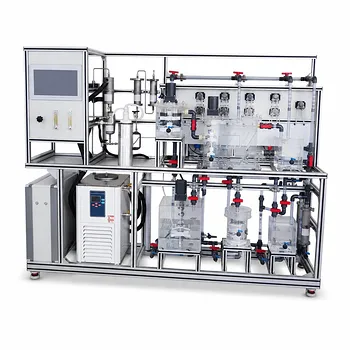
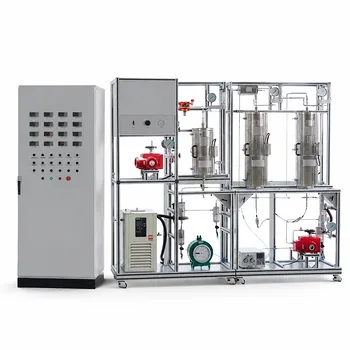
Particle size is the master control for both slurry uniformity and bed volume behavior. In a three‑phase fluidized bed pilot plant, a sharp rule of thumb separates homogeneous slurries from stratified solids: particles smaller than 100 µm remain uniformly suspended, creating a pseudohomogeneous slurry, while larger particles develop an axial concentration gradient. At the same time, the same size boundary dictates whether the bed contracts or expands when gas is introduced—a direct hydrodynamic consequence of bubble‑wake dynamics and bubble break‑up.
The 100 µm threshold is the pivotal decision point. Designing below it gives a uniform slurry but can trigger gas‑induced bed contraction; designing above it yields an axially segregated solids profile and forces bed expansion. Mastering this size‑dependent behavior is essential to achieve stable operation and meaningful pilot‑plant data.
The Critical Particle Size Threshold for Slurry Uniformity
The 100 µm Rule of Thumb
For cocurrent three‑phase columns, solid particles smaller than about 100 µm form a pseudohomogeneous slurry. No measurable solids concentration gradient develops along the column height. Above this size, an axial solids distribution appears: larger particles concentrate in the lower regions while finer material elutriates higher, creating a stratified bed. This simple engineering rule directly determines whether the pilot plant behaves as a single‑phase equivalent or a segregated multiphase system.
Why Small Particles Stay Uniformly Suspended
Fine particles remain evenly distributed because they closely follow the liquid motion. Their settling velocity is low relative to the turbulent fluctuations generated by the gas‑liquid flow. The liquid‑phase axial dispersion coefficient in such slurry‑bubble columns becomes practically independent of particle diameter and liquid velocity, mimicking gas‑liquid systems. This uniformity makes small‑particle beds attractive for fundamental kinetic studies, where a well‑mixed assumption simplifies data interpretation.
How Particle Size Governs Bed Contraction vs. Expansion
Gas‑Induced Bed Contraction in Fine‑Particle Systems
When small particles (< 100 µm) are fluidized and gas is injected, the bed can contract rather than expand. The physical mechanism lies in bubble wakes: each rising bubble carries a wake of liquid that travels faster than the continuous liquid phase. This accelerated liquid entrains fine solids, increasing the local solid holdup inside and around the wake. The net result is a denser, more compact bed—a phenomenon unique to small‑particle three‑phase fluidization.
Bed Expansion Through Bubble Breakup with Large Particles
Larger particles behave differently. Their inertia is sufficient to disrupt and break gas bubbles as they rise. Bubble break‑up suppresses coalescence, leading to a higher population of small, uniformly dispersed bubbles. Smaller bubbles translate into greater gas holdup and a lower average bed density, causing the bed to expand. Instead of the compacting effect seen with fines, large‑particle beds swell with gas, demanding taller reactors and altering residence time distributions.
Beyond Uniformity and Volume: Secondary Effects in Pilot Plants
Axial Dispersion and Liquid Mixing
Particle size directly shapes liquid‑phase axial dispersion. With very small, low‑density‑difference solids, the dispersion coefficient scales with column diameter and gas velocity but remains insensitive to particle size. Once particles grow beyond the 100 µm threshold and density differences become pronounced, the dispersion coefficient becomes strongly dependent on particle diameter and both gas and liquid velocities. This transition complicates scale‑up because the mixing pattern shifts from a predictable gas‑liquid analog to a particle‑size‑driven profile.
Mass Transfer and Gas‑Solid Contact
Small particles (e.g., 0.07‑3.0 mm) dramatically increase the effective gas‑solid contact area, enhancing mass and heat transfer rates. However, going too fine escalates dust carryover and downstream separation loads. Pilot plants simulating roasting or catalytic reactions often converge on a practical window of 0.07 to 3.0 mm to balance high reaction rates with manageable solids handling and minimal blockages.
Interstitial Mixing and Reaction Selectivity
In the interstitial spaces between particles, gas flow remains streamlined because closely packed solids suppress turbulence. With nonporous particles, gas mixing is extremely poor—a liability if reactant gases are fed separately. Porous particles offer a limited remedy, absorbing, transporting, and releasing gas, but the overall mixing still relies on the bulk fluid dynamics governed by particle size and bubble patterns.
Understanding the Trade‑offs
Every particle size choice trades one advantage for another. No single size simultaneously optimises uniformity, bed volume, mixing, and operational stability.
- Uniform slurry vs. bubble‑driven contraction: Staying below 100 µm guarantees homogeneity but introduces the risk of bed contraction. A contracting bed can create low‑voidage zones that favour channelling and reduce phase contacting.
- Large‑particle expansion vs. control complexity: Larger particles avoid contraction and self‑regulate bubble size, but the resulting bed expansion increases column height requirements and introduces axial solids distribution. Sampling and scale‑up become more complex when the solids concentration is not height‑invariant.
- Mass transfer vs. dust carryover: Pushing towards smaller sizes increases surface area but also raises dust load and the likelihood of particle elutriation into downstream recovery systems. In contrast, larger particles reduce dust but suffer from diffusion resistance, leaving unreacted cores and demanding longer residence times.
Making the Right Choice for Your Pilot Plant Goal
The optimal particle size depends entirely on your primary experimental or demonstration objective. Use the following guide to align particle selection with your intended outcome.
- If your primary focus is maximising reaction rate and interphase contact: Choose particles in the 0.07–3.0 mm range (preferring the finer end of the spectrum) to boost specific surface area, but manage gas velocity carefully to prevent excessive bed contraction and downstream dust overload.
- If your primary focus is a uniform, easily modelled slurry for kinetic research: Select particles below 100 µm to guarantee a pseudohomogeneous suspension and liquid‑phase axial dispersion that mirrors gas‑liquid systems, accepting that bed contraction may occur at higher gas flows.
- If your primary focus is studying segregation phenomena or scaling up industrial stratified reactors: Deliberately choose particles larger than 100 µm to create axial solids distribution and bubble‑breakup‑driven bed expansion, faithfully representing the hydrodynamics of large‑scale heterogeneous processes.
- If your primary focus is stable, long‑duration operation with minimal downstream blockages: Settle on a particle size around 0.1–0.5 mm to limit dust carryover, reduce elutriation, and maintain a manageable trade‑off between slurry uniformity and bed volume stability.
By mapping your experimental goals directly to the 100 µm threshold and its attendant bed‑volume effects, you can engineer a pilot‑plant configuration that yields reliable data and translates faithfully to industrial‑scale design.
Summary Table:
| Particle Size | Slurry Uniformity | Bed Volume Behavior | Liquid Mixing & Dispersion | Key Application |
|---|---|---|---|---|
| < 100 µm | Pseudohomogeneous (Uniform) | Gas-induced bed contraction | Insensitive to particle size | Fundamental kinetic studies |
| > 100 µm | Axial segregation (Stratified) | Bed expansion (Bubble breakup) | Strongly dependent on size & velocity | Industrial scale-up & segregation modeling |
Scale Up Your Chemical Engineering Research with LABPARK
Mastering complex hydrodynamics like fluidization requires precise, reliable equipment. LABPARK designs and manufactures high-quality Educational and Vocational Unit Operations Pilot Plants tailored for universities, research institutes, and enterprises.
Our systems span key disciplines including:
- Chemical Engineering (including multiphase fluidized beds and reactor systems)
- Bioprocess & Biotechnology
- Environmental & Water Treatment
Let us help you configure the ideal pilot plant to achieve stable operations and generate reliable, scalable data.
Contact LABPARK Today to Get Started
Related Products
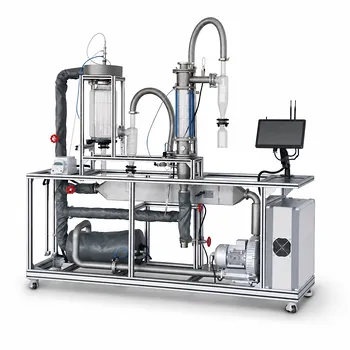
- Fluidized Bed Gas Solid Catalytic Reaction Educational Pilot Plant
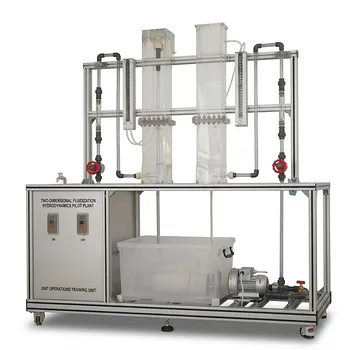
- Two-Dimensional Fluidization Hydrodynamics Educational Pilot Plant for Unit Operations Training
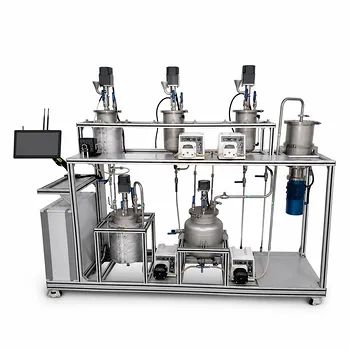
- Multi-Reactor Educational Pilot Plant for Reaction Engineering Unit Operations
- Multi-Functional Drying Educational Unit Operations Pilot Plant
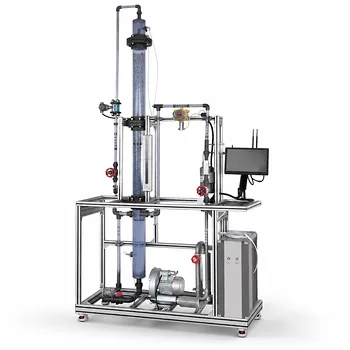
- Multi Functional Catalytic Reaction and Reactor Evaluation Educational Unit Operations Pilot Plant
People Also Ask
- Why is the bed height-to-diameter ratio (L/dt) critical? Fluidized bed pilot plant selection guide.
- How is the minimum fluidization velocity (U_mf) determined and utilized? A Unit Operations Guide
- How does the Mears criterion evaluate transport resistance? Key Guide to Intrinsic Kinetics
- How do reactor pilot plants safely study gas-solid reactions? Master kinetics with thermal & flow control.
- How do pilot plants demonstrate fluidized-bed reactor advantages over fixed-bed? Find Out Now