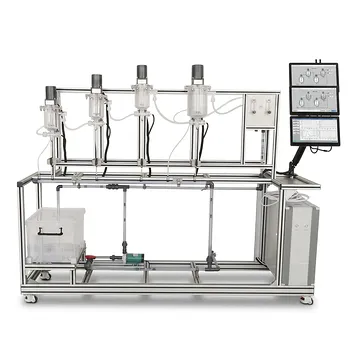
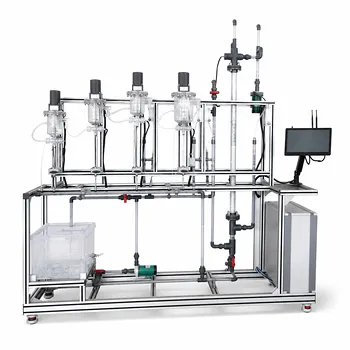
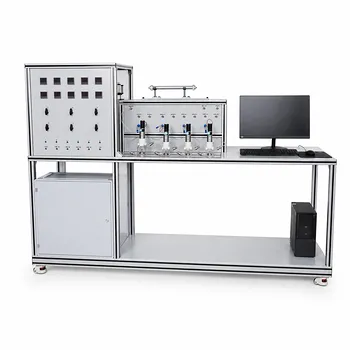
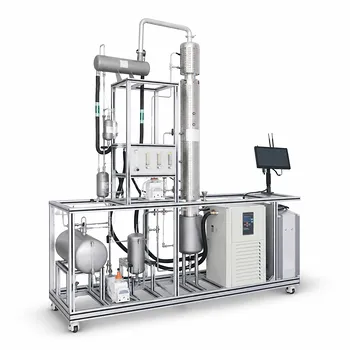
Bridging the Theory-Practice Gap. Integrating process simulation software with physical unit operations pilot plants—like batch reactors and continuous stirred tank reactors (CSTR)—transforms hands-on chemical engineering education from isolated lab exercises into a deeply integrated learning loop. Students move beyond simply collecting experimental data; they simultaneously model, predict, and reconcile that data, learning to validate idealized models against real-world behavior. This hybrid approach directly builds the engineering judgment required to safely scale up processes, tune controllers, and assess economic viability long before ever setting foot on an industrial plant floor.
The real educational leap comes from the gap between simulation and reality, not from the simulation itself. By forcing students to explain why a well-mixed CSTR model deviates from physical temperature and concentration profiles, this method teaches the critical skill of model calibration and limitation awareness—abilities no textbook alone can deliver.
From Textbook Models to Real Reactors: The Core Educational Shift
Physical pilot plants make process variables tangible, while simulation software gives those variables a predictive framework. When the two are coupled, education shifts from passive observation to active hypothesis testing.
Visualizing Time-Dependent Behavior in Batch Reactors
Batch reactors are inherently transient; concentrations and temperatures change with time, often following nonlinear paths. Process simulation lets students map these trajectories before any chemical is charged. They can pre-calculate heating/cooling curves, conversion profiles, and optimal reaction endpoints.
When they then run the physical batch reactor, the comparison is immediate. Students see how real heat losses, imperfect mixing, and sensor delays stretch or distort the ideal curves they modeled. This direct comparison cements the concept of dynamic mass and energy balances in a way no static problem set can.
Analyzing Steady-State and Mixing in CSTRs
For non-isothermal CSTR pilot plants, the simulation provides a steady-state anchor. Students calculate the expected temperature and conversion at design flow rates, then observe the physical reactor’s behavior. They quickly discover that ideal mixing is an assumption, not a guarantee.
By injecting tracers and comparing physical residence time distribution (RTD) data against the simulation’s ideal RTD curve, they quantify dead zones, bypassing, and channeling. The simulation becomes a tool to ask “what should happen,” while the pilot plant answers “what actually happens”—a direct lesson in non-ideal reactor design.
Confronting Idealized Assumptions with Physical Data
Every simulation relies on simplifications: perfect mixing, constant heat transfer coefficients, instantaneous sensor response. The pilot plant exposes these limits. Students measure wall heat losses, jacket temperature lags, and concentration gradients that the idealized model missed. This frustration is pedagogically valuable; it forces them to refine their mental models and appreciate the safety margins built into industrial design.
Beyond Isothermal Conditions: Safety, Dynamics, and Control
The true power of the integration emerges when processes deviate from steady state. This is where dynamic simulation acts as a virtual sandbox for operational decisions that would be dangerous or costly to practice on physical equipment first.
Dynamic Simulation as a Safety Sandbox
Startup, shutdown, and emergency scenarios carry real risk in a pilot plant. Dynamic simulation allows students to rehearse these sequences safely. They can model pump failures, runaway exotherms, or cooling water loss on a CSTR, observe the predicted temperature excursions, and then design the appropriate control responses.
When they later execute a controlled version on the physical pilot plant, they already have a mental model of the transient sequence. This approach hardwires process safety thinking into operational habits, bridging the gap between chemical engineering theory and the hazardous reality of reactive chemicals.
Transient Responses and Control Loop Tuning
Physical pilot plant sensors exhibit lag times and signal noise that simulations rarely capture out-of-the-box. By comparing the simulated dynamic response of a reactor to the real-time temperature or flow data, students can quantify sensor dynamics and liquid holdup times.
They then use the simulation to test control loop tuning parameters—adjusting proportional, integral, and derivative gains—before implementing them on the physical plant. The result is a hands-on introduction to industrial process control that connects controller logic directly to the thermal and hydraulic behavior of real equipment.
The Calibration Loop: Teaching Model Validation
This integration flips the typical workflow. Instead of using simulation to predict an outcome and then ignoring the discrepancy, students learn to feed real data back into the model.
Plugging Empirical Parameters Back into the Model
The physical pilot plant provides empirical parameters that theory cannot predict accurately: actual reaction rate constants under non-ideal mixing, overall heat transfer coefficients fouled over time, or catalyst deactivation profiles. Students extract these from physical runs and update their simulation models, then use the calibrated model to predict new operating points. This iterative loop is the foundation of process development and scale-up methodology, teaching that models are living tools, not static answers.
Understanding Sensor Lag and Non-Ideal Mixing
Complex multiscale phenomena—molecular interactions, fluid dynamics, catalyst deactivation—cannot be fully captured by commercial simulation software alone. By overlaying simulated concentration profiles onto physical sensor data, students learn to decouple measurement artifacts from true process changes. They gain the practical troubleshooting skill of distinguishing between a real conversion drop and a delayed reading from a poorly placed thermowell.
Extending the Learning Loop to Economic Analysis
The educational impact extends to the economics that govern industrial decision-making.
From Yields to ISBL Investment Estimates
Pilot plant data on yields, conversion rates, and utility consumption become inputs to process economic evaluation tools integrated with the simulation software. Students can directly estimate equipment procurement costs, installation, and total Inside Battery Limits (ISBL) investment. This closes the gap between a good reaction and a profitable process, preparing them for real-world engineering, procurement, and construction (EPC) projects where technical performance must justify capital expenditure.
Understanding the Trade-Offs and Limitations
This integration is not a silver bullet. Its educational value depends entirely on how the tension between simulation and reality is managed.
The Danger of Over-Reliance on Simulation
If not carefully framed, simulations can lull students into trusting idealized outputs. A perfectly converged Aspen model may predict a stable operation that would thermally runaway in reality due to poor mixing. Educators must explicitly teach that simulation validates the model, not the process itself. The primary pedagogical goal is to build healthy skepticism toward computer-generated numbers.
The Cost and Complexity Barrier
Commercial process simulation licenses and modular pilot plants represent significant financial investments. Instructors must also invest time in curriculum redesign to avoid treating the software as a black-box button-pushing exercise. Without well-designed inquiry-based experiments, students may simply match numbers without understanding the underlying thermodynamics and transport phenomena.
The Time Crunch in Curriculum Design
Running a physical batch reactor experiment already consumes a lab session. Adding a simulated pre-lab, dynamic control exercises, and post-lab model calibration can overwhelm an already packed syllabus. The integration must be carefully scoped so that each component reinforces the core learning objectives rather than becoming a separate, disconnected task.
Making the Right Choice for Your Educational Goals
The integration of simulation and pilot plants is not one-size-fits-all. Tailor the depth and focus based on what your students need most.
- If your primary focus is foundational reaction engineering: Use the simulation to pre-calculate ideal batch profiles and steady-state CSTR conversions, then let the physical plant reveal mixing and heat transfer limitations.
- If your primary focus is process safety and control: Prioritize dynamic simulation for emergency scenario rehearsal, then use the physical pilot plant to validate controller tuning and sensor dynamics.
- If your primary focus is scale-up and process economics: Emphasize the calibration loop—feeding physical kinetic and utility data into simulation models and then using the economic evaluation tools to estimate ISBL investment.
- If your primary focus is research and model development: Leverage the physical plant to generate empirical parameters for multiscale phenomena and use the simulation to test hypotheses rapidly before committing expensive pilot runs.
It is precisely the disciplined clash between simulated ideals and physical reality that builds the engineering intuition textbooks cannot teach.
Summary Table:
| Learning Aspect | Process Simulation Role | Physical Pilot Plant Role | Combined Educational Value |
|---|---|---|---|
| Reactor Dynamics | Predicts ideal concentration/temp profiles | Shows real-world heat loss & mixing | Teaches model calibration and validation |
| Process Safety | Safe sandbox for emergency failures | Rehearses dynamic control sequences | Builds robust safety habits |
| Process Economics | Estimates ISBL and equipment costs | Provides real yield & consumption data | Connects technical scaling to finance |
Bring Industrial-Grade Learning to Your Institution
Are you looking to bridge the gap between chemical engineering theory and real-world practice? LABPARK provides state-of-the-art Educational and Vocational Unit Operations Pilot Plants in chemical engineering, bioprocess & biotech, and environmental & water treatment.
Designed specifically for universities, research institutes, and enterprises, our modular pilot plants seamlessly integrate with modern process simulation software to help students validate idealized models, practice safe process control, and master industrial scale-up.
Contact LABPARK Today to discover how we can customize a pilot plant solution for your lab!
Related Products
- Multi-Stage Stirred Tanks in Series Residence Time Distribution and Mixing Performance Determination Educational Pilot Plant
- Multi-Reactor Educational Pilot Plant for Reaction Engineering Unit Operations
- Multi Functional Catalytic Reaction and Reactor Evaluation Educational Unit Operations Pilot Plant
- Residence Time Distribution and Reactor Flow Characteristics Determination Educational Pilot Plant
- 100L Continuous Loop Hydrogenation Educational Unit Operations Pilot Plant
People Also Ask
- How does MRF model impeller rotation in CFD? Key Boundary Conditions Explained
- How can a CSTR pilot plant demonstrate reactor staging? Visualize volume savings.
- How does steady-state multiplicity affect the operation and safety of exothermic reactions within a CSTR pilot plant? - Guide
- What parameters to monitor transitioning from Batch to CSTR? Master Pilot Plant Setup
- Why is temperature regulation via a cooling jacket a critical feature in CSTR pilot plants used for laboratory training?