Gas-liquid disengagement acts as the hydraulic throttle of an airlift fermentor’s circulation loop. If gas is not efficiently separated at the top of the riser, bubbles are dragged downward into the downcomer. This entrainment directly reduces the liquid circulation rate because it erodes the density difference between the riser and downcomer zones that drives the entire flow. In bioprocess training, understanding this link transforms a theoretical momentum balance into a tangible pilot-plant troubleshooting skill.
Poor gas-liquid disengagement doesn’t just waste energy—it can stall the loop. The liquid circulation rate in an airlift pilot unit is governed by the hydrostatic pressure imbalance created by gas holdup. When separation at the top fails, the downcomer loses its bubble-free, higher-density column, diminishing the driving force and dragging the circulation rate to a fraction of its design potential.
The Driving Force: Why Gas Separation Matters
An airlift bioreactor has no mechanical impeller. It relies entirely on the density difference created by sparging gas into the riser. That density gradient is what pushes liquid through the loop, dictating mixing time, oxygen transfer, and shear forces.
Density Difference and Buoyancy
Gas bubbles in the riser lower the average fluid density. The downcomer, by contrast, stays relatively liquid-filled and heavy. This hydrostatic imbalance generates a pressure head that moves the broth.
When disengagement at the top is incomplete, bubbles are carried into the downcomer. The downcomer density drops, and the driving force collapses. Circulation rate can fall by 30–50% or more, directly slowing oxygen delivery to the cells.
The Role of the Downcomer Velocity
The liquid’s downward speed in the column decides whether a bubble of a given size can escape. Too high a velocity, and even large bubbles get swept into the downflow, accumulating gas and braking the loop. Too low, and the reactor may not achieve adequate mixing or heat transfer.
In the pilot unit, this velocity becomes the single most teachable control parameter. Students can measure it, vary it, and see the immediate effect on overall circulation—turning an abstract fluid dynamics lesson into a visible, hands-on demonstration.
How Disengagement Directly Shapes Circulation Rate
The physical mechanism is straightforward but unforgiving. Once the top separator allows bubbles to “carry under,” a negative feedback loop begins that tanks performance.
Gas Carry-Under and Loop Braking
Bubbles entrained in the downcomer face downward drag. They resist buoyant rise and accumulate. This gas holdup in the downcomer reduces the net density difference, which in turn lowers the liquid velocity—further reducing the ability to flush bubbles out.
The result is a self-reinforcing slowdown. In extreme cases, the circulation loop can become so sluggish that the reactor effectively stops behaving as an airlift, starving the culture of oxygen and creating stagnant zones.
The Narrow Window of Optimal Downflow Velocity
For effective disengagement, the primary reference specifies a target downflow liquid velocity of 10–30 cm/s. This window is larger than the rise velocity of fine, slowly-buoyant bubbles (which will be dragged under) but smaller than the rise velocity of large coalesced bubbles (which can escape against the flow).
- If velocity is below 10 cm/s: Large bubbles escape easily, but overall circulation may be too slow for adequate mixing and oxygen transfer.
- If velocity exceeds 30 cm/s: Even large bubbles are forced downward, gas holdup builds in the downcomer, and the driving force erodes rapidly.
Teaching this principle helps trainees internalize that reactor hydrodynamics are not “more is better”. There is a sweet spot where separation and circulation are balanced, and it is defined by bubble size distribution, column geometry, and gas flow rate.
Understanding the Trade-offs
This topic is rich with practical compromises. A perfectly bubble-free downcomer would maximize driving force but might require a headspace volume so large that foam control becomes a nightmare or residence time distribution shifts unfavorably.
- Oxygen transfer vs. circulation: Aggressive sparging boosts kLa but also increases small-bubble carry-under, which can choke circulation. Trainees learn that maximizing kLa may inadvertently cut off the very flow that distributes oxygen throughout the reactor.
- Shear sensitivity: Higher circulation velocities generate more turbulence and shear. For filamentous fungi or shear-sensitive cells, that may be damaging, yet lowering velocity risks gas entrainment. The disengagement design thus becomes an indirect rheostat for shear exposure.
- Scale-up pitfalls: The 10–30 cm/s guideline is pilot-scale specific. At larger diameters, bubble rise velocities and coalescence patterns change, meaning the optimal velocity window shifts. Teaching this prevents simplistic linear scale-up attempts.
How to Apply This to Your Project
Airlift pilot units are uniquely instructive because their performance can be seen, not just calculated. Use the primary reference’s velocity window as a starting point, then tailor the operating conditions to your training objectives.
- If your primary focus is teaching momentum balances: Have learners measure downcomer liquid velocity and gas holdup simultaneously. Ask them to calculate the pressure head loss and compare it to the theoretical density difference.
- If your goal is to maximize oxygen transfer for a culture: Start at a gas flow rate that gives a downcomer velocity near 20 cm/s. Monitor dissolved oxygen and watch for evidence of loop stalling—this directly links hydrodynamics to cell physiology.
- If you want to demonstrate scale-down challenges: Intentionally increase the downcomer velocity above 30 cm/s to induce gas carry-under, then have students propose geometric or operational fixes (e.g., enlarging the top separator, reducing sparger orifice size).
- If the training emphasizes robustness and troubleshooting: Simulate a foam event or a sudden coalescence change by adding antifoam, and observe how the disengagement pattern shifts—this builds the intuition that reactor hydraulics are dynamic, not static.
Ultimately, gas-liquid disengagement is the linchpin that converts a bubble column into a controllable circulation loop. When you teach it as a design lever rather than an afterthought, you equip bioprocess trainees with an engineering instinct that scales with them from pilot-plant benchtops to full production.
Summary Table:
| Downflow Velocity | Hydrodynamic Impact | Training & Process Recommendation |
|---|---|---|
| < 10 cm/s | Insufficient circulation, poor mixing, and low oxygen transfer rates. | Avoid unless working with highly shear-sensitive cultures. |
| 10 - 30 cm/s | Optimal balance; large bubbles escape while maintaining steady circulation. | The ideal target window for standard bioprocess training. |
| > 30 cm/s | Severe gas carry-under, reduced driving force, and potential loop stalling. | Use to demonstrate hydraulic failure and troubleshooting. |
Enhance Your Engineering Lab with LABPARK
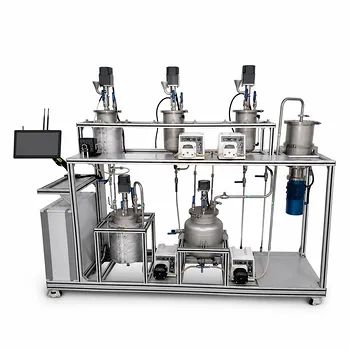
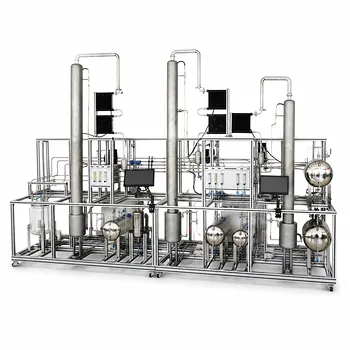
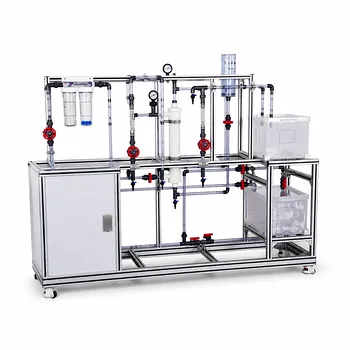
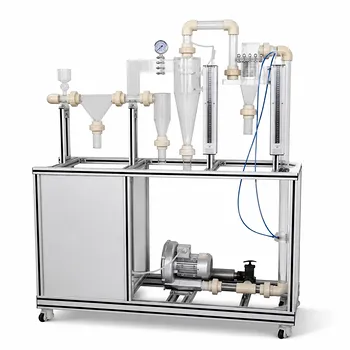
To help students master complex concepts like airlift hydrodynamics, hands-on experience is essential. LABPARK provides premium Educational and Vocational Unit Operations Pilot Plants in chemical engineering, bioprocess & biotech, and environmental & water treatment.
Designed for universities, research institutes, and enterprises, our pilot plants turn theoretical fluid dynamics into practical skills. Contact us today to discover how we can support your educational and research goals!
Related Products
- Bio-fermentation Ethanol Production Practical Training Unit Operations Pilot Plant
- Dual-Mode Rectification Pilot Plant for Practical Training Unit Operations
- Multi-Modal Distillation Unit Operations Training Pilot Plant
- Supercritical High-Gravity Flash Evaporation Educational Unit Operations Pilot Plant
- Multi-Functional Special Distillation Educational Pilot Plant
People Also Ask
- Why Use PTFE & Hastelloy in Chemical Pilot Plants? Prevent Corrosion & Ensure Safety
- Why Compare Predicted and Experimental Excess Enthalpy? Key to Accurate Pilot Plant Scale-up
- Why is the chemical plant startup schedule crucial? De-risk scale-up with pilot plants.
- When to transition from PID to adaptive control in pilot plants? Key process indicators.
- Why must batch and fed-batch fermentation pilot plants be designed to accommodate changing rheological conditions?