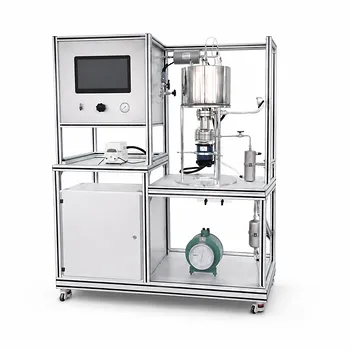
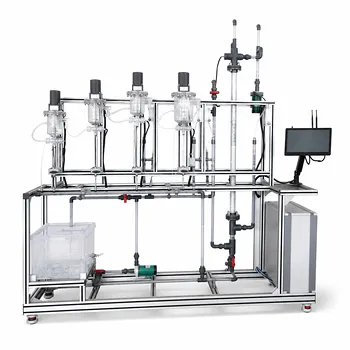
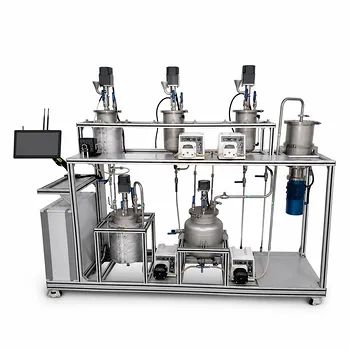
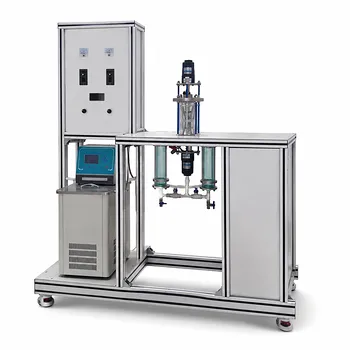
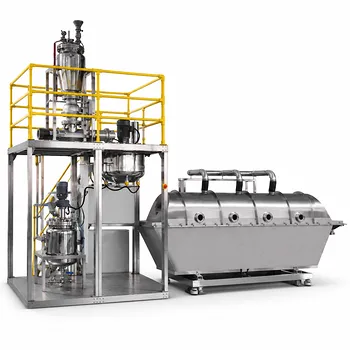
First-principles modeling of dCO2 mass transfer removes the guesswork from scale-up. It translates the complex interplay of cellular respiration, pH control chemistry, and gas-liquid transfer into predictive equations. By validating these equations with your bioprocess pilot plant data, you can accurately forecast dCO2 profiles at manufacturing scale, size critical sparging equipment, and design control loops—eliminating the need for prohibitively expensive, large-scale trial-and-error campaigns.
Addressing the deep need for risk-free scale-up requires more than empirical rules of thumb. A validated first-principles dCO2 model acts as a digital twin of your process’s carbon dioxide behavior. It quantifies how scale-induced changes in mixing, pressure, and mass transfer will affect dCO2 accumulation, letting you lock in product quality and cell health before a single production run is ever commissioned.
The dCO2 Challenge in Bioreactor Scale-Up
The core problem isn’t just that CO2 is produced; it’s that its management directly impacts your critical quality attributes and process stability. As cell densities climb in a larger vessel, so does the risk of drifting outside the narrow window between inhibiting accumulation and disruptive over-stripping.
Why dCO2 Matters for Cell Health and Product Quality
Excessive dCO2 can suppress cell growth and productivity. It also alters protein glycosylation patterns—a critical quality attribute for many biologics. On the flip side, over-stripping CO2 by sparging too aggressively will shift the culture pH away from its optimal setpoint, triggering compensatory base additions that increase osmolality and stress the cells.
The Hidden Complexity: Respiration, pH Control, and Carbonate Equilibria
dCO2 doesn’t come from a single source. Cellular respiration produces CO2 directly. pH control with bicarbonate or CO2 gas contributes additional dissolved species. Furthermore, CO2 exists in a carbonate equilibrium (CO2, HCO3-, CO3^2-) that buffers the liquid and changes with pH. A first-principles model captures all these contributions simultaneously, giving you a true mass balance rather than a simple, misleading empirical correlation.
Building a First-Principles Model of dCO2 Mass Transfer
You construct the model by writing the mass balance equations that describe the formation, dissociation, and stripping of dCO2. This turns your pilot bioreactor into a calibration yardstick for any future scale.
Linking Cellular Metabolism to CO2 Evolution Rate
The model directly ties the CO2 Evolution Rate (CER) to the metabolic activity of your culture. It uses your known variables—Viable Cell Density (VCD) and lactate concentration—to calculate the CO2 generated by respiration. This connects a standard offline measurement to a real-time gas-phase prediction.
Capturing the Liquid-Phase Chemistry
You can’t ignore the buffer system. The model accounts for the dissociation of carbonic acid and the addition of base for pH control, which can trap CO2 as bicarbonate. By including these reactions, the model correctly predicts the pool of total dissolved carbon species, not just the partial pressure of CO2.
The Mass Transfer Coefficient: The Bridge Between Gas and Liquid
The heart of the model is the volumetric mass transfer coefficient (kLa) for CO2. This parameter defines how efficiently your sparger and impeller move CO2 from the liquid into the gas bubbles. Even though kLa values are often measured for oxygen, the model uses the ratio of diffusivities to predict the CO2-specific kLa, giving you a mechanistic link between power input, gas flow, and stripping.
Validating the Model with Pilot Plant Data
This is where your pilot plant becomes the linchpin. You run the model against historical small-scale and pilot-scale data, tweaking only the physically meaningful parameters. Once the model faithfully reproduces those dCO2 profiles, it is calibrated and ready to extrapolate. The pilot plant provides the critical data density—high-frequency off-gas analysis, dCO2 probes, and mass flow readings—needed to build that trust.
How the Model Transforms the Scale-Up Process
With the validated model, your scale-up activity shifts from expensive physical iteration to informed, low-risk simulation. The pilot plant effectively becomes a “model test” bed for the full manufacturing design.
Predicting dCO2 Profiles Without Full-Scale Trials
You feed your intended large-scale geometry, sparge rates, and operating pressure into the model. It immediately outputs the expected dCO2 range for your peak VCD. You can run dozens of virtual experiments in an afternoon to find the safe window, rather than risking a single, costly engineering run.
Informing Equipment Sizing and Sparger Design
The model quantifies exactly how much CO2 must be stripped, directly determining the required maximum flow rate for your mass flow controllers. It also guides the selection of sparger pore size and geometry to achieve the necessary kLa without introducing excessive foam or shear. You size your gas supply system based on a mathematical requirement, not a budgeted over-design.
Defining Control Strategies for Automated pH/dCO2 Loops
A first-principles model serves as the foundation for advanced process control. Since you understand the dynamic response of dCO2 to changes in sparge rate and agitation, you can design automated control loops that cascade from the dCO2 measurement to the gas flow controller. This ensures consistent stripping even as the culture’s metabolic rate changes, locking in your desired design space.
Understanding the Trade-offs in Aeration Scale-Up for dCO2 Control
Modeling also protects you from the hidden pitfalls of traditional, simplistic scale-up criteria that can sabotage dCO2 control. Understanding these trade-offs is essential for making your validated model work in the real world.
The Danger of Scaling by Constant VVM
Keeping the gas volume per liquid volume per minute (VVM) constant during scale-up seems intuitive. However, this causes a sharp rise in superficial gas velocity in the larger tank. The resulting higher gas throughput can flood the impeller, collapse mixing efficiency, and destroy the very kLa your dCO2 model relies on for predictable stripping.
The Risk of Starvation with Constant Superficial Velocity
Conversely, fixing the superficial gas velocity causes the VVM to plummet in a larger vessel—often to only 30% of the original value. The dramatic drop in total gas flow leads to oxygen limitation and insufficient CO2 stripping, even if the impeller is operating well. Your model would correctly predict rising dCO2, but only if you use the right scaling basis.
The Balanced Path: Scaling by Model-Derived kLa
The most common and robust approach is to use the model to target a constant volumetric mass transfer coefficient (kLa). This balances the trade-offs: it yields a moderate increase in superficial velocity and a controlled decrease in VVM. By scaling to maintain the kLa predicted by your first-principles model, you ensure that the CO2 stripping capacity stays matched to the metabolic load, avoiding both impeller flooding and gas starvation.
Making the Right Choice for Your Scale-Up Strategy
Your validated model gives you the power to choose the optimal scale-up path. The recommendations below help you translate that power into a concrete strategy.
- If your primary focus is minimizing the risk of a failed scale-up run: Use the model to simulate dCO2 profiles under a constant-kLa scale-up criterion. This provides the safest, most balanced path between oxygen supply and CO2 removal without demanding a full-scale validation batch.
- If your primary focus is maintaining a specific protein glycosylation profile: The model allows you to set a precise dCO2 upper limit as your critical quality attribute control threshold. Simulate backwards from that limit to determine the maximum allowable VCD and minimum sparge rate, then design your upstream process accordingly.
- If your primary focus is accelerating process development and technology transfer: Embed the validated model into a digital twin. This allows your pilot plant team to explore process parameter shifts and raw material variability virtually, defining a robust design space that remains valid at the intended manufacturing scale without time-consuming physical runs.
Your pilot plant bioreactor, guided by a first-principles dCO2 mass transfer model, transforms from a simple scale-down tool into a predictive engine for manufacturing success.
Summary Table:
| Scale-Up Strategy | Key Mechanism | Main Risk / Trade-off | Recommended Use |
|---|---|---|---|
| Constant VVM | Keeps gas volume per liquid volume constant | Impeller flooding, collapsed mixing efficiency | Avoid at large scale |
| Constant Superficial Velocity | Keeps gas rise velocity constant | Gas starvation, insufficient CO2 stripping | Avoid under high metabolic loads |
| Model-Derived $k_La$ | Balances gas velocity and VVM via modeling | Requires accurate pilot calibration data | Best choice for risk-free scale-up |
Ready to bridge the gap between theoretical modeling and physical validation? LABPARK provides premium Educational and Vocational Unit Operations Pilot Plants in chemical engineering, bioprocess & biotech, and environmental & water treatment. We help universities, research institutes, and enterprises validate predictive models, optimize scaling parameters, and transition seamlessly to production-grade processes. Contact us today to explore our pilot-scale solutions!
Related Products
- Bio-fermentation Ethanol Production Practical Training Unit Operations Pilot Plant
- Natural Product Extraction Unit Operations Training Pilot Plant
- Fixed-Bed Chemical Reaction and Gas Dust Tar Removal Unit Operations Pilot Plant
- Internal Circulation Gradient Free Catalytic Reaction Educational Pilot Plant
- Educational Unit Operations Pilot Plant for Intraparticle Diffusion Effective Factor Measurement
People Also Ask
- Why Use PTFE & Hastelloy in Chemical Pilot Plants? Prevent Corrosion & Ensure Safety
- Why Compare Predicted and Experimental Excess Enthalpy? Key to Accurate Pilot Plant Scale-up
- Why is the chemical plant startup schedule crucial? De-risk scale-up with pilot plants.
- When to transition from PID to adaptive control in pilot plants? Key process indicators.
- Why must batch and fed-batch fermentation pilot plants be designed to accommodate changing rheological conditions?