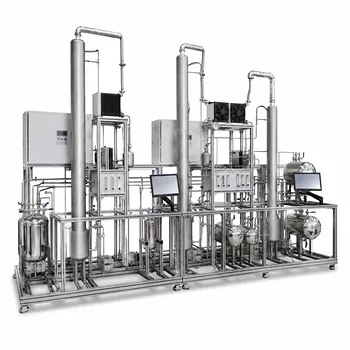
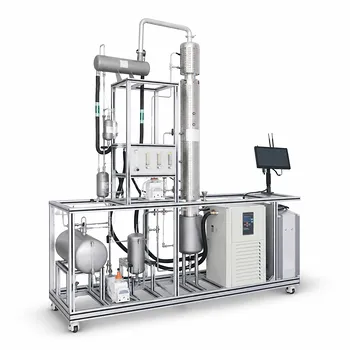
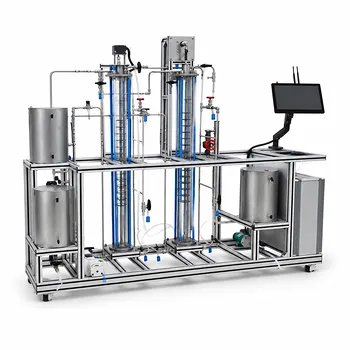
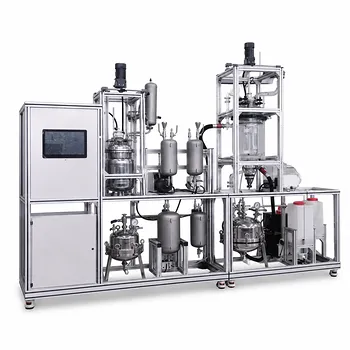
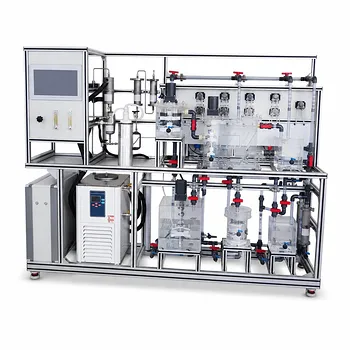
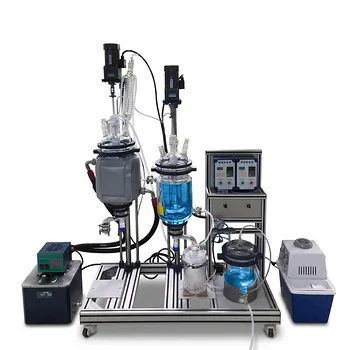
Extractive distillation is the workhorse for separating mixtures that defy conventional methods. In a chemical engineering unit operations pilot plant, it works by introducing a high-boiling, non-volatile solvent into a distillation column at a point between the top condenser and the main feed stage. This solvent flows downward, selectively altering the relative volatility of the key components so that one can be drawn off as a pure overhead product, while the solvent-rich bottoms are sent to a second column for recovery.
The core principle is tactical manipulation of vapor-liquid equilibrium. A carefully chosen solvent changes the molecular interactions within the mixture, breaking azeotropes or making a low-relative-volatility separation practical. The solvent’s introduction point—above the main feed and below the condenser—creates a scrubbing zone that ensures complete separation before the vapor reaches the top.
The Core Mechanism of Extractive Distillation
How the Solvent Changes the Game
Conventional distillation relies on inherent boiling-point differences. When those differences are too small or an azeotrope pins the composition, extractive distillation adds a third component—the extractive solvent—to create the necessary volatility shift.
The solvent selectively interacts with one of the mixture components, usually through hydrogen bonding or structural similarity. If the solvent forms strong hydrogen bonds with component 2, it holds that component in the liquid phase, effectively reducing its vapor pressure. This dramatically increases the relative volatility of component 1, allowing it to be distilled out in high purity.
In pilot-plant education, this demonstrates a fundamental truth: you can change thermodynamic behavior not by altering temperature or pressure, but by changing the chemical environment on the trays.
Where the Solvent Is Introduced
The solvent feed point is critical for process success. In a pilot-scale column, the solvent is introduced directly below the top condenser and above the main mixture feed. This creates three distinct column sections:
- The rectifying (top) section: A short zone above the solvent entry where any traces of solvent are separated from the overhead product vapor.
- The extractive (middle) section: The solvent-rich zone between the solvent feed and the mixture feed. Here, the downward-flowing liquid solvent contacts the rising vapor, stripping out the less-volatile component.
- The stripping (bottom) section: Below the mixture feed, where the solvent and the captured component are concentrated and sent to the reboiler.
Without this precise solvent injection point, the column would lose its dedicated extractive zone, and separation would collapse.
The Two-Column System in Practice
A true extractive distillation pilot plant is not a single column but a two-column system. The first column receives the azeotropic feed and the solvent, delivering one pure component at the top. The bottoms stream—a mixture of solvent and the second component—flows to a second distillation column.
In the solvent recovery column, the second component is boiled off as the overhead product, while the clean, high-boiling solvent is drawn from the bottoms and recycled back to the first column. This closed-loop design lets students and researchers study industrial realities like solvent degradation, heat integration, and recycle stream purity.
Critical Operating Parameters in a Pilot Plant
Solvent Concentration and Tray Efficiency
The mole fraction of solvent in the liquid on the trays, denoted x_S, is the master dial of separation performance. Higher x_S increases selectivity and boosts relative volatility—but only up to a point. Once solvent concentration passes a threshold (typically around 0.6–0.8), further gains in efficiency plateau while energy costs continue to climb.
Maintaining a liquid-phase solvent concentration of 0.6 to 0.8 on the trays is thus the operational sweet spot. Beyond this range, you are simply heating and pumping excess solvent for no thermodynamic reward.
A significant operational consequence is tray efficiency. Because the solvent feed rate is much larger than other streams, the internal liquid flow dwarfs the vapor flow, leading to poor vapor–liquid contact. As a result, overall tray efficiency in extractive distillation can drop to roughly 50% of a conventional column. Pilot plants must be designed with this derating in mind.
Solvent Temperature and Column Stability
The massive volume of solvent circulating through the column makes the system exquisitely sensitive to temperature disturbances. Even minor fluctuations in the solvent feed temperature can trigger large-scale instability in the internal liquid flow, causing the column to weep, flood, or lose separation.
For this reason, a strictly controlled, constant solvent feed temperature is a non-negotiable operating rule in pilot-plant trials. Preheating the solvent to a precise setpoint dampens thermal shocks and ensures the column profile remains stable.
End-Point Determination
Knowing when the separation is complete can be done directly or indirectly. Direct sampling involves taking aliquots from the still for off-line analysis (e.g., gas chromatography), but it requires cooling the batch and introduces turnaround delays.
A more practical, real-time method is monitoring the still temperature. During solvent exchange, the boiling temperature holds constant while the original solvent is being displaced. Once the original solvent is fully removed, the temperature rises sharply toward the boiling point of the pure replacement solvent, signaling the end point.
Understanding the Trade-offs
Extractive distillation is powerful, but it comes with clear costs that pilot-plant research aims to quantify and minimize.
- Solvent flow imbalance: The exceptionally high liquid-to-vapor ratios reduce tray efficiency, meaning you need more stages or taller columns to achieve the same purity.
- Energy intensity: Large solvent inventories must be heated in the reboiler and cooled in the condenser, plus an entire second column is needed for solvent recovery, roughly doubling the energy footprint compared with a simple distillation.
- Temperature sensitivity: The same high solvent flow that causes efficiency loss also magnifies the impact of temperature instabilities, demanding tighter control systems and often preheating loops.
- Plateau in selectivity: Above an x_S of about 0.8, adding more solvent rarely improves separation enough to justify the extra pumping, heating, and cooling load. Balancing x_S is a classic engineering trade-off between purity and operating cost.
Making the Right Choice for Your Pilot Plant Study
Your experimental goals will determine which aspects of extractive distillation you emphasize. Here’s how to orient your pilot-plant campaign:
- If your primary focus is understanding thermodynamic principles: Vary the solvent-to-feed ratio systematically and measure how relative volatility changes, keeping solvent concentration in the liquid phase between 0.6 and 0.8 to see the plateau effect firsthand.
- If your primary focus is energy optimization: Experiment with solvent preheat temperatures and trace the reboiler duty. Even a 2–3 °C improvement in solvent feed consistency can stabilize column operation and cut energy waste.
- If your primary focus is scaling up for industrial design: Run the two-column system with recycle, measuring tray efficiency derating (expect around 50%) and solvent make-up rates to build a reliable mass and energy balance for scale-up calculations.
- If your primary focus is handling heat-sensitive materials: Consider solvent extraction or low-boiling-solvent extractive distillation to lower the operating temperature, reducing thermal degradation while still breaking the azeotrope.
Mastery of extractive distillation in a pilot plant is not just about learning where to inject a solvent—it is about developing an intuition for the delicate interplay of thermodynamics, mass transfer, and energy. With the right controls and a disciplined experimental plan, you transform a stubborn mixture into a pure-stream success story.
Summary Table:
| Parameter | Target / Detail | Operational Impact |
|---|---|---|
| Solvent Feed Point | Below condenser, above main feed | Creates the rectifying, extractive, and stripping zones |
| Solvent Concentration ($x_S$) | 0.6 – 0.8 in liquid phase | Maximizes selectivity; prevents energy waste above 0.8 |
| Tray Efficiency | ~50% of conventional columns | Requires derating design due to high liquid-to-vapor ratios |
| System Configuration | Two-column closed loop | Column 1 separates components; Column 2 recovers solvent |
Elevate Your Chemical Engineering Lab with LABPARK
To master complex separations like extractive distillation, hands-on training on industrial-grade equipment is essential. LABPARK provides premium Educational and Vocational Unit Operations Pilot Plants in chemical engineering, bioprocess & biotech, and environmental & water treatment for universities, research institutes, and enterprises.
Why choose LABPARK?
- Accurate Scaling: High-fidelity pilot plants that match industrial thermodynamic behaviors.
- Robust Controls: Precise temperature and flow management for stable column runs.
- Comprehensive Learning: Complete systems including solvent recovery loops.
Ready to enhance your research and educational capabilities? Contact the LABPARK team today to discuss your project needs!
Related Products
- Green Anhydrous Ethanol Purification Extractive Distillation Unit Operations Training Pilot Plant
- Continuous Batch Extractive Distillation Educational Pilot Plant
- Multi-Functional Special Distillation Educational Pilot Plant
- Green Anhydrous Ethanol Refining Practical Training Pilot Plant
- Continuous Sieve-Plate Distillation Pilot Plant for Unit Operations Laboratory Education
People Also Ask
- How can energy balance equations for condensers & reboilers be validated experimentally? Guide
- Fugacity vs Activity Coefficient: How to Choose VLE Models for Distillation Pilot Plants
- How can real-time carbon number prediction improve distillation pilot plants? Optimize control.
- Why run shortcut fractionation before rigorous distillation calculations? Optimize your pilot plant.
- Why is vacuum operation capability an essential feature for a distillation unit operations pilot plant? Unlock Efficiency