When you introduce axial mixing in a fluidized bed pilot plant, you immediately gain exceptional heat transfer uniformity, but at the cost of reduced reaction kinetics efficiency—that’s the foundational trade-off. This mixing, driven by the vigorous, liquid-like circulation of solid particles, eliminates dangerous hot spots and gives you an almost perfectly isothermal bed. However, the same chaotic particle movement that makes temperature control so robust also creates significant backmixing, flattening the concentration gradient that drives the chemical reaction forward. In essence, you are trading peak conversion for thermal safety and stability.
The central challenge of designing a fluidized bed lies in this tension: intensive axial mixing makes the pilot plant inherently safe and thermally uniform, but the resulting backmixing dilutes reactants and can lower overall conversion. A good design actively manages this balance by optimizing particle properties, gas flow rates, and internal geometry to meet the specific goals of the process.
The Two Faces of Axial Mixing in a Fluidized Bed
Axial mixing refers to the continuous upward and downward movement of solid particles, which gives the bed its fluid-like behavior. In a pilot plant, you can visually observe this as gas bubbles rise and drag particles along, creating a constant, churning circulation.
This mixing is not just an interesting hydrodynamic phenomenon—it directly controls both the thermal and chemical performance of the reactor. Understanding its dual nature is the first step toward solving the real-world problem: designing a pilot plant that is safe, efficient, and scalable.
How Axial Mixing Creates a Thermally Perfect Environment
The most celebrated advantage of a fluidized bed is its ability to maintain a uniform bed temperature, even during highly exothermic reactions.
That uniformity is a direct result of the rapid movement of solid particles. Solids have a much higher volumetric heat capacity than the gas, so they act as a massive thermal flywheel. As particles circulate, they absorb heat in one zone and release it in another, smearing out any temperature differences almost instantly.
In fact, approximately 90% of the temperature change of the inlet gas occurs in a shallow bottom layer just a few particle diameters thick. After that zone, the remainder of the bed operates at a single, stable temperature. This makes temperature control in a pilot plant remarkably simple—you are monitoring one representative value, not chasing dangerous gradients.
The Heat Transfer Boost: Gas, Particles, and Walls
The intensive mixing also generates exceptionally high heat transfer rates on every surface it touches.
- Gas-to-Particle Heat Transfer: Because the fluidized solids present an enormous surface area, the gas quickly reaches the bed temperature. This rapid thermal equilibration is why the bed remains isothermal.
- Bed-to-Wall Heat Transfer: Heat transfer to reactor walls or immersed heat exchangers is comparable to that of a boiling liquid, with coefficients around 200 W/(m²·°C). Such high rates allow you to quickly remove reaction heat using a relatively small internal coil or jacket.
- Critical Design Constraint: However, these high rates depend entirely on uninterrupted particle movement against the surface. If you place an immersed heat exchanger in a way that blocks solids circulation, the heat transfer coefficient will collapse, creating a dead zone. The design must integrate heat transfer surfaces as part of the flow pattern, not as an obstruction to it.
The Kinetic Trade-off: The Backmixing Penalty
While axial mixing is a hero for heat transfer, it is a liability for reaction kinetics in certain scenarios. This happens because the same circulation that homogenizes temperature also homogenizes concentration.
Why Plug-Flow Reactors Get Higher Conversion
In an ideal plug-flow reactor (like a well-designed fixed bed), reactants enter at high concentration, and the concentration gradually decreases along the length as the reaction progresses. This maintains a strong concentration driving force from inlet to outlet, maximizing conversion.
In a vigorously mixed fluidized bed, however, the circulating solids rapidly disperse the incoming reactants throughout the entire reactor. The bed operates at a relatively uniform, low outlet concentration from the very first moment. The concentration gradient that pushes a reaction to completion is flattened, a phenomenon called backmixing.
The Direct Consequence on Reaction Rate
Because the average reactant concentration throughout the bed is low, the overall reaction rate per unit volume of reactor is lower than it would be in a plug-flow system. To achieve the same conversion, a fluidized bed may need to be larger or operate with a longer mean residence time.
This is the fundamental safety-vs-efficiency trade-off at the heart of fluidized bed design: you accept a kinetic penalty to eliminate hot spots and simplify thermal management.
When Kinetic Penalties Are Acceptable
The kinetic penalty is most pronounced in reactions with positive-order kinetics (e.g., first-order), where conversion depends strongly on maintaining a high concentration gradient. For reactions that are product-inhibited or where selectivity is improved by a flat temperature profile, the advantage of uniform temperature often outweighs the conversion loss.
Understanding the Trade-offs: More Than Just Kinetics
Axial mixing is not the only factor that creates design complexity. You must also balance hydrodynamic stability, particle integrity, and fluidization quality.
The Attrition Problem: Mixing That Grinds Your Catalyst
The same violent particle collisions that give you excellent mixing also break down the solid material. Particle attrition increases with excess gas velocity (U₀ — U_mf) and bed mass. High attrition generates fines, which can:
- Entrain out of the reactor, causing catalyst loss.
- Plug downstream cyclones and filters.
- Change the particle size distribution, shifting the fluidization behavior over time.
Selecting particles with sufficient mechanical strength and operating at the lowest velocity that still achieves good mixing is a critical lever for managing this trade-off.
Fluidization Regime and Gas Mixing Pitfalls
Axial mixing is not uniform across all operating regimes. In the bubbling and slugging regimes, you get the fastest solids circulation and best thermal uniformity. At lower gas flows, the bed may not mix adequately; at extremely high flows, you risk moving into a transport mode with severe entrainment.
Furthermore, while solids mixing is excellent, gas mixing in the interstitial spaces can be poor, especially with non-porous particles. If two reactant gases are fed separately, the lack of local gas turbulence might lead to poor contacting and reduced reaction performance. Using porous catalyst particles helps because they absorb, carry, and release gas, improving cross-mixing.
Quantitative Design Insight: The Bed-to-Wall Coefficient
For a more tailored design, pilot-plant operators can use empirical correlations like Botterill's equation:
h_bw = 35.8 (k'_g)^0.6 d_p^-0.36 ρ_s^0.2
This relationship shows that the bed-to-wall heat transfer coefficient can be tuned by adjusting particle diameter (d_p) and solid density (ρ_s). In a pilot plant, running experiments with different media (sand vs. alumina vs. catalyst) gives you the data to validate these correlations and predict the heat exchange surface needed at commercial scale.
Making the Right Choice for Your Goal
Your design target in a fluidized bed pilot plant must reflect the primary need of the process you are studying or scaling up. There is no single optimal setup; the solution depends entirely on what you prioritize.
- If your primary focus is temperature control and safety: Maximize solid circulation by operating in a vigorously bubbling regime. Accept the lower per-pass conversion, knowing you have eliminated hot-spot risk. This is the classic approach for highly exothermic reactions like phthalic anhydride or acrylonitrile production.
- If your primary focus is maximizing reaction conversion: You must consider whether a fluidized bed is the right choice at all. For mildly exothermic reactions, a multi-tubular fixed bed, which approximates plug flow, might deliver higher conversion with less attrition. If a fluidized bed is mandatory, use a taller bed (increased aspect ratio) or staged fluidized beds to reduce backmixing.
- If your primary focus is scalable pilot plant research: Design your unit to be as flexible as possible. Use transparent columns to correlate flow regimes with data, vary particle size and distributor plate design systematically, and measure attrition rates. Document how changes in axial mixing shift the balance between thermal uniformity and conversion, giving you the insights needed for a reliable scale-up.
Ultimately, the fluidized bed pilot plant is a powerful platform for understanding trade-offs, not just a test reactor. By intentionally manipulating axial mixing, you learn precisely how to navigate the boundary between safe, robust thermal control and the relentless pursuit of chemical efficiency.
Summary Table:
| Parameter | Impact of High Axial Mixing | Design Mitigation / Solution |
|---|---|---|
| Heat Transfer | Exceptional thermal uniformity; high wall-to-bed coefficients (~200 W/m²·°C). | Integrate internal heat exchangers carefully to avoid blocking solids circulation. |
| Reaction Kinetics | Strong backmixing dilutes reactants, lowering the overall conversion rate. | Increase reactor aspect ratio (taller beds) or design staged fluidized beds. |
| Particle Attrition | Intensive particle collisions cause catalyst breakdown and generate fines. | Use high-strength catalyst media and operate at optimized, lower fluidization velocities. |
Optimize Your Research and Training with LABPARK Pilot Plants
Are you looking to master complex reactor dynamics and scale up your chemical processes effectively? LABPARK provides state-of-the-art Educational and Vocational Unit Operations Pilot Plants in chemical engineering, bioprocess & biotech, and environmental & water treatment.
Engineered specifically for universities, research institutes, and enterprises, our pilot plants help you hands-on analyze fluidization, heat transfer, and reaction kinetics with precision.
Ready to elevate your laboratory capabilities? Contact our technical team today to find the perfect pilot plant solution for your institution!
Related Products
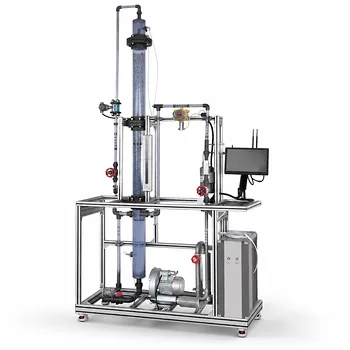
- Fluidized Bed Gas Solid Catalytic Reaction Educational Pilot Plant
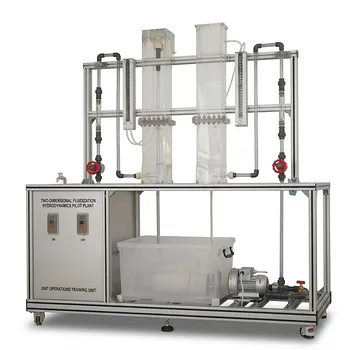
- Two-Dimensional Fluidization Hydrodynamics Educational Pilot Plant for Unit Operations Training
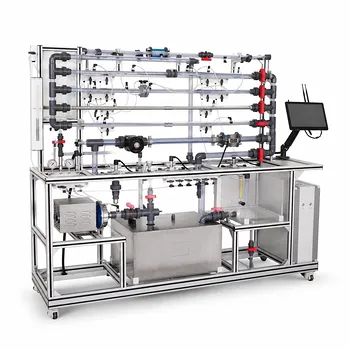
- Multi-Reactor Educational Pilot Plant for Reaction Engineering Unit Operations
- Multi-Functional Drying Educational Unit Operations Pilot Plant
- Multi Functional Catalytic Reaction and Reactor Evaluation Educational Unit Operations Pilot Plant
People Also Ask
- Why is the bed height-to-diameter ratio (L/dt) critical? Fluidized bed pilot plant selection guide.
- How is the minimum fluidization velocity (U_mf) determined and utilized? A Unit Operations Guide
- How does the Mears criterion evaluate transport resistance? Key Guide to Intrinsic Kinetics
- How do reactor pilot plants safely study gas-solid reactions? Master kinetics with thermal & flow control.
- How do pilot plants demonstrate fluidized-bed reactor advantages over fixed-bed? Find Out Now