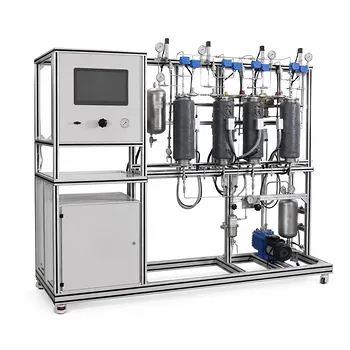
The thermodynamic film-coating model transforms scale-up from an empirical guessing game into a precision engineering task. By enforcing identical exhaust air temperature and relative humidity across scales, it recreates the exact drying environment the tablets experience, no matter the coater size. This environmental similarity lets engineers calculate the required inlet air temperature, drying airflow, and spray rate for a production unit directly from pilot-plant data, slashing the need for costly trial-and-error runs.
The core insight: Scale-up is not about geometric mimicry—it’s about matching the thermodynamic state inside the pan. When the heat and mass balance around the exhaust air stream is preserved, the droplet drying, film formation, and tablet quality become predictable across laboratory, pilot, and commercial coaters. The model relies on determining the coater’s heat loss factor (HLF) and maintaining constant droplet size through controlled atomization parameters.
The Thermodynamic Scale-Up Principle
Environmental Similarity Through Exhaust Air
The coating process inside a pan operates as an adiabatic evaporative cooler. Wet coating is sprayed onto the tablet bed, and the latent heat of evaporation is supplied entirely by the drying air. Consequently, the temperature and relative humidity of the exhaust air become the direct fingerprints of the thermodynamic state the product sees. Matching those two variables means every tablet experiences identical heat and mass transfer rates, regardless of drum diameter or batch size.
The Role of the Heat Loss Factor (HLF)
Real coaters are never perfectly adiabatic—some energy leaks to the surroundings. The heat loss factor quantifies this deviation. Once you measure the HLF on a laboratory or pilot coater, you can feed it into a material balance that equates the water entering (via inlet air humidity plus spray rate) with the water leaving (via exhaust). This lets you accurately predict the exhaust humidity and, with the first law of thermodynamics, solve for the inlet air temperature and airflow needed at the production scale to hit the target exhaust conditions.
Applying the First Law of Thermodynamics
Three master variables govern the thermodynamic state: airflow volume, inlet air temperature, and the moisture content of the air. Increasing the spray rate raises the pan’s moisture load; increasing the inlet air temperature drives the relative humidity back down. A first-law energy balance, combined with the mass balance, converts pilot-plant measurements into a complete set of operating conditions for the scaled-up unit. Exhaust temperature and humidity become your invariant anchors, and the model calculates the adjustable levers—inlet temperature, air volume, and spray rate—to maintain them.
Critical Pilot Plant Monitoring Parameters
Pre-Process Data for Heat Loss Determination
Before any scale-up calculation can be trusted, the heat loss factor of the pilot coater must be known. This requires measuring the inlet air temperature, exhaust air temperature, airflow rate, and spray rate under steady-state conditions while running a simple water spray (no coating solids). The difference between the theoretical adiabatic exhaust temperature and the actual measured temperature reveals the HLF. This single number then characterizes the pan’s thermal efficiency and becomes a mandatory input for all subsequent scale-up models.
Atomization and Droplet Size Control
Scale-up fails immediately if droplet size changes, because droplet drying kinetics and film formation depend on surface area-to-volume ratio. To keep droplets identical, the pilot plant operator must specify nozzle characteristics (orifice size, air cap design, liquid insert) and measure the coating solution’s rheological properties: viscosity, surface tension, and density. The atomization model then translates these inputs into the required liquid and atomization gas flow rates at any scale to reproduce the same droplet size distribution.
Dynamic Process Variables
Beyond the thermodynamic and atomization parameters, real-time process monitoring prevents overwetting or premature drying. The four key control points during a pilot run are:
- Liquid and gas flow rates at the coaxial nozzle (directly set droplet size).
- Drying gas flow rate and temperature (balance evaporation rate against spray rate).
- Drum rotation speed (RPM) (ensures uniform mixing and exposure of every tablet to the spray zone).
- Spray rate and pan speed interaction (higher pan speed exerts strong leverage in reducing coating defects; the relationship between spray rate, pan speed, and solids concentration can be optimized via regression models).
Understanding the Trade-offs and Pitfalls
When the Model Doesn’t Save You
A thermodynamic model is only as reliable as its input data. If the heat loss factor is determined on a dirty or poorly insulated pilot coater, it will not represent the production machine. Additionally, the model assumes the tablet bed is well-mixed and that drying is entirely limited by the air’s capacity. In large coaters, spray zone saturation or localized overwetting can occur even if the bulk exhaust conditions are identical. This demands that spray gun-to-bed distance and pattern be matched geometrically, not just thermodynamically.
Atomization Assumptions
Maintaining constant droplet size across scales sounds simple but often fails when moving from a single-nozzle pilot to a multi-gun production coater. The rheological properties of the coating solution can also drift due to evaporation in the supply system or shear history. If viscosity changes, the atomization gas pressure must be compensated; otherwise, droplet size shifts and defects like orange peel or bridging appear, despite a perfect thermodynamic match.
The Risk of Over-Reliance on Exhaust Alone
Focusing exclusively on exhaust temperature and relative humidity can mask issues with tablet bed dynamics. For example, a high pan speed may reduce the coating residence time per pass, artificially lowering the tablet surface temperature briefly. The exhaust-based model sees none of this. Therefore, pilot plant scale-up must also track pan speed, fill level, and baffle design—mechanical factors that interact with the thermodynamic envelope.
Making the Right Choice for Your Scale-Up Goal
The thermodynamic film-coating model gives you a programmable path from pilot to production. How you apply it depends on what you’re trying to achieve:
- If your primary focus is minimizing validation batches: Invest time in accurately measuring the heat loss factor and coating solution rheology. A well-characterized HLF and fixed droplet size turn the model into a digital twin that predicts production conditions with enough fidelity to skip most trial runs.
- If your primary focus is reducing coating defects: Do not rely on thermodynamics alone. Complement the model with a design-of-experiments approach that explores interactions between spray rate, pan speed, and suspension concentration. Use regression modeling on pilot data to find the sweet spot where exhaust conditions and mechanical forces align.
- If your primary focus is scaling a continuous coater: Apply the same exhaust-matching principle but also control the tablet feed rate and residence time precisely. The thermodynamic model will set the drying gas and spray rates, while the mass flow of tablets must be synchronized to achieve uniform coating weight gain.
Mastering this model means you never look at scale-up as a mysterious risk again—you see it as an engineered transfer of a thermodynamic fingerprint, backed by smart process monitoring.
Summary Table:
| Parameter | Type | Impact on Scale-Up |
|---|---|---|
| Exhaust Air Temp & RH | Thermodynamic | Recreates the exact tablet drying environment. |
| Heat Loss Factor (HLF) | Calibration | Solves the energy balance to set inlet air temp. |
| Atomization Air/Liquid Flow | Spray Dynamics | Controls droplet size to prevent defects like orange peel. |
| Drum Rotation Speed (RPM) | Mechanical | Ensures uniform mixing and tablet bed exposure. |
Streamline Your Unit Operations Scale-Up
Transitioning from pilot testing to full-scale production requires highly accurate process monitoring and reliable equipment. LABPARK provides state-of-the-art Educational and Vocational Unit Operations Pilot Plants in chemical engineering, bioprocess & biotech, and environmental & water treatment for universities, research institutes, and enterprises.
Accelerate your research and training outcomes with our precision-engineered pilot systems. Contact LABPARK today to discuss your project!
Related Products
- Constant Pressure Filtration Educational Unit Operations Pilot Plant
- Plate Column Hydrodynamics Tray Demonstration Educational Pilot Plant
- Multi Functional Membrane Crystallization Educational Unit Operations Pilot Plant
- Rising and Falling Film Evaporation Educational Unit Operations Pilot Plant
- High-Gravity Emulsification and Mass Transfer Educational Pilot Plant
People Also Ask
- How do educational unit operations pilot plants bridge theory and design? Bridge the Engineering Gap
- How do educational unit operations pilot plants address safety and waste management when scaling up?
- Why splitting a filtration batch doesn't always reduce cycle time? Pilot Plant Insights
- Why Demo Constant-Rate to Constant-Pressure Filtration on a Pilot Plant? Key Practical Insights
- How can researchers identify and resolve filter medium blinding? Optimize Your Pilot Plant Runs