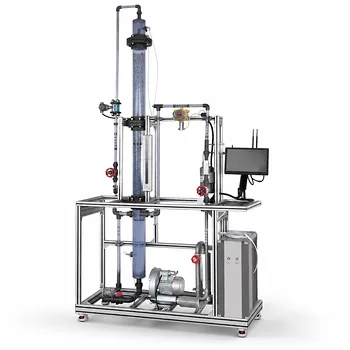
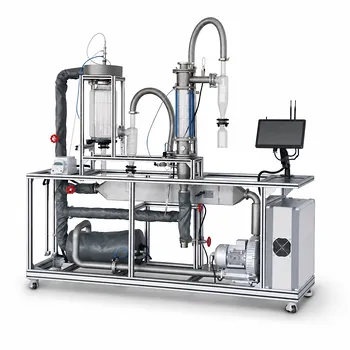
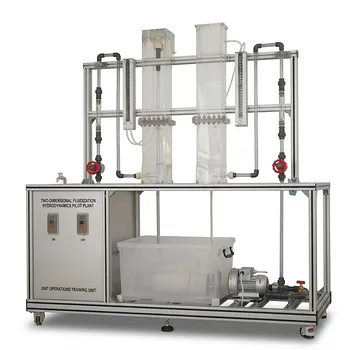
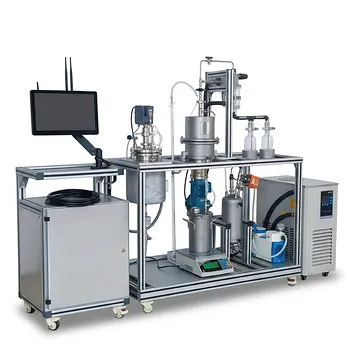
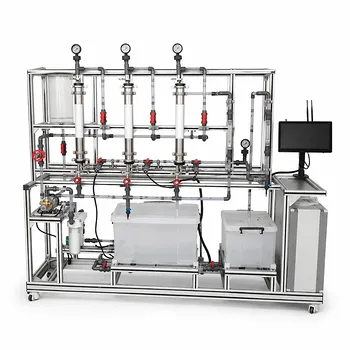
The simulated moving bed (SMB) pilot plant transforms adsorption training from an inefficient batch process into a true continuous, counter-current operation. Unlike traditional fixed-bed units that operate in stop-and-start cycles, the SMB design simulates the continuous movement of solid adsorbent against the liquid feed by periodically shifting inlet and outlet ports. This teaches students to achieve higher product purity and concentration while dramatically reducing solvent consumption — mirroring the exact demands of modern industrial purification standards.
The core advance is that an SMB pilot plant demonstrates continuous, counter-current contact without physically moving the solid phase. This eliminates the batch-mode limitations of fixed-bed units, providing hands-on experience with the same high-efficiency, low-waste processes used in advanced pharmaceutical and biotech separations.
The Fundamental Flaw in Fixed-Bed Training Units
The traditional approach teaches the basics, but its inherent limitations create a gap between academic labs and real-world production.
Batch Operation Creates Inefficiency by Design
In a fixed-bed column, feed is injected into a continuous mobile phase, and components elute at different times based on their adsorption affinity. This is inherently a batch process — you load, you elute, you stop, you repeat. Maximizing throughput forces you to scale up column diameter, which leads to peak broadening, longer columns, and high pressure drops. For students, this masks the true potential of adsorption technology for efficient, large-scale purification.
High Adsorbent and Solvent Usage Distort Economic Understanding
Fixed-bed training units consume far more adsorbent and desorbent per unit of purified product than is economically viable in industry. Supplementary research indicates an SMB system can reduce adsorbent inventory to as low as 1/25 and desorbent consumption to roughly half of what a comparable fixed-bed requires. Relying solely on batch training leaves students with a skewed perception of operating costs and material efficiency.
How the SMB Pilot Plant Bridges the Gap
The SMB approach solves these training deficiencies by introducing continuous counter-current logic in a practical, scalable format.
Simulating Movement to Preserve the Adsorbent
True counter-current systems would physically circulate the solid adsorbent, causing severe mechanical wear and attrition that rapidly degrades the packing. The SMB pilot plant avoids this entirely. By using a multiport rotary valve (or a bank of solenoid valves) to periodically switch the positions of the feed, desorbent, extract, and raffinate streams along a fixed series of columns, the system simulates the solid phase moving against the liquid flow. Students learn that they can achieve all the process benefits of counter-current contact without destroying the column internals.
Teaching Zone-Specific Control and Mass Transfer Dynamics
An SMB is divided into four conceptual zones, each with its own critical flow-rate ratio. Operating the pilot plant forces students to grapple with valve-switching frequency, internal recycle rates, and the dynamics of continuous mass transfer. They see firsthand how manipulating these parameters directly impacts product purity — often exceeding 99.5% for notoriously difficult separations like optical isomers (chiral drugs) or glucose-fructose mixtures.
From Batch Mindset to Continuous Product Withdrawal
The most visible leap is in operation. Instead of collecting timed fractions from a single elution, an SMB pilot plant continuously receives feed and continuously discharges two high-purity streams: the extract and the raffinate. This teaches students to design and troubleshoot processes for steady-state production, a skill directly transferable to industries running Sorbex-type units for high-volume separations.
Understanding the Trade-offs
Despite its clear educational advantages, the SMB pilot plant introduces complexities that must be addressed in any training curriculum.
Increased System Complexity and Control Requirements
An SMB is not a plug-and-play device. The periodic port switching demands precise synchronization, and the correct setting of multiple flow rates requires a solid grasp of adsorption equilibrium and mass-transfer kinetics. For students, the learning curve is steeper — a misconfigured switch timing can ruin a run. This teaches invaluable process control discipline but requires more instructor oversight and robust diagnostic software.
Higher Initial Capital Cost
The multiport valve and the series of precision columns make an SMB pilot plant a larger upfront investment than a single glass column setup. However, for institutions aiming to prepare students for the bioprocessing and fine chemical industries, this expense must be weighed against the irreplaceable hands-on experience it provides. The cost reflects the shift from teaching a simple unit operation to teaching a fully integrated, continuous separation strategy.
Not a Replacement for Fundamental Batch Training
The SMB is a specialized tool. Students still need to understand the fundamentals of adsorption isotherms, breakthrough curves, and basic chromatographic principles — concepts best introduced in a simple batch column. The SMB pilot plant is the advanced step, not the starting point.
Making the Right Choice for Your Training Goal
The decision to prioritize SMB over traditional fixed-bed units depends entirely on what you need your students to take away.
- If your primary focus is fundamental principles of adsorption: A traditional fixed-bed unit remains the clearest, most cost-effective way to teach breakthrough curves, isotherms, and the basics of elution chromatography.
- If your primary focus is industrial relevance and process intensification: An SMB pilot plant is non-negotiable. It replaces an outdated batch paradigm with the continuous, low-solvent, high-purity reality of modern pharmaceutical and biotech manufacturing.
- If your primary focus is advanced process control education: The SMB pilot plant provides a uniquely rich challenge, demanding mastery of cyclic valve switching, multi-zone flow balancing, and real-time purity monitoring under continuous operation.
Ultimately, the simulated moving bed pilot plant doesn’t just improve on a fixed bed — it redefines what students understand a separation process can be: truly continuous, inherently efficient, and ready for the demands of sustainable production.
Summary Table:
| Feature | Fixed-Bed Adsorption Units | Simulated Moving Bed (SMB) Pilot Plant |
|---|---|---|
| Operation Mode | Batch (load, elute, stop, repeat) | Continuous, simulated counter-current |
| Solvent & Adsorbent Usage | High consumption (less economically viable) | Low (up to 96% less adsorbent, 50% less solvent) |
| Product Purity | Lower throughput/purity due to peak broadening | High purity (>99.5% for difficult separations) |
| System Complexity | Low (simple columns and manual control) | High (multi-zone flow balancing, cyclic valves) |
| Primary Training Focus | Fundamental isotherms & breakthrough curves | Industrial process intensification & control |
Upgrade Your Separation Training with LABPARK
Bring industry-standard continuous purification technology to your lab. LABPARK provides premium Educational and Vocational Unit Operations Pilot Plants in chemical engineering, bioprocess & biotech, and environmental & water treatment. Designed specifically for universities, research institutes, and enterprises, our systems equip your students and researchers with hands-on experience in advanced, sustainable process control.
Ready to transition from batch to continuous separation? Contact us today to request a quote or custom consultation!
Related Products
- High-Gravity Emulsification and Mass Transfer Educational Pilot Plant
- Packed Bed Absorption Educational Unit Operations Pilot Plant
- Multi-Reactor Educational Pilot Plant for Reaction Engineering Unit Operations
- Fixed-Bed Chemical Reaction and Gas Dust Tar Removal Unit Operations Pilot Plant
- Multi-Functional Drying Educational Unit Operations Pilot Plant
People Also Ask
- How to update chemometric calibration models in pilot plants? Best practices for process engineers.
- How does column packing affect absorption intensification, and how is it evaluated experimentally?
- Why Compare Membrane-Reservoir Models with Pilot Plant Data? Ensure Successful Process Scale-Up
- How should OSBL investments be estimated? Key Steps to Avoid Budget Overruns in Pilot Plant Projects
- What are the limitations of acentric factor models? Avoid pilot plant errors with polar fluids.