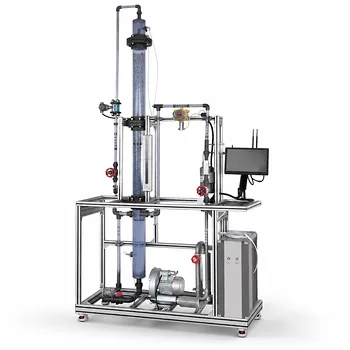
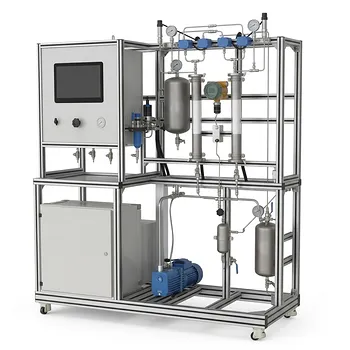
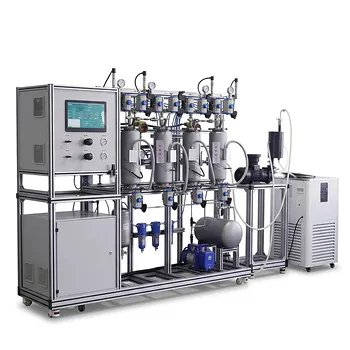
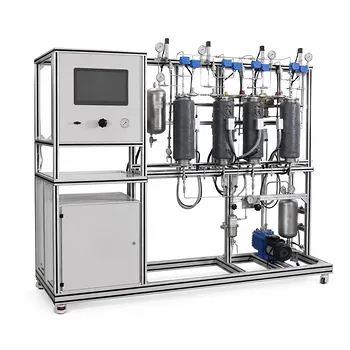
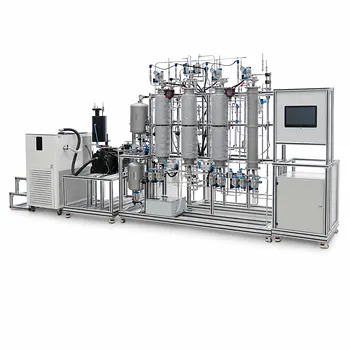
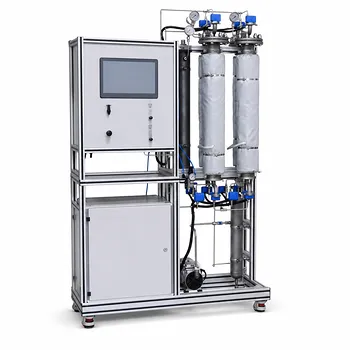
The fundamental leap in efficiency comes from transforming a batch process into a continuous, counter-current one. A simulated moving bed (SMB) pilot plant dramatically improves separation efficiency by using a multi-port rotary valve to mimic the true counter-current movement of the solid adsorbent against the liquid. This eliminates the inherent limitations of a traditional fixed-bed, allowing the separation to reach a thermodynamic steady state where mass transfer driving forces are maximized. The result is a system that consumes up to 96% less adsorbent and half the solvent while producing a continuous stream of high-purity product.
While a fixed-bed teaches the foundational "what" of adsorption, an SMB system teaches the "how" of efficient, large-scale purification. The core insight for education is that the SMB demonstrates how intelligent process design, rather than simply scaling up equipment, solves the critical industrial challenge of separating complex mixtures with minimal resource consumption. It shifts the learning focus from basic adsorption isotherms to the dynamics of continuous mass transfer and advanced process control.
Deconstructing the Efficiency Gap: SMB vs. Fixed-Bed
To understand the 25x reduction in adsorbent consumption, you must first understand the fundamental flaw in a batch-operated fixed-bed. An SMB system elegantly solves this by re-engineering the physics of the separation itself.
The Thermodynamic Limitation of Batch Operation
In a traditional fixed-bed adsorption unit, a liquid feed pulse is injected into a column packed with solid adsorbent. Different components in the mixture adhere to the solid surface with varying strengths, causing them to travel through the bed at different speeds.
The problem is that this process is inherently transient. The separation occurs over a single, finite bed. To achieve high purity with a difficult separation in a single pass, you would need an impractically long column and very precise timing to "cut" the eluting bands of pure product.
Bridging the Gap with a Simulated Counter-Current
Instead of physically moving the solid adsorbent, an SMB system rotates the liquid injection and collection points. A complex multi-port rotary valve connects the system’s pump to a series of smaller, discrete columns arranged in a closed loop.
By perfectly synchronizing the switching of the feed, desorbent, extract, and raffinate ports, the device creates a standing wave pattern within the column loop. The solid phase effectively "moves" left while the liquid phase flows right. This continuous counter-current contact sharpens the concentration profiles between the separated components, preventing the remixing that plagues a single-pass batch column.
How the SMB Pilot Plant Redefines Upskilling
For chemical engineering education, the superiority of an SMB unit is not just about purer product. It fundamentally shifts the curriculum from passive observation to active, industrial-style process control.
From Static Measurement to Dynamic Control
A traditional fixed-bed experiment is largely a study in passive measurement. A student injects a sample and records the effluent concentration over time to calculate static parameters like Gibbs free energy or breakthrough curve shapes. The learning is centered on thermodynamics and mass transfer coefficients.
An SMB pilot plant, however, is a dynamic process. The key efficiency metric, often achieving 99.5% purity for chiral drugs or sugar separations, is a direct result of a student’s ability to manipulate active variables. Students learn to optimize a separation in real time by adjusting:
- Valve Switching Frequency: The timing that dictates the simulated movement of the solid phase.
- Internal Flow-rate Ratios: The precise control of liquid flow in each of the SMB's four zones to prevent contamination of the product streams.
Minimizing Hidden Operational Costs
The primary reference highlights efficiency gains that are critical for industrial economics. An SMB system showcases how to cut desorbent consumption by half.
In a fixed-bed, fresh solvent is continuously pumped through a single column, diluting the product. An SMB’s looped design allows the solvent to be internally recycled. The fraction of solvent that is not needed to desorb the product stays within the system, dramatically reducing the volume that needs to be recovered or disposed of. This directly teaches principles of sustainable engineering and green chemistry by minimizing solvent waste.
Understanding the Educational Trade-offs
Adopting an SMB pilot plant is a significant pedagogical commitment. Its complexity is both its greatest teaching asset and a potential source of frustration if not properly scaffolded.
High Complexity Over Foundational Clarity
A traditional fixed-bed teaches a single unit operation in isolation. A student can quickly visualize the mass transfer zone moving along the column. An SMB unit, conversely, is a system operation. Students must troubleshoot a coordinated dance between a multi-port valve, four independent flow-rate controllers, and multiple column backpressures. A small timing error in the valve sequence can completely collapse the separation, which teaches valuable troubleshooting but obscures the basic adsorption mechanism for a novice.
The Risk of a "Black Box" Result
The intricate automation and internal recycle loops can feel like a "black box" to a student who hasn't first mastered the batch process. They see high-purity extract and raffinate streams, but they cannot easily visualize the internal concentration profiles. The most effective curriculum uses the fixed-bed to teach the basic surface phenomenon—the difference between physical van der Waals forces and irreversible chemical adsorption—before introducing the SMB as the engineering solution to scale up that process efficiently.
Making the Right Choice for Your Training Goal
The tool must match the training objective. Both systems serve distinct and vital roles in a chemical engineering laboratory.
- If your primary focus is teaching core adsorption thermodynamics: A traditional fixed-bed is superior. It allows for the clear measurement of Langmuir or Freundlich isotherms, calculation of heat of adsorption, and visual demonstration of breakthrough curves without the confounding variable of a multi-column cycle.
- If your primary focus is modern downstream processing and process intensification: The SMB pilot plant is mandatory. It directly demonstrates how to achieve continuous separation of high-value bio-products, cutting adsorbent inventory to as low as 4% of an equivalent fixed-bed, which is the primary industrial driver.
- If your primary focus is advanced process control and automation: An SMB unit is the ideal platform for teaching students to manage the complex interplay of valve-switching logic, pump synchronization, and achieving a controlled steady state that never truly settles.
Ultimately, an SMB pilot plant does not just separate chemical components with greater efficiency; it separates a student’s understanding of batch limitations from the reality of continuous, sustainable manufacturing.
Summary Table:
| Feature | Traditional Fixed-Bed System | Simulated Moving Bed (SMB) Pilot Plant |
|---|---|---|
| Operation Mode | Batch / Transient | Continuous / Counter-current |
| Adsorbent Consumption | High (100% baseline) | Extremely Low (Reduces inventory by up to 96%) |
| Solvent/Desorbent Use | High (Continuous dilution) | Low (Internally recycled, cut by 50%) |
| Primary Learning Focus | Basic thermodynamics & isotherms | Dynamic process control & intensification |
Elevate Your Engineering Lab with LABPARK
Ready to transition your curriculum from basic batch principles to modern industrial process intensification?
LABPARK provides premium Educational and Vocational Unit Operations Pilot Plants in chemical engineering, bioprocess & biotech, and environmental & water treatment. Specifically designed for universities, research institutes, and enterprises, our pilot plants—including advanced Simulated Moving Bed (SMB) systems—bridge the gap between classroom theory and real-world industrial efficiency.
Contact LABPARK today to discover how we can customize the ideal pilot plant solution for your training and research goals!
Related Products
- Packed Bed Absorption Educational Unit Operations Pilot Plant
- Absorption and Desorption Educational Unit Operations Pilot Plant
- High-Gravity Emulsification and Mass Transfer Educational Pilot Plant
- Multimodal Absorption and Desorption Pilot Plant for Unit Operations Training
- Pressure Swing Adsorption Educational Unit Operations Pilot Plant
People Also Ask
- How Do Flow Regimes Transition in Packed Bed Pilot Plants? Key Scale-up Insights
- How does reactant concentration determine absorption column control? Gas-film vs. dual-film.
- How is the packing height of an absorption column calculated? Master HTU & NTU Concepts
- How does static vs. operating holdup affect pilot plant calibration? Avoid Critical Scale-Up Errors
- Why is counter-current flow selected for gas absorption? Maximize Pilot Plant Efficiency