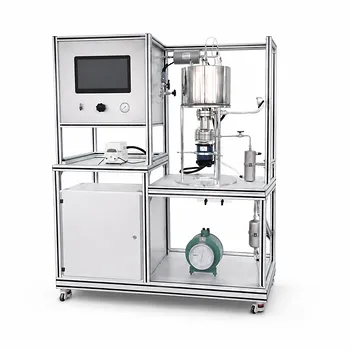
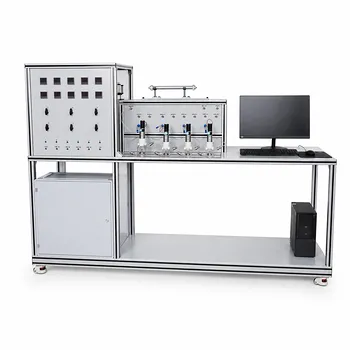
The multi-stage cold-shot adiabatic reactor is a remarkably elegant solution for harnessing powerful exothermic reactions. It regulates temperature by splitting the catalyst bed into multiple adiabatic stages and injecting a precisely controlled stream of cold reactant gas between them. This "cold-shot" instantly quenches the reaction mixture, resetting its temperature downward toward the optimal thermodynamic curve before it enters the next catalyst layer. This design is critical for pilot-plant studies because it safely enables the exploration of the fundamental kinetic-thermodynamic trade-off—high initial rates require heat, but ultimate conversion demands progressively cooler conditions—all while preventing thermal runaway and catalyst damage.
Core Takeaway: The cold-shot strategy converts a dangerously hot, single-pass reaction into a controlled, multi-stage thermal staircase. By repeatedly resetting the temperature, it mimics the ideal continuously decreasing temperature profile needed for reversible exothermic reactions, allowing pilot plants to safely maximize single-pass conversion and teach the core principles of industrial thermal management.
How a Cold-Shot Adiabatic Reactor Regulates Temperature
The regulation mechanism is a straightforward thermal reset, implemented through smart process design rather than complex internal heat exchange.
The Adiabatic Rise in Each Stage
In any adiabatic catalyst bed, the heat released by the reaction stays within the fluid.
As the exothermic reaction progresses through a bed, the mixture’s temperature rises rapidly and continuously.
This is unavoidable because the reactor walls are insulated—there is no external cooling inside the bed. The temperature climbs along a predictable adiabatic line.
The Cold-Shot Interruption
Between two adjacent catalyst stages, a bypass stream of cold, unconverted reactant is injected directly into the hot process gas.
This does not involve a separate heat exchanger. The mixing itself provides immediate, direct-contact cooling.
The cold gas drops the mixture’s temperature back to a lower setpoint—typically near or slightly above the optimal feed temperature for the next bed’s inlet conditions.
The Sawtooth Temperature Profile
The result is a distinctive sawtooth temperature trace along the reactor’s length.
Temperature rises steeply inside each bed, then is sharply cut down at the inter-stage injection point. The cycle repeats through 2–4 stages (or more, depending on the reaction).
This profile approximates the ideal continuously descending temperature path required for equilibrium-limited, exothermic reactions like ammonia synthesis. The optimal reaction temperature must decrease as the product concentration increases to maintain a favourable equilibrium constant.
Why This Temperature Regulation Is Critical for Studying Exothermic Processes
Pilot plants are living laboratories. The cold-shot strategy allows students and researchers to confront the real-world tensions that define scaled-up reactor engineering.
Managing the Kinetic–Thermodynamic Trade-off Safely
High temperatures accelerate reaction kinetics (rate constant (k) follows (\lg k = A + B/T)), but they also punish conversion in exothermic equilibrium reactions.
The cold-shot reactor lets you have both: operate the first bed at a high temperature to kick-start the kinetics, then cool the stream so subsequent beds operate nearer to thermodynamic optimums.
This hands-on observation—watching conversion rise while bed temperatures fall—cements the core design principle of ammonia, methanol, and SO₃ synthesis loops.
Preventing Thermal Runaway and Catalyst Damage
Exothermic reactions like nitrations (e.g., benzene nitration releasing ~134 kJ/mol) can self-accelerate beyond safe limits if heat accumulates.
The inter-stage cold-shot acts as an emergency brake. By intentionally dividing the total heat release into smaller increments, you prevent any single bed from reaching a temperature that could deactivate the catalyst or trigger a dangerous pressure surge.
This teaches operators how to respect critical safety ceilings—such as staying below 300°C in benzene hydrogenation or below 120°C in dinitrotoluene production—through reactor design alone.
Bridging Educational Theory and Industrial Reality
Multi-bed pilot plant reactors with cold-shot capability are direct miniatures of commercial ammonia and sulfuric acid units.
Students can adjust bypass flow rates, observe the resulting shift in the temperature profile, and directly calculate activation energies or heat transfer demands using integrated thermocouples and PID controllers.
This ingrains core concepts like heat-flow calorimetry, adiabatic temperature rise, and conversion optimization far more deeply than a textbook ever could.
Understanding the Limitations: The Sawtooth Profile Trade-Off
No design is perfect. The cold-shot method comes with inherent constraints that must be understood for it to be used wisely.
A Stepwise, Not Continuous, Approach to the Optimum
The best theoretical temperature trajectory for a reversible exothermic reaction is a smooth, continuously decreasing curve.
A cold-shot adiabatic reactor can only produce a zigzag approximation—a series of rises and sharp drops. There will always be segments where the actual temperature is above or below the ideal.
In contrast, a reactor with continuous internal heat exchange (like a multitubular design) can track the optimal curve cleanly. Educational pilot plants often include both types to illustrate this trade-off directly.
Potential for Over-Dilution and Reduced Rates
Every cold-shot injection introduces cold, unconverted feed. While it cools the stream, it also dilutes the product concentration and can lower the average reaction rate in the following bed.
The operator or control system must balance the cooling benefit against the kinetic penalty. Too much cold-shot gas can shift the composition away from the most productive range, reducing the very conversion you’re trying to protect.
Complex Control Dynamics
The system’s stability depends on precise bypass valve control and reliable temperature feedback. A delay or oversized cold-shot can chill the downstream bed too much, destabilizing the reaction front.
Pilot plants therefore integrate advanced PID temperature controllers and high-precision sensors, not only for safety but also to teach the art of dynamic thermal management—a critical skill for any process engineer.
Making the Right Choice for Your Pilot-Plant Goals
Your selection or study of a cold-shot adiabatic reactor should be driven by what you need to learn or demonstrate. Here is how different priorities map to the design.
- If your primary focus is maximizing single-pass conversion safely: The multi-bed cold-shot arrangement is ideal. It lets you practically approach 98–99% conversion for reactions like SO₂ oxidation while keeping each bed within stable thermal limits.
- If your primary focus is fundamentals of thermal runaway and safety: Use this reactor to simulate the heat release of potent reactions like nitration. Programmed cold-shot failures become powerful teaching moments about process safeguarding.
- If your primary focus is comparing ideal and real temperature management strategies: Run the cold-shot unit side-by-side with a continuously cooled (e.g., multitubular) reactor. The contrasting sawtooth versus smooth profiles will make the thermodynamic and economic trade-offs unmistakable.
- If your primary focus is scale-up and data collection: Leverage the cold-shot configuration’s inherent stability; the segmented beds make it easier to measure heat transfer coefficients and adiabatic temperature rises, directly feeding your scale-up calculations.
Ultimately, the multi-stage cold-shot adiabatic reactor turns an uncontrollable thermal torrent into a manageable, multi-step cascade. It is the bridge between the unforgiving kinetics of an exothermic reaction and the gentle cooling curve thermodynamics demands.
Summary Table:
| Reactor Feature | Temperature Regulation Mechanism | Key Operational Benefit |
|---|---|---|
| Adiabatic Catalyst Bed | Heat is retained inside the insulated bed; temperature rises steeply. | Maximizes initial reaction kinetics and rate constants. |
| Cold-Shot Injection | Cold, unconverted reactant bypass gas is injected directly. | Instantly cools the reaction mixture without heat exchangers. |
| Sawtooth Profile | Temperature repeatedly rises in beds and drops at injection points. | Approximates the ideal decreasing temperature curve safely. |
| Bypass Control Valves | PID-controlled flow adjustments based on real-time feedback. | Prevents thermal runaway and protects catalyst from damage. |
Bring Industrial-Scale Thermal Control to Your Laboratory
To master complex exothermic processes, students and researchers need hands-on experience with realistic thermal management systems. LABPARK provides advanced Educational and Vocational Unit Operations Pilot Plants in chemical engineering, bioprocess & biotech, and environmental & water treatment tailored for universities, research institutes, and enterprises.
Our pilot plants feature precise multi-stage cold-shot adiabatic reactors, integrated PID controllers, and robust safety mechanisms to help you:
- Safely demonstrate the kinetic-thermodynamic trade-off and prevent thermal runaway.
- Capture highly accurate scale-up data and thermodynamic profiles.
- Bridge the gap between classroom theory and real-world industrial operations.
Equip your facility with the industry standard. Contact LABPARK today to discuss your pilot plant requirements!
Related Products
- Multi-Stage Stirred Tanks in Series Residence Time Distribution and Mixing Performance Determination Educational Pilot Plant
- Throttling Effect Determination Educational Unit Operations Pilot Plant
- Multi-Reactor Educational Pilot Plant for Reaction Engineering Unit Operations
- Micro-Scale Gas-Solid Catalytic Reaction Educational Pilot Plant
- Multi Functional Catalytic Reaction and Reactor Evaluation Educational Unit Operations Pilot Plant
People Also Ask
- How does MRF model impeller rotation in CFD? Key Boundary Conditions Explained
- How can a CSTR pilot plant demonstrate reactor staging? Visualize volume savings.
- What parameters to monitor transitioning from Batch to CSTR? Master Pilot Plant Setup
- How does steady-state multiplicity affect the operation and safety of exothermic reactions within a CSTR pilot plant? - Guide
- Why is temperature regulation via a cooling jacket a critical feature in CSTR pilot plants used for laboratory training?