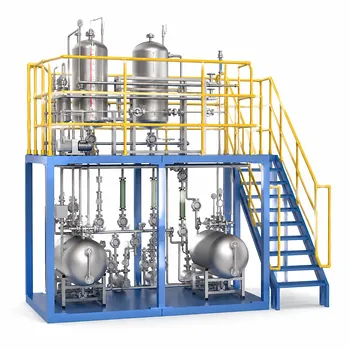
A hydrofining pilot plant is a uniquely integrated teaching and research tool that directly demonstrates industrial chemical purification alongside environmental emission control. It serves chemical engineering education by providing hands-on training in high-pressure hydrogen handling, multiphase catalytic reaction engineering, and process control. Simultaneously, it addresses environmental needs by physically showing how sulfur and nitrogen impurities in fuel are converted into separable waste streams, preventing them from becoming the air pollutants SO₂ and NOₓ upon combustion.
The core challenge is bridging theoretical models with physical reality. A hydrofining pilot plant does this by operating at the intersection of industrial reactor design and environmental protection, allowing users to manipulate a high-pressure, gas-liquid-solid reaction to achieve a product specification while managing hazardous reactants and byproducts. It transforms the abstract goals of refinery upgrading and clean air into a tangible, data-driven experiment.
Bridging Theory and Industrial Reality in Chemical Engineering
A hydrofining pilot plant physically bridges the gap between textbook reaction kinetics and the complexities of an industrial-scale fixed-bed reactor.
Transforming Classroom Chemistry into Practical Catalysis
The primary reference confirms this unit directly demonstrates the removal of sulfur, nitrogen, and unsaturated olefins from petroleum fractions. Students move beyond writing reaction equations for hydrodesulfurization (HDS) and hydrodenitrogenation (HDN) to physically managing the process. They must load a reactor with cobalt-molybdenum or nickel-molybdenum catalyst, perform a leak test, and establish the high-pressure hydrogen flow—a stark contrast to a magnetic stirrer in a round-bottom flask.
Mastering Multiphase Reaction Engineering
This operation epitomizes a gas-liquid-solid reaction system, a cornerstone of chemical engineering education mentioned in the supplementary references on fluid dynamics and mass transfer. Students observe how hydrogen (gas) must dissolve and diffuse into a liquid hydrocarbon before reacting on a solid catalyst pore. Changing the gas flow rate or reactor pressure makes the impact of mass transfer limitations on the apparent reaction rate immediately visible and experimentally measurable.
Validating Models with Real-World Data
Pilot plants generate physical performance data, which the supplementary references highlight as essential to identifying the discrepancies that pure simulations miss. In a hydrofining unit, a student can compare the calculated Gibbs free energy for a desulfurization reaction with the actual, measured product sulfur concentration. The difference teaches a profound lesson about catalyst deactivation, heat loss, and fluid channeling—factors no ideal mathematical model fully captures.
Addressing Environmental Treatment as an Operational Goal
The hydrofining pilot plant reframes environmental compliance from a regulatory requirement into a core unit operation that can be optimized.
Source Reduction of Primary Air Pollutants
The primary reference establishes that the unit directly demonstrates the reduction of downstream SO₂ and NOₓ emissions. By converting organic sulfur into hydrogen sulfide (H₂S) and nitrogen into ammonia (NH₃) inside the reactor, the pilot plant teaches the principle of source treatment over end-of-pipe scrubbing. The research goal becomes a measurable separation problem: how do you design the post-reactor separator to efficiently strip these generated gases from the liquid product?
Integrating Waste Stream Treatment and Recovery
As the supplementary reference on effluent recovery notes, environmental units investigate recovering valuable components. The H₂S-rich gas stream from a hydrofiner is not just waste; it’s the feed for an amine gas treating unit or a Claus process to make elemental sulfur. The pilot plant experiment thus extends beyond the reactor to study the full train of separation and recovery operations necessary for both profit and environmental compliance.
Applying Quality by Design to Environmental Parameters
Researchers can use this platform to apply the Quality by Design (QbD) principles detailed in the supplementary C&E risk assessment text. Variables like reactor temperature and hydrogen-to-oil ratio become experimental factors (X), while variations in catalyst batch activity are noise (N). This structured experimentation, using Design of Experiments (DoE), directly identifies the robust operating window needed to guarantee a treated product will meet a strict environmental sulfur specification like 10 ppm or lower.
Understanding the Trade-offs in a Single System
An objective assessment requires acknowledging the inherent conflicts this unit forces an operator to resolve, which is a critical educational outcome.
Product Quality versus Operating Cost
Increasing the reactor temperature accelerates the HDS reaction kinetics and improves sulfur removal. However, it also increases the hydrogen consumption and accelerates catalyst coking and deactivation. The pilot plant makes this economic-environmental trade-off a physical reality, forcing students to find the lowest-cost point that still achieves the target product purity.
Safety Rigor as an Educational Prerequisite
High-pressure hydrogen gas poses a significant deflagration and embrittlement risk. The supplementary reference on laboratory infrastructure is non-negotiable here; the need for gas detection, proper ventilation, and intrinsically safe electrical systems is paramount. The deep learning is that this high level of safety infrastructure is not an obstacle to research but a design specification for a viable industrial process.
The Gap Between Steady-State and Real Feedstocks
The pilot unit usually runs on a model feedstock for reproducibility. Real refinery feeds contain trace metals and larger asphaltenes that cause rapid, permanent catalyst poisoning. A key learning occurs when students compare their clean, steady-state results with the theoretical lifespan of an industrial catalyst, understanding that pilot data often represents a best-case scenario that must be carefully interpreted.
Making the Right Choice for Your Goal
Whether you are configuring an experiment or designing a curriculum, the hydrofining unit's value depends on how you frame its operation.
- If your primary focus is a chemical reaction engineering course: Use the unit to teach multiphase kinetics. Focus experiments on varying the liquid hourly space velocity and measuring the resulting reactor pressure drop and conversion, directly linking residence time to performance.
- If your primary focus is environmental process integration: Frame the H₂S-laden gas outlet as the core study point. Attach a downstream absorption column and optimize the entire two-unit system for maximum sulfur containment and recovery.
- If your primary focus is industrial plant simulation for vocational training: Base your experiments on the equipment utilization and capacity balancing principles from the supplementary references. Have students write standard operating procedures for startup, emergency shutdown, and catalyst regeneration cycles.
This single pilot unit fundamentally teaches that industrial chemical efficiency and environmental protection are not separate fields but outcomes of the same carefully controlled, high-pressure catalytic operation.
Summary Table:
| Focus Area | Chemical Engineering Learning | Environmental Treatment Learning |
|---|---|---|
| Core Principle | Multiphase catalytic reaction kinetics | Source reduction of SO₂ & NOₓ emissions |
| Practical Skills | High-pressure H₂ handling & reactor loading | Waste stream separation & H₂S/NH₃ recovery |
| Process Control | Validating steady-state simulation models | Applying Quality by Design (QbD) parameters |
| Key Trade-offs | Catalyst deactivation vs. reactor temp | Operating cost vs. target product purity |
Elevate Your Research and Training with LABPARK Pilot Plants
Are you looking to bridge the gap between classroom theory and industrial reality? LABPARK provides state-of-the-art Educational and Vocational Unit Operations Pilot Plants in chemical engineering, bioprocess & biotech, and environmental & water treatment.
Designed specifically for universities, research institutes, and enterprises, our pilot plants—including advanced hydrofining units—equip students and researchers with hands-on experience in high-pressure operations, multiphase reactions, and real-world emissions control. We deliver robust, safe, and highly parameter-adjustable systems that prepare the next generation of engineers for real-world industrial challenges.
Ready to upgrade your laboratory infrastructure? Contact LABPARK today to discuss your customized pilot plant configuration and request a quote!
Related Products
- Two-Dimensional Fluidization Hydrodynamics Educational Pilot Plant for Unit Operations Training
- 100L Continuous Loop Hydrogenation Educational Unit Operations Pilot Plant
- Crude Benzene Hydrogenation Educational Unit Operations Pilot Plant
- Electrolytic Hydrogen Production Educational Unit Operations Pilot Plant
- Dual-Mode Rectification Pilot Plant for Practical Training Unit Operations
People Also Ask
- What pressure drop characteristics should students & researchers monitor in a fluidization pilot plant?
- Why is minimum fluidization velocity (U_mf) critical? Optimize Your Pilot Plant Operations
- How is total skin friction drag calculated for laminar flat-plate flow? Blasius formula and valid Reynolds range
- How does active time pulsing mixing enhance fluid homogenization? Configuration Guide for Educational Pilot Plants
- How does Reynolds number characterize flow regimes and momentum transfer? Master pilot-plant analysis