Knowledge Chemical Engineering Education How to recover CH3I in pilot plants? Master closed-loop carbonylation.
Author avatar

Tech Team · LABPARK

Updated 1 month ago

How to recover CH3I in pilot plants? Master closed-loop carbonylation.


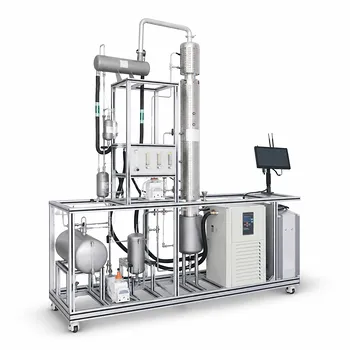
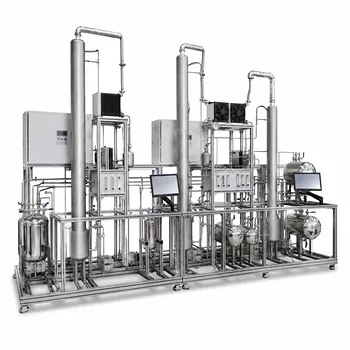
The heart of the demonstration is a closed-loop recovery circuit that integrates distillation, liquid-liquid separation, and gas absorption. A pilot plant simulates the post-reactor environment where a flash vapor stream—laden with volatile methyl iodide—is sequentially processed. First, a light-ends distillation column fractionates the condensable vapors, then a decanter separates an organic phase for direct recycle, and finally a series of absorption columns scrub the non-condensable gases with acetic acid to capture the final traces before venting.

The critical challenge in carbonylation is that methyl iodide’s volatility makes it prone to leaving the liquid reactor phase. The pilot plant demonstrates that an integrated separation scheme is not just a purification step—it is the mechanism that closes the economic loop, transforming a potential fugitive loss into a continuous internal recycle stream.

The Recovery Circuit: A Step-by-Step Journey

This section follows the methyl iodide molecule from the moment it leaves the reactor zone in a vapor stream until it is safely returned to the process.

From Reactor Flash to Distillation

The journey begins in the flash vessel, which operates at a lower pressure than the main reactor to induce vaporization. The resulting top vapor is a multi-component mixture containing the volatile co-catalyst, methyl acetate, and water.

This vapor is fed directly into a light-ends distillation column. This is the first major separation unit, designed to handle the components with the lowest boiling points. The column actively concentrates the methyl iodide into the top product stream.

The Decisive Liquid-Liquid Split

The rich vapor from the top of the distillation column is then condensed. This condensation creates an opportunity for a highly efficient physical separation based on density and polarity. The resulting liquid spontaneously forms two distinct layers in a decanter. A denser, methyl iodide-rich organic phase settles to the bottom.

Crucially, both the organic phase and the aqueous phase are valuable. They are both pumped back to the reactor, preserving the co-catalyst and the reaction medium. This dual recycle is a key operational insight the pilot plant makes tangible.

Scrubbing the Uncondensed Gases

Some process gases, like carbon monoxide (CO) and carbon dioxide (CO2), will not condense. Left unchecked, this vent stream could carry away a final, significant portion of methyl iodide. The pilot plant addresses this by channeling the gas stream through a sequence of high-pressure and low-pressure absorption columns.

This is where the gas absorption principle is demonstrated. Acetic acid, a process-native solvent, is used to wash the rising gas. The methyl iodide has a strong affinity for liquid acetic acid and transfers from the gas phase into the liquid solvent. This rich solvent is then also returned to the reactor, completing the cycle.

The Science Behind the Demonstration

Operating a pilot plant provides an invaluable, hands-on window into the core engineering principles that make the recovery possible.

Visualizing Phase Behavior and Equilibrium

The system is a live example of vapor-liquid and liquid-liquid equilibrium in action. In the distillation column, operators visually observe how temperature and pressure profiles dictate separation. In the decanter, they see how a multi-component mixture’s thermodynamics dictate miscibility, enabling the clean split during liquid-liquid separation.

Mastering an Integrated System

The true value of the pilot plant is not in the individual units, but in their integration. A disturbance in the flash vessel upstream immediately impacts the feed composition to the distillation column, which then changes the decanter’s level and the load on the absorption columns. This teaches dynamic process control in a way that isolated unit operations cannot.

Understanding the Trade-offs and Operational Pitfalls

No separation scheme is without its challenges. The demonstration also reveals where the process is most vulnerable.

The Complexity of Closed-Loop Recycling

While economically essential, total recycle introduces operational fragility. A stream imbalance, such as recycling an aqueous phase that is slightly too large, can slowly shift the reactor’s water concentration. This shift alters the reaction rate and, ironically, the amount of methyl iodide that flashes off in the first place, creating a slow-moving but hard-to-diagnose control loop.

Solvent Selectivity and Gas Purity

The acetic acid absorption step is effective, but it is not perfectly selective. The pilot plant can demonstrate how CO2 can also be absorbed, potentially returning unwanted compounds to the reactor. The choice to use acetic acid as the solvent is a deliberate trade-off: its compatibility with the process is its greatest strength, but its non-selectivity for one gas over another is a built-in limitation.

Extracting the Full Educational Value

A pilot plant is more than equipment; it's a training tool. The focus should be on extracting principles, not just operating procedures.

  • If your primary focus is operator training: Use the system to deliberately induce upsets—like a cooling water failure on the condenser—to teach diagnostic skills for phase-behavior problems.
  • If your primary focus is process design: Treat the pilot plant as a data-rich testbed to compare real-world separation efficiency against theoretical models for multi-component mixtures.
  • If your primary focus is troubleshooting plant losses: Map exactly where methyl iodide can accumulate or escape; the absorption column's vent is the primary measurement point for confirming total recovery efficiency.

The ultimate proof of the concept is a steady-state mass balance around the entire pilot plant, showing that the only significant outlet for methyl iodide is its purposeful conversion in the reactor—not a waste stream.

Summary Table:

Recovery Stage Equipment Used Process Mechanism Key Outcome
Separation Flash Vessel & Distillation Column Fractionation of condensable vapors Concentrates volatile CH3I in top stream
Phase Split Decanter Liquid-liquid density separation Yields organic & aqueous recycle phases
Scrubbing Absorption Columns Gas washing with acetic acid solvent Captures fugitive CH3I from vent gases

Bring Advanced Chemical Engineering to Your Lab

Are you looking to demonstrate complex closed-loop recovery and unit operations in your curriculum or research? LABPARK designs and manufactures premium Educational and Vocational Unit Operations Pilot Plants in chemical engineering, bioprocess & biotech, and environmental & water treatment.

We help universities, research institutes, and enterprises bridge the gap between theory and industrial reality with safe, high-fidelity systems.

  • Hands-on Training: Empower students and operators to master dynamic process control and phase equilibria.
  • Custom Engineering: Tailored pilot plant designs to meet your specific research or training objectives.
  • Reliable Quality & Support: Globally certified systems engineered for durability and safety.

Ready to elevate your engineering lab? Contact LABPARK today to discuss your pilot plant requirements with our specialists!

Related Products

People Also Ask

Related Products

Continuous Sieve-Plate Distillation Pilot Plant for Unit Operations Laboratory Education

Continuous Sieve-Plate Distillation Pilot Plant for Unit Operations Laboratory Education

Integrated pilot-scale teaching system for continuous sieve-plate distillation studies. Visual demonstration of tray hydraulics, flexible feed positions, and automatic reflux control for hands-on unit operations education in engineering labs. Designed for higher education engineering laboratories.

Multi-Functional Special Distillation Educational Pilot Plant

Multi-Functional Special Distillation Educational Pilot Plant

Versatile multi-functional special distillation pilot plant for chemical engineering education. Supports continuous, vacuum, azeotropic, reactive, extractive distillation. Transparent glass columns enable real-time visual observation of hydrodynamics and separation processes.

Electrolyte Distillation Purification and Formulation Educational Pilot Plant

Electrolyte Distillation Purification and Formulation Educational Pilot Plant

Integrated bench-to-pilot scale educational pilot plant for electrolyte distillation, purification, and formulation with borosilicate glass construction, PLC automation, touchscreen HMI, and advanced industrial safety features for hands-on chemical process training, ideal for chemical engineering and materials science curricula.

Multi-Modal Distillation Unit Operations Training Pilot Plant

Multi-Modal Distillation Unit Operations Training Pilot Plant

Multi-modal distillation pilot plant for practical unit operations training in chemical engineering education. Features real, analog, and semi-physical simulation modes, industrial construction, customizable for university labs. Hands-on fractionation columns, SCADA control, safety systems. Includes sight glasses, sampling ports, closed-loop recycling.

Continuous Batch Extractive Distillation Educational Pilot Plant

Continuous Batch Extractive Distillation Educational Pilot Plant

Versatile pilot plant for continuous, batch, and extractive distillation training. High-borosilicate glass column for visualizing hydraulics, 15.6-inch touchscreen with data logging, precise reflux ratio control 1-99, and durable corrosion-resistant frame. Ideal for chemical engineering education and process research.

Ethyl Acetate Synthesis Unit Operations Pilot Plant for Practical Training

Ethyl Acetate Synthesis Unit Operations Pilot Plant for Practical Training

Modular and customizable pilot plant for ethyl acetate synthesis practical training. Integrates esterification reaction, liquid-liquid extraction, neutralization, and sieve-plate distillation unit operations. Bridging theory and real-world industrial processes. Designed for university chemical engineering labs

Green Anhydrous Ethanol Purification Extractive Distillation Unit Operations Training Pilot Plant

Green Anhydrous Ethanol Purification Extractive Distillation Unit Operations Training Pilot Plant

Modular pilot plant produces high-purity anhydrous ethanol from crude ethanol via extractive distillation in a zero-emission closed-loop process providing hands-on training in unit operations with PLC-based control SCADA software and digitalized process management focusing on green engineering principles

Green Anhydrous Ethanol Refining Practical Training Pilot Plant

Green Anhydrous Ethanol Refining Practical Training Pilot Plant

Advanced integrated pilot plant for university labs demonstrating extractive distillation to produce high-purity absolute ethanol from crude feedstock, featuring multi-column continuous operation, closed-loop solvent recycling, and customizable controls for hands-on engineering education, ideal for chemical engineering training and research.

Absorption and Desorption Educational Unit Operations Pilot Plant

Absorption and Desorption Educational Unit Operations Pilot Plant

Dual packed column absorption and desorption pilot plant for chemical engineering education, offering real-time mass transfer coefficient measurement, durable mobile frame, industrial touch-screen interface, and customizable design for varied laboratory curricula, enabling hands-on study of gas absorption and stripping.

Carbon Dioxide Absorption and Desorption Educational Pilot Plant for Carbon Capture Studies

Carbon Dioxide Absorption and Desorption Educational Pilot Plant for Carbon Capture Studies

Explore carbon dioxide absorption and desorption with this educational pilot plant. Transparent columns visualize mass transfer; electric heating simulates industrial solvent regeneration; touchscreen interface enables data monitoring. Ideal for chemical engineering, bridging theory and practice.

Dual-Mode Gas Absorption and Desorption Unit Operations Training Pilot Plant

Dual-Mode Gas Absorption and Desorption Unit Operations Training Pilot Plant

Industrial-scale pilot plant for gas absorption and desorption training in chemical engineering. Features dual-mode operation with real and simulated materials, transparent columns for flow visualization, and customizable design. Supports independent or combined loops for hands-on unit operations experiments.

Multimodal Absorption and Desorption Pilot Plant for Unit Operations Training

Multimodal Absorption and Desorption Pilot Plant for Unit Operations Training

Multimodal absorption and desorption pilot plant for higher education labs. Bridges theory and industrial practice with transparent packed columns, three operational modes (real-material, simulated, semi-physical), and SCADA control. Students explore mass transfer, column hydraulics, and process control. Customizable.

Dual-Mode Rectification Pilot Plant for Practical Training Unit Operations

Dual-Mode Rectification Pilot Plant for Practical Training Unit Operations

Industrial-scale dual-mode rectification pilot plant for chemical engineering practical training. Features real-material and simulated-material operation modes, sieve-plate column with sight glasses for visual observation of hydrodynamics, and customizable SCADA control for safe, hands-on learning of unit operations and mass transfer.

Packed Bed Absorption Educational Unit Operations Pilot Plant

Packed Bed Absorption Educational Unit Operations Pilot Plant

Study gas-liquid absorption, pressure drop, flooding, and mass transfer coefficients with this pilot plant. Transparent packed column, industrial touchscreen, real-time sensor data, automated analysis. Investigate two-phase flow, loading points, column efficiency. Comprehensive data logging and assessment software included.

Bench Scale Carbon Dioxide Capture Educational Unit Operations Pilot Plant

Bench Scale Carbon Dioxide Capture Educational Unit Operations Pilot Plant

This bench-scale educational pilot plant simulates industrial CO₂ separation using a multi-tower adsorption system for hands-on engineering training. Students achieve ≥90% CO₂ purity while studying pressure swing adsorption, desorption kinetics, and process control in gas purification experiments.

Multi Functional Membrane Crystallization Educational Unit Operations Pilot Plant

Multi Functional Membrane Crystallization Educational Unit Operations Pilot Plant

Integrated bench-scale membrane crystallization pilot plant for engineering education. Provides hands-on training in advanced separation technologies, combining membrane distillation crystallization and process intensification. Features variable scaling vessels, industrial-grade flow control, and interactive digital data acquisition. Customizable for university labs.

Natural Product Extraction Unit Operations Training Pilot Plant

Natural Product Extraction Unit Operations Training Pilot Plant

Integrated natural product extraction pilot plant for chemical engineering training bridges theory and industrial practice with modular extraction and evaporation/concentration units, hybrid touchscreen and manual control, realistic process simulation, and self-contained softened water and vacuum utilities.

Comprehensive Liquid-Liquid Extraction Pilot Plant for Engineering Education

Comprehensive Liquid-Liquid Extraction Pilot Plant for Engineering Education

Comprehensive liquid-liquid extraction pilot plant for engineering education, integrating rotary and vibratory columns for hands-on observation of phase behavior, flooding limits, and mass transfer efficiency, enabling precise HTU and mass transfer coefficient calculations.

Bench Scale Dual Column Gas Separation and Capture Educational Pilot Plant

Bench Scale Dual Column Gas Separation and Capture Educational Pilot Plant

This dual-column educational pilot plant provides hands-on teaching of gas adsorption, separation, and capture processes. It features stainless steel columns, regeneration up to 400°C, and a 15.6-inch touchscreen PLC for TSA and PSA studies in chemical engineering curricula, process simulation.

Thermal Desorption Exhaust Gas and Tail Water Treatment Educational Pilot Plant

Thermal Desorption Exhaust Gas and Tail Water Treatment Educational Pilot Plant

Bench-scale educational pilot plant for treating thermal desorption exhaust gas and tail water integrates condensation, Fenton oxidation, precipitation, filtration, and carbon adsorption. Ideal for chemical engineering and environmental labs, teaching unit operations, process control, and real-time data analysis.


Leave Your Message