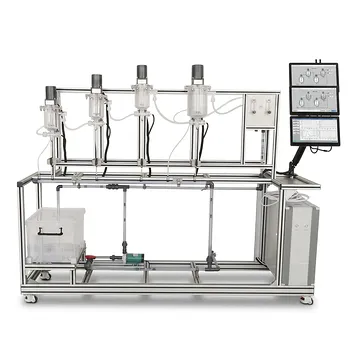
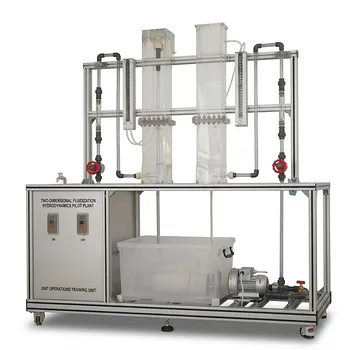
By inverting the pressure drop problem into a flow distribution solution. A cross-flow packed-bed microreactor effectively eliminates the excessive pressure drop of traditional tubular reactors by using a wide, shallow catalyst bed divided into numerous short parallel paths. Instead of forcing gas through a single long column of catalyst, it distributes flow through an array of shallow inlet and outlet channels that create a dominant hydraulic resistance upstream and downstream of the bed. This ensures that the pressure drop across the catalyst itself is negligible and that every particle sees the same flow, temperature, and pressure—turning a former handicap into the reactor’s greatest strength.
The true genius of the cross-flow design is its ability to decouple reaction length from pressure drop. A traditional tube piles up pressure drop with every millimeter of catalyst depth; this reactor adds only a tiny, constant pressure penalty across the short bed depth, while the dedicated distribution channels guarantee uniform residence time without the need for perfect packing.
The Pressure Drop Paradox in Heterogeneous Catalysis Testing
The Traditional Tubular Reactor’s Achilles' Heel
In a conventional packed-bed tubular reactor, a high flow rate combined with small catalyst particles (often required to avoid mass transfer limitations) creates a severe pressure drop. This pressure drop scales directly with bed length, so even a modestly deep bed can demand impractically high inlet pressures.
For kinetic measurements, you want to operate with small particles to ensure the intrinsic reaction rate dominates. But smaller particles exponentially increase resistance to flow. This forces the operator into a frustrating trade-off: either accept a large pressure drop that distorts kinetics, or switch to larger particles that introduce unwanted mass transfer artifacts.
Why High Pressure Drop Corrupts Kinetic Data
A high pressure gradient along the reactor axis means the reactant partial pressures change not just from conversion, but from friction. Your equation of state becomes non-ideal, your measured rate constants get smeared, and the catalyst bed experiences a varying gas density that complicates heat management.
Even worse, a significant pressure drop can lead to flow maldistribution if the packing is not perfectly uniform. Tiny variations in bed density create low-resistance paths, channeling, and hotspots. The clean kinetic data you set out to collect becomes clouded by physical artifacts—the opposite of what a process engineering lab needs.
How the Cross-Flow Packed-Bed Microreactor Redefines the Game
Decoupling Flow Distribution from Reaction Length
The cross-flow design separates two roles that a traditional tube forces together: fluid distribution and the catalytic reaction zone. It does this by integrating many short parallel beds into a single continuous, wide packed bed.
Each miniature pathway through the catalyst is only a few particle diameters deep. The overall bed depth is kept extremely shallow, so the intrinsic catalyst-bed pressure drop is trivially small—regardless of particle size or flow rate. There is no need to compromise on catalyst form factor to control pressure; you can use the ideal small particles for kinetics without penalty.
The Shallow Channel Strategy: Pressure Drop as a Design Tool
The real engineering masterstroke is the network of numerous shallow inlet and outlet channels. These channels are deliberately designed to have a pressure drop much larger than the pressure drop through the catalyst bed itself.
This creates a dominant hydraulic resistance at the distribution level. Even if the catalyst packing is locally uneven, the differential pressure across each short bed segment is overwhelmed by the fixed resistance in the feeding channels. Flow is forced to distribute evenly, with a uniform residence time across the entire catalyst area. The design doesn’t try to eliminate packing density variations—it makes them irrelevant.
Achieving Isothermal and Isobaric Conditions
Because the overall pressure drop is negligible and the bed is shallow, the reactor operates essentially at a constant pressure. This near-isobaric condition, combined with the thin bed’s excellent heat transfer characteristics, keeps the bed very nearly isothermal.
For a kinetics researcher, this is transformative. You can confidently treat measured reaction rates as data gathered at a well-defined reference pressure and temperature. There is no hidden axial profile to deconvolve from your data, making the cross-flow microreactor an ideal configuration for extracting intrinsic kinetics.
Understanding the Trade-offs
Potential Challenges in Fabrication and Scale-up
The cross-flow design requires precise micro-machining of the inlet/outlet channels to ensure the dominant pressure drop remains consistent. Any blockage or imperfection in a single distribution channel can disrupt flow to an entire bed section. While robust in a laboratory microreactor, translating this same uniform distribution to a larger production-scale unit often demands a rethinking of the channel architecture, increasing complexity and cost.
Sensitivity to Channel Design and Packing Uniformity
Although the system forgives minor packing inconsistencies, the ratio of channel pressure drop to bed pressure drop must be meticulously maintained. If the channel resistance is designed too low, you lose the equalizing benefit. If it’s too high, you burn excessive pump energy. Getting this balance right relies on a thorough CFD-informed design, and any change to catalyst particle size or gas flow rate may necessitate a re-optimization of the distributor geometry.
Making the Right Choice for Your Kinetic Studies
Your decision should be guided by what kind of data you need most urgently. Below are goal-oriented recommendations for applying the cross-flow concept.
- If your primary focus is obtaining intrinsic kinetic parameters without pressure corrections: Choose a cross-flow microreactor with a very shallow bed and well-characterized distribution channels. It will give you the flat pressure–temperature profile your kinetic model assumes.
- If your primary focus is screening catalysts at high space velocities with small particles: This design eliminates the pressure drop penalty of small particles, enabling true high-flow screening without mechanical limits. Focus on the ratio of channel-to-bed pressure drop to keep any maldistribution below 2%.
- If your primary focus is scaling a lab-proven catalyst to a pilot plant: Use the cross-flow data as a baseline, but anticipate that commercial tubular reactors will introduce pressure drop again. Plan for a separate scale-up study that adds back the axial gradients you successfully avoided in the lab.
- If your primary focus is minimizing experimental uncertainty from temperature and pressure gradients: The cross-flow microreactor’s inherent isothermal and isobaric nature makes it superior to a traditional tube. Invest in a design that includes multiple thermocouples to verify the uniform profile and protect your conclusions.
The cross-flow packed-bed microreactor doesn’t just reduce pressure drop—it reframes it as an engineering lever that guarantees uniformity, turning a stubborn limitation into a precise kinetic characterization tool.
Summary Table:
| Feature | Traditional Tubular Reactor | Cross-Flow Microreactor |
|---|---|---|
| Pressure Drop | High; scales with bed length | Negligible; decoupled from bed length |
| Flow Distribution | Prone to channeling & hotspots | Uniform; controlled by design channels |
| Kinetic Data | Distorted by pressure gradients | High accuracy; isobaric & isothermal |
| Particle Size | Constrained by flow resistance | Allows optimal small particles |
Optimize Your Chemical Engineering & Catalysis Research
Are you looking to eliminate experimental bottlenecks and scale your processes efficiently? LABPARK provides state-of-the-art Educational and Vocational Unit Operations Pilot Plants in chemical engineering, bioprocess & biotech, and environmental & water treatment.
Designed specifically for universities, research institutes, and enterprises, our pilot plants ensure accurate kinetics, seamless scale-up, and hands-on learning.
Contact LABPARK today to discuss your laboratory and pilot plant requirements!
Related Products
- Micro-Scale Gas-Solid Catalytic Reaction Educational Pilot Plant
- High-Gravity Emulsification and Mass Transfer Educational Pilot Plant
- Packed Bed Absorption Educational Unit Operations Pilot Plant
- Multi-Reactor Educational Pilot Plant for Reaction Engineering Unit Operations
- Gas Phase Mixing and Residence Time Distribution Determination Educational Unit Operations Pilot Plant
People Also Ask
- Fluidized vs. Fixed Bed Reactors: Comparing Heat & Complexity in Pilot Plants
- Why is a multibed configuration necessary for exothermic reactions? Optimize your pilot plant trajectory.
- Why is thermal management a major challenge in methane oxidative coupling? Reactor Solutions for Pilot Plants
- How does the Mears criterion evaluate transport resistance? Key Guide to Intrinsic Kinetics
- How do reactor pilot plants safely study gas-solid reactions? Master kinetics with thermal & flow control.