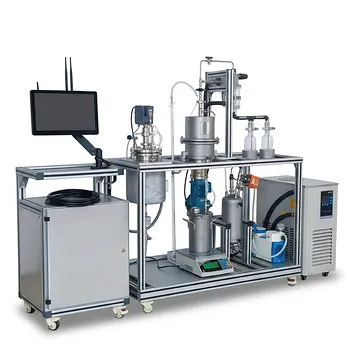
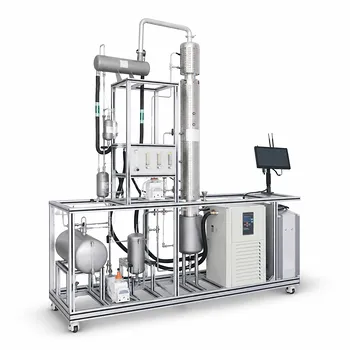
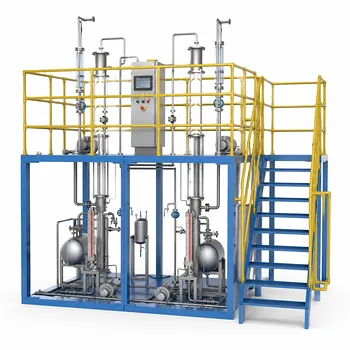
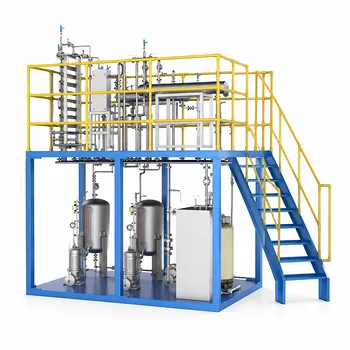
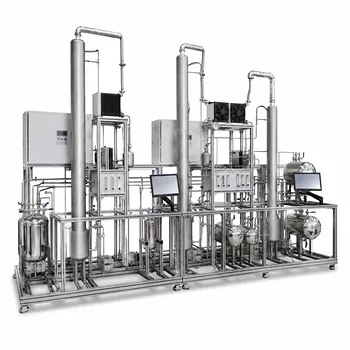
The pilot plant makes the difference starkly visible by turning abstract mass balances into measurable data. It lets you physically sample liquid streams from each stage. In a multi-stage cross-current setup, you’ll observe a rapidly decreasing extract concentration in each subsequent stage, along with a massive total volume of combined extract. In a multi-stage counter-current setup, you’ll see the extract phase become progressively richer as it moves toward the solids inlet, while the final raffinate–contacted by pure solvent–has almost no solute left. This hands-on sampling directly proves that counter-current operation achieves a higher overall recovery and a more concentrated final extract while using a fraction of the fresh solvent.
The fundamental demonstration is a trade-off in driving force versus final product quality. Cross-current leaching uses brute force with fresh solvent everywhere, generating huge volumes of dilute liquid. Counter-current leaching elegantly balances the driving force, using nearly saturated solvent to wash fresh solids and pure solvent to strip the depleted solids, maximizing concentration and minimizing waste in one integrated process.
Visualizing the Flow: What the Pilot Plant Shows
The Cross-Current Demonstration: Dilution is the Cost
In a pilot plant configured for cross-current mode, the solids move in one direction, but every single stage receives a stream of fresh, pure solvent. The effect is immediate: the mass transfer driving force stays high in every stage because the concentration gradient is always maximized. You can measure this at the pilot plant’s sampling ports. The extract from the first stage will be rich, but the extract from the second stage will be much weaker, and the third even more so. You learn that the final combined extract is a large volume of a highly diluted product. While the final solid raffinate is very clean, the downstream cost to concentrate this massive, weak liquid stream is the obvious, visible penalty.
The Counter-Current Demonstration: Efficiency Through a Gradient
The same pilot plant can be reconfigured so solids and solvent travel in opposite directions. Here, fresh, pure solvent is only fed into the final stage, where it contacts already-leached, nearly-depleted solids. This strips out the last traces of solute. As this now slightly concentrated solvent moves to the previous stages, it contacts solids with progressively higher solute content. You can take samples and see the extract concentration profile grow. The richest extract leaves from the first stage, where the freshest solids enter. This directly demonstrates the process’s core advantage: maximizing the final extract concentration while minimizing the total solvent volume required to achieve a given recovery.
Why the Profiles Differ: The Principle of Driving Force
The Solute Concentration Profile is the Key Data
The pilot plant’s true educational power is its ability to generate a stage-by-stage concentration profile. For cross-current, the solute concentration in the extract phase drops in a stepwise manner at every single stage, as pure solvent constantly resets the driving force for mass transfer. For counter-current, the solute concentration in the extract phase drops gradually along the entire cascade. This visual, numerical data lets you perform a mass balance to calculate the average mass transfer driving force. Counter-current operation maintains a more uniform, and on average higher, driving force across all stages, which is the thermodynamic reason for its superior efficiency.
From Data to Design: Plotting the Operating Line
Using the measured solute concentrations from both the liquid extract and the solid underflow, you can plot the operating line on a phase diagram. The pilot plant experiment transforms a graphical design method from a textbook theory into a physical reality. The data from a counter-current run will produce an operating line that demonstrates how the process squeezes the maximum extraction potential from the solvent. This is done by always contacting a partially concentrated solvent with an even more solute-rich solid, avoiding the thermodynamic pinch points that waste solvent capacity.
Understanding the Trade-offs and Practical Limits
Capital Complexity vs. Operating Cost
Cross-current is simple to build but expensive to run, as the pilot plant makes clear through the sheer volume of solvent you handle and the energy required for its recovery. Counter-current is more complex to stage and control. On a pilot scale, you see the operational challenge of maintaining counter-current solid-liquid flow without channeling or flooding. The key trade-off is that counter-current dramatically reduces operating expenses (solvent and energy) but requires a higher initial capital investment and greater operational know-how.
The Impact of Stage Efficiency
No real stage in a pilot plant is ideal. You can measure the actual stage efficiency by comparing the concentration change achieved in one real stage against the theoretical change from the phase diagram. The pilot plant reveals that counter-current cascades can be more sensitive to individual stage inefficiencies. A low-efficiency stage in a cross-current bank simply does less work, but in a counter-current cascade, it disrupts the concentration gradient for the entire train, a critical lesson for scale-up that mass balance calculations alone cannot teach.
Recovery vs. Concentration
The pilot plant also clarifies a key economic trade-off. Cross-current extraction can approach complete solute recovery if you add enough stages and fresh solvent, but it will always produce a diluted extract. Counter-current extraction balances recovery and concentration. By measuring the final raffinate, you learn that an optimally designed counter-current train can achieve an identical high recovery to a cross-current train with significantly more stages, but produce a final extract that is orders of magnitude more concentrated.
Making the Right Choice for Your Process Goal
The pilot plant teaches you which configuration to select based on your specific separation objective.
- If your primary focus is maximum solute recovery with no constraint on solvent cost: A multi-stage cross-current cascade with fresh solvent injection at every stage will strip the solid nearly completely, as the pilot plant's near-zero final raffinate concentration will prove.
- If your primary focus is producing a high-concentration extract to minimize downstream evaporation costs: Multi-stage counter-current extraction is the clear, demonstrable winner on the pilot plant, producing a rich extract from the first stage while using minimal fresh solvent.
- If your primary focus is processing solids that degrade with recirculation or long residence times: The cross-current pilot plant setup shows how short, discrete contacts can be beneficial, even though the solvent volume is high, because it avoids the concentrated, long-duration exposure found in a counter-current train.
The pilot plant doesn’t just show you two processes; it quantifies the elegant balance between the thermodynamics of mass transfer and the practical economics of solvent recovery.
Summary Table:
| Feature | Multi-Stage Cross-Current Leaching | Multi-Stage Counter-Current Leaching |
|---|---|---|
| Solvent Feed | Fresh solvent added at every stage | Fresh solvent added only at the final stage |
| Solvent Consumption | High (large total volume of dilute extract) | Low (minimized total solvent volume) |
| Extract Concentration | Low (highly diluted final product) | High (rich extract collected from first stage) |
| Driving Force | Maximized per stage, drops step-wise | Gradually declines, maintaining optimal gradient |
| Capital & OpEx | Simple design, high operating costs | Complex design, low operating costs |
Bring Theoretical Chemical Engineering to Life
Are you looking to bridge the gap between textbook mass transfer equations and physical pilot-scale operations? LABPARK provides premium Educational and Vocational Unit Operations Pilot Plants designed for universities, research institutes, and enterprises. Our systems in chemical engineering, bioprocess & biotech, and environmental & water treatment empower students and researchers to visualize complex processes like leaching, extraction, and distillation firsthand.
Ready to elevate your training and research capabilities? Contact us today to find the perfect pilot plant for your laboratory!
Related Products
- Multi Pump Fluid Transport Process Piping Unit Operations Training Pilot Plant
- Supercritical High-Gravity Flash Evaporation Educational Unit Operations Pilot Plant
- Dual-Mode Rectification Pilot Plant for Practical Training Unit Operations
- Natural Product Extraction Unit Operations Training Pilot Plant
- Rising and Falling Film Evaporation Educational Unit Operations Pilot Plant
People Also Ask
- Why distinguish Newtonian & non-Newtonian fluids in pilot plants? Prevent design errors.
- Why is the chemical plant startup schedule crucial? De-risk scale-up with pilot plants.
- When to transition from PID to adaptive control in pilot plants? Key process indicators.
- How to study gasification in pilot plants? Compare exit gas composition & efficiency
- How do deviations in estimating latent heat impact pilot plant thermal systems? Avoid hardware mis-sizing.