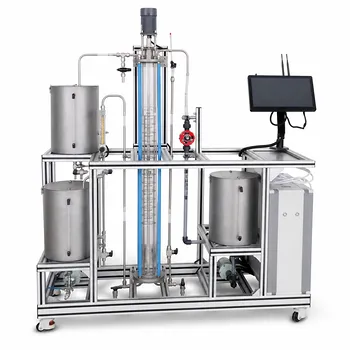
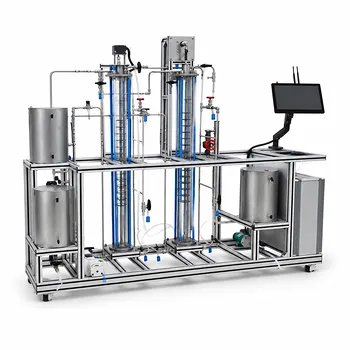
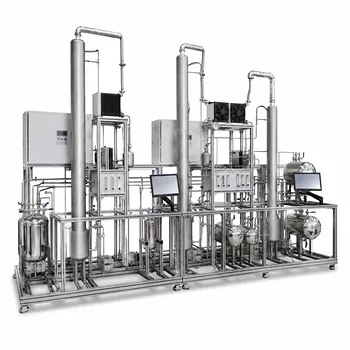
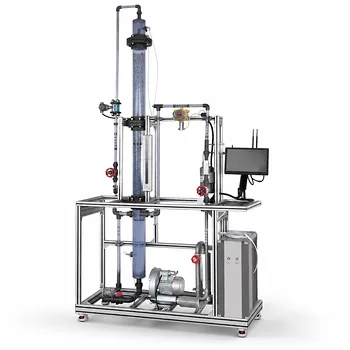
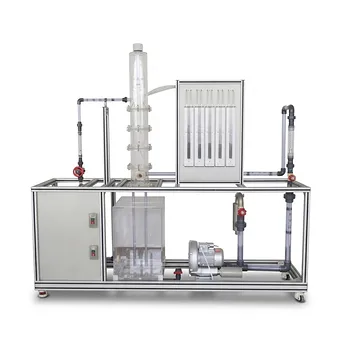
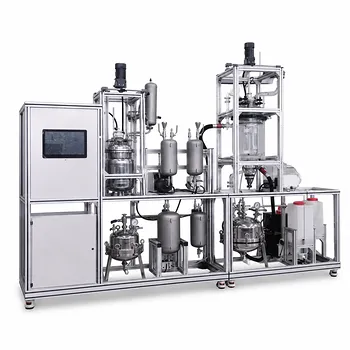
When configured to separate compounds with mere 4°C boiling point differences, an extractive distillation pilot plant introduces a high-boiling solvent—typically water—that selectively interacts with one component to dramatically widen the relative volatility gap. In the case of acrylonitrile (77.3°C) and acetonitrile (81.6°C), water fed near the top of the column carries the more soluble acetonitrile downward while purified acrylonitrile exits overhead. The process pairs an extractive column with a solvent recovery column to continuously recycle the solvent, making the entire separation teachable, scalable, and energy-aware.
The core of the configuration is a two-column loop: an extractive distillation column where the solvent alters volatility to separate the close-boiling pair, and a recovery column that reclaims the solvent for reuse. Control of the solvent-to-feed ratio and strategic feed placement turn an impossible fractional separation into a clean, reproducible demonstration of multi-component distillation principles.
Configuring the Two-Column Pilot Plant
The Extractive Distillation Column: Where Separation Happens
The pilot plant uses a main column equipped with either trays or structured packing. The acetonitrile-acrylonitrile mixture enters partway up, while the solvent (water) enters at a feed point above the mixture but below the condenser.
This countercurrent contact allows the descending liquid solvent to preferentially absorb acetonitrile. The solvent forms stronger interactions with acetonitrile, effectively pulling it away from the vapor phase.
The more volatile acrylonitrile, now freed from its close-boiling companion, rises to the top and is drawn off as the overhead product. The solvent-acetonitrile mixture exits the bottom of the column.
The Solvent Recovery Column: Closing the Loop
The bottom stream from the extractive column flows directly into a second, smaller column. Here, the large boiling point difference between water (100°C) and acetonitrile (81.6°C) makes separation straightforward.
Acetonitrile is distilled overhead as the recovered second product, while the hot, essentially pure water is removed from the bottom. The reclaimed water is then cooled and pumped back to the feed point of the first column, completing the solvent cycle.
This two-column arrangement ensures the process runs continuously with minimal solvent makeup, exactly as industrial units do. Educational pilot plants highlight the mass and energy balance across both columns.
Solvent Selection and Interaction Principles
Why Water Works for Acrylonitrile-Acetonitrile
Water is the solvent of choice because it is safe, inexpensive, and dramatically alters the system’s vapor-liquid equilibrium. It forms strong hydrogen bonds with the cyano group of acetonitrile, drastically reducing that component’s volatility.
Meanwhile, acrylonitrile is far less soluble in water, so its volatility remains nearly unchanged. This selective solubility difference can be engineered by analogy: select solvents that are homologically similar to the component you wish to keep in the liquid phase.
In pilot plant teaching, students can test alternative solvents (e.g., higher-boiling cyano compounds) to observe how molecular structure governs selectivity, following the principle that a solvent from the same homologous series as the heavy key often gives an ideal or negative-deviation solution.
Critical Operating Parameters
The Solvent-to-Feed Ratio as the Master Switch
The water-to-acrylonitrile mass ratio is typically maintained between 8:1 and 10:1. Too little solvent, and the separation collapses; too much, and energy costs soar while flooding risks rise.
This ratio directly sets the liquid flow down the column and the corresponding mass transfer driving force. Pilot plant data tables log this ratio alongside product purity to train operators on the “sweet spot” balancing yield and utility consumption.
Feed Point Locations and Temperature Control
Preheating the feed and injecting the solvent slightly subcooled improve the concentration gradients across the trays or packing. The solvent must not flash upon entry—it must remain liquid to cascade down and do its job.
Thermocouples placed at multiple column heights reveal the temperature profile that makes this separation legible: a sharp inflection near the solvent feed point confirms the volatility shift is active.
Understanding the Trade-Offs
Energy Consumption vs. Purity Demands
Extractive distillation is inherently more energy-intensive than simple distillation because a large mass of solvent must be heated and cooled repeatedly. The recovery column adds further reboiler duty.
Pilot plants quantifying the total steam and cooling water consumption show that pursuing ultra-high purity beyond 99.5% can cause a disproportionate energy spike. This trade-off is a core teaching point about process optimization.
Continuous vs. Batch Applicability
This water-based extractive distillation method is ideally suited for continuous operation. It allows thermal separation at moderate temperatures, protecting heat-sensitive acrylonitrile from polymerization.
However, it does not translate well to batch mode because the large solvent inventory would dominate the still and make sequential cut points unmanageable. For batch-capable separation of close-boilers, azeotropic distillation using a vaporizing entrainer is a more flexible, albeit more energy-hungry, alternative often featured in academic pilot plants.
Solvent Contamination and Purity Drift
Recycled water can accumulate trace impurities or acrylonitrile, altering the selectivity over time. Pilot plants must incorporate a small solvent bleed stream and makeup water feed to maintain steady-state purity. This demonstrates a real-world issue that small-scale distillation columns experience within hours of operation.
Making the Right Choice for Your Pilot-Plant Goal
The configuration of your extractive distillation pilot plant should directly mirror your educational or research objective. Consider the following guidance based on your primary focus.
- If your primary focus is demonstrating fundamental thermodynamics: Configure a simple two-column setup with water as the solvent and emphasize measurement of the solvent-to-feed ratio effect on relative volatility. Use glass columns to visualize phase behavior and temperature profiles.
- If your primary focus is optimizing energy and cost for close-boiling separations: Instrument both columns with flow meters and wattmeters to perform a net energy balance. Vary the reflux ratio and solvent preheating to map the energy-performance Pareto front.
- If your primary focus is comparing process alternatives (extractive vs. azeotropic): Integrate quick-change piping and dual feed points to switch between the water-based extractive mode and an entrainer-based azeotropic mode on the same hardware, enabling direct head-to-head comparison of batch flexibility against continuous efficiency.
- If your primary focus is scaling up to production: Operate the pilot plant over multiple continuous shifts with a solvent recycle loop that includes a small purification bleed. Collect data on column flooding, weeping, and product purity drift to generate scale-up criteria for industrial column sizing.
By treating the solvent as a dynamic design variable rather than a fixed recipe, a single pilot plant becomes a platform for exploring the full landscape of close-boiling separations.
Summary Table:
| System Component / Parameter | Optimal Configuration / Value | Key Function in Pilot Plant |
|---|---|---|
| Extractive Column | Trays/packing; feed mid-column, solvent upper column | Separates close-boiling components by altering relative volatility. |
| Recovery Column | Bottom stream feed from extractive column | Reclaims pure solvent (water) from the bottom and recycles it. |
| Solvent-to-Feed Ratio | 8:1 to 10:1 mass ratio (Water to Feed) | Balances separation efficiency against energy and flooding limits. |
| Ideal Solvent (Water) | Safe, inexpensive polar solvent | Forms strong hydrogen bonds with acetonitrile to reduce its volatility. |
Bring Industrial-Scale Distillation Principles to Your Lab
Teaching complex chemical separations requires robust, highly visual, and reliable equipment. LABPARK designs and delivers premium Educational and Vocational Unit Operations Pilot Plants for chemical engineering, bioprocess & biotech, and environmental & water treatment.
We empower universities, research institutes, and enterprises to bridge the gap between thermodynamic theory and industrial practice.
Ready to elevate your engineering curriculum or research capabilities? Contact the LABPARK team today to get a customized pilot plant proposal!
Related Products
- Continuous Batch Extractive Distillation Educational Pilot Plant
- Multi-Functional Special Distillation Educational Pilot Plant
- Educational Rotary Disc Liquid-Liquid Extraction Pilot Plant
- Comprehensive Liquid-Liquid Extraction Pilot Plant for Engineering Education
- Continuous Sieve-Plate Distillation Pilot Plant for Unit Operations Laboratory Education
People Also Ask
- Wilson vs. UNIQUAC: How to Choose the Right Thermodynamic Model for Your Pilot Plant
- Why use non-ideal VLE calculations in distillation pilot plants? Ensure accurate scale-up & purity
- How does the feed thermal state influence distillation pilot plant design and utility consumption?
- How to Configure a Distillation Pilot Plant? Key Steps for Multi-Mode Setup
- How to Integrate Spectroscopy in Distillation Pilot Plants for Advanced Process Control