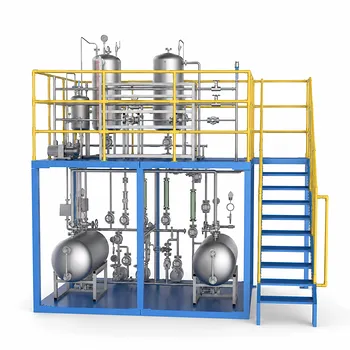
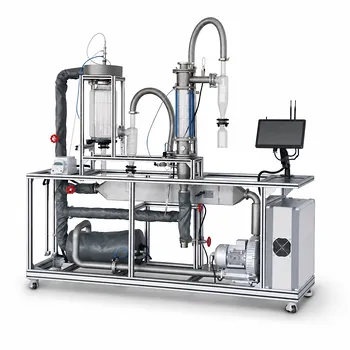
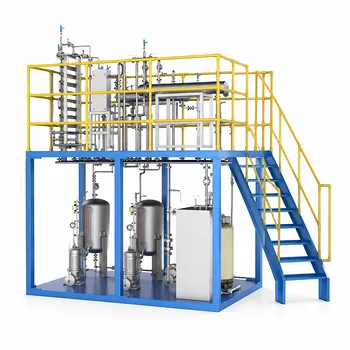
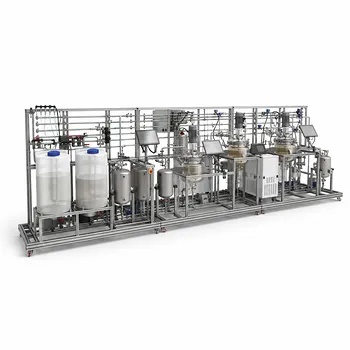
A bioprocess unit operations pilot plant serves as a critical bridge where students and researchers can physically measure and validate the complex scaling laws that govern agitator power consumption under aeration and continuous media sterilization. Instead of relying solely on mathematical models, users gather empirical data on gassed power draw and nutrient thermal degradation kinetics, giving them the concrete evidence needed to de-risk full-scale bioreactor scale-up.
The core value of a pilot plant is that it transforms abstract scaling equations into tangible performance data. For agitator design, it reveals precisely how aeration collapses power consumption and tests whether a chosen scaling criterion actually works. For sterilization, it exposes the delicate time-temperature balance required to kill contaminants without destroying the nutrients essential for cell growth—a compromise that purely theoretical studies cannot resolve.
Experimentally Verifying Agitator Power Scaling
The leap from a 10-liter bench-top fermenter to a 10,000-liter production vessel is fraught with non-linear behavior. A pilot plant typically operating in the 100L to 1,000L range makes these phenomena visible and measurable.
The Impact of Aeration on Power Draw
When gas is sparged into a bioreactor, it significantly reduces the liquid density around the impeller, causing a dramatic drop in power consumption. This gassed power ($P_g$) can be half or less of the non-aerated power ($P$).
In a pilot plant, students can directly monitor this power drop by varying the gas flow rate and agitator speed, then plotting the power reduction ratio ($P_g/P$) against the aeration number ($N_a$). This provides a hands-on lesson in why academic correlations — like the empirical relation $P_g = 0.157(P^2 n d^3 / Q_g^{0.56})^{0.45}$ — are essential for accurate motor sizing at scale.
Testing Scaling Criteria with Live Data
Theoretical scale-up often begins with a fixed criterion like constant power per unit volume (P/V). A pilot plant allows you to test whether this idea actually preserves mixing quality. Users can calculate the required impeller speed using the geometric scale factor ($s$):
$$N_{plant} = N_{lab} \cdot s^{-2/3}$$
But they can then measure the real oxygen transfer rate (kLa) and mixing time. The data often shows that a constant P/V strategy may lead to impractically high tip speeds or, conversely, that a constant tip speed approach ($N_{plant} = N_{lab} \cdot s^{-1}$) fails to suspend solids. This experimental feedback closes the loop between theory and manufacturability.
Empirical Correlations and Real-World Verification
Sophisticated pilot systems with integrated torque sensors let researchers capture the exact, live relationship between aeration, power, and vessel geometry. They can validate complex logarithmic predictions that incorporate impeller-to-tank diameter ratios, Reynolds numbers, and Froude numbers. This direct measurement of the gassed-to-ungassed power transition builds an intuition that textbook equations alone cannot provide, giving future engineers the diagnostic skill to spot an under-aerated or poorly mixed reactor.
Investigating Continuous Media Sterilization
Thermal sterilization in a pilot plant moves far beyond the batch autoclave. The ability to run a continuous sterilization process, holding media at precisely controlled temperatures like 120°C or 140°C, opens the door to critical degradation-kinetics research.
From Batch to Continuous Thermal Treatment
A pilot-scale continuous sterilizer subjects media to a precisely controlled time-and-temperature history, often using a hold tube. By adjusting the flow rate and steam injection, students can map the thermal death time of target microorganisms while simultaneously tracking the fate of heat-labile nutrients. The exercise reveals why a shift from a long batch hold at 121°C to a short continuous exposure at 140°C can drastically alter the final media quality.
The Nutrient Degradation Dilemma
The core challenge is that the same thermal energy that kills contaminants also destroys valuable growth factors. Researchers use the pilot plant to analyze the kinetics of thermal degradation for compounds like vitamin B1 (thiamine) and vitamin C, fitting data to first-order reaction models to calculate activation energies and pre-exponential factors.
By generating degradation curves at multiple temperatures, they can then apply optimization algorithms to find the sterilization time that maximizes cell viability while minimizing nutrient loss. This is an inherently empirical exercise, impossible to perform with confidence from lab-scale beaker tests alone when dealing with the fluid dynamics and heating profiles of real process equipment.
Understanding the Trade-offs
Scaling is not about finding a perfect formula; it is about making informed compromises. A pilot plant lays these trade-offs bare.
Mixing Intensity vs. Shear and Energy Costs
The drive to maintain a high P/V ratio ensures rapid mixing and oxygen transfer, but it can generate excessive impeller tip speeds, causing hydrodynamic shear that damages mammalian cells or filamentous organisms. Equally, high power input raises energy costs. A pilot plant experiment can show that while a constant P/V strategy gives excellent kLa, a slightly lower power input coupled with a refined impeller geometry achieves the same cell density with 20% less energy and far better cell viability.
Sterility Assurance vs. Nutrient Integrity
A sterilization cycle programmed for an extreme level of sterility (a very high Fo value) will almost certainly degrade a significant fraction of your growth medium. In a pilot plant, you can run side-by-side liquid chromatography analyses to quantify the resulting vitamin loss. The operational choice becomes stark: a 140°C short-time process may preserve nutrients but risks cold spots that fail to sterilize, while a conservative 120°C long-hold process ensures sterility but halves your thiamine concentration, crippling the subsequent fermentation.
Making the Right Choice for Your Research Goal
Your specific objective dictates how you should leverage a bioprocess pilot plant’s agitator and sterilization capabilities.
- If your primary focus is scaling up a shear-sensitive cell line: Use the pilot plant to map the exact tip speed and energy dissipation rate that triggers apoptosis. Base your scale-up on a constant tip speed or a modified P/V criterion that does not exceed that shear threshold.
- If your primary focus is fermenting a heat-sensitive, chemically defined medium: Dedicate pilot plant runs to mapping the Arrhenius degradation kinetics of the most fragile nutrient. Opt for a continuous, ultra-short sterilization cycle at a higher temperature and validate the sterility of the cold stream post-heat exchanger.
- If your primary focus is teaching fundamental scaling principles: Design experiments where students must scale a known lab process by two different criteria (e.g., constant P/V vs. constant mixing time), then have them measure gassed power, kLa, and cell yield. The lesson that "all scale-up criteria are wrong, but some are useful" will never be forgotten.
The pilot plant’s ultimate gift is the hard-earned experimental evidence that allows you to select the scale-up rule that is "least wrong" for your specific biological system and nutritional constraints.
Summary Table:
| Investigation Area | Key Scaling Challenge | Pilot Plant Empirical Output |
|---|---|---|
| Agitator Power | Aeration collapses power draw ($P_g$); constant P/V risks high tip speed / shear. | Measures $P_g/P$ vs. $N_a$; validates real $k_La$ & mixing times. |
| Media Sterilization | Thermal death of contaminants vs. nutrient thermal degradation. | Maps Arrhenius degradation kinetics; optimizes continuous sterilization time/temp. |
Bring Theory to Life with LABPARK Pilot Plants
Bridging the gap between lab-scale theory and industrial reality requires robust, reliable equipment. LABPARK provides premium Educational and Vocational Unit Operations Pilot Plants in chemical engineering, bioprocess & biotech, and environmental & water treatment for universities, research institutes, and enterprises.
Whether you are training the next generation of engineers or scaling up a critical bioprocess, our pilot plants deliver the precise data acquisition and control systems you need to de-risk your operations.
Ready to elevate your research and training capabilities? Contact LABPARK today to discuss your custom pilot plant requirements!
Related Products
- Bio-fermentation Ethanol Production Practical Training Unit Operations Pilot Plant
- Multimodal Absorption and Desorption Pilot Plant for Unit Operations Training
- Natural Product Extraction Unit Operations Training Pilot Plant
- Multi Pump Fluid Transport Process Piping Unit Operations Training Pilot Plant
- Multi-Functional Drying Educational Unit Operations Pilot Plant
People Also Ask
- Why Use PTFE & Hastelloy in Chemical Pilot Plants? Prevent Corrosion & Ensure Safety
- Why Compare Predicted and Experimental Excess Enthalpy? Key to Accurate Pilot Plant Scale-up
- Why is the chemical plant startup schedule crucial? De-risk scale-up with pilot plants.
- When to transition from PID to adaptive control in pilot plants? Key process indicators.
- Why must batch and fed-batch fermentation pilot plants be designed to accommodate changing rheological conditions?