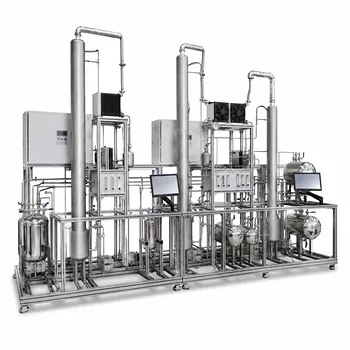
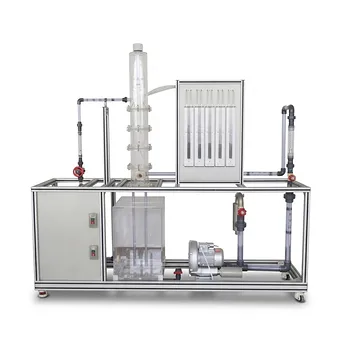
Weeping and entrainment are two hydrodynamic imbalances that directly sabotage separation performance in a pilot-scale distillation column. Weeping leaks liquid through the tray perforations when vapor velocity is too low, bypassing the intended contacting zone and reducing plate efficiency. Entrainment occurs when rising vapor carries liquid droplets to the tray above, causing backmixing that degrades the composition gradient. Both are controlled by maintaining vapor velocity inside a narrow, safe operating window—above the weep point to prevent significant weeping and below the entrainment limit to avoid excessive droplet carryover—while using adequate tray spacing and stable auxiliary systems.
The pilot plant operator’s core challenge is not simply to avoid weeping or flooding, but to navigate the hydrodynamic sweet spot between them. Weeping at low vapor loads and entrainment at high vapor loads both destroy mass transfer efficiency; effective control means continuously balancing the column’s gas and liquid rates to stay within a stable, measurable region where wet plate efficiency is maximized.
The Nature of Weeping and Entrainment
What Is Weeping and Why It Matters
Weeping happens when the vapor velocity is too low to support the liquid on a tray. Instead of flowing across the tray and down the downcomer, a portion of the liquid leaks directly through the perforations onto the plate below.
This bypassed liquid has not been properly contacted by the vapor, so it fails to achieve the expected compositional change. The result is a sharp drop in wet plate efficiency ((E_a)) and, in severe cases, the column can no longer develop a stable temperature and concentration profile.
How Entrainment Disrupts the Separation Cascade
Entrainment is the carryover of liquid droplets by the rising vapor from one tray to the tray above. These droplets contain liquid richer in the less volatile component, which is essentially backmixing into a region that should be leaner in that component.
The backmixed liquid shifts the local vapor–liquid equilibrium and effectively cancels out some of the separation achieved by the lower trays. This reduces the overall separation power of the column and can make it impossible to meet product purity targets.
The Efficiency Penalty: Backmixing and Wet Plate Performance
Both weeping and entrainment cause liquid back‑mixing. Weeping allows liquid to bypass the contact zone entirely, while entrainment reintroduces the wrong composition into an upper tray. In either case, the actual plate efficiency falls far below the theoretical value.
Pilot plant data show that even a small amount of entrainment—on the order of 0.05–0.1 kg liquid/kg gas—can cause a measurable efficiency loss. Similarly, weeping exceeding roughly 10 % of the tray’s liquid load signals that the vapor rate has dropped below the safe weep point.
Detecting Weeping and Entrainment in a Pilot Plant
Visual Cues and Pressure Signatures of Weeping
In transparent pilot columns, weeping is often visible as a rain‑like fall of liquid through the tray holes when vapor rates are low. Even without sight glasses, operators can detect weeping by a sustained drop in the temperature gradient or an inability to reach the desired top‑product purity.
A more systematic approach is to monitor differential pressure ((\Delta P)) across the tray. When weeping begins, the measured (\Delta P) falls below the value predicted for normal froth‑regime operation, because the liquid head on the tray is reduced.
Tracking Entrainment Through Purity and ΔP Spikes
Entrainment typically announces itself as a sudden decline in overhead purity or a flattening of the composition profile. The column’s pressure drop may also spike upward as froth heights grow and liquid holdup increases on each tray.
During educational runs, students can deliberately increase the vapor rate step‑wise and observe the point where the entrainment limit is exceeded. At that moment, the calculated Murphree efficiency from mass balances begins to drop, and the column’s overhead composition shifts toward the bottoms component.
Proven Strategies to Control Weeping and Entrainment
Operating Above the Weep Point: Minimum Vapor Velocity
The most direct cure for weeping is to increase the vapor velocity through the column. This is accomplished by raising the reboiler heat input or lowering the column pressure. The target is to keep the F‑factor or the vapor hole velocity above the empirically determined weep point of the tray, ensuring that weeping stays below about 10 % of the total liquid flow.
In a pilot plant, this often means implementing a stable reboiler duty control loop so that fluctuations in steam supply or heating medium do not periodically push the column into the weeping zone.
Operating Below the Entrainment Limit: Managing Gas and Liquid Loads
To prevent entrainment, the vapor velocity must stay below the entrainment flooding limit. The classic design rule is to limit the liquid entrainment rate to less than 0.1 kg liquid per kg of vapor. If entrainment is detected, the first response is to reduce the vapor rate by lowering the boil‑up, or to reduce the liquid load if the column is approaching its hydraulic limits.
Because pilot columns often operate with wide variations in feed flow rate and composition, incorporating upstream level controllers or a feed preheater with temperature control prevents sudden slugs of liquid or temperature changes that could temporarily push the vapor rate into the entrainment regime.
Optimizing Tray Spacing and Internal Design
When the operating window between weeping and entrainment is too narrow, the physical design of the trays becomes decisive. Increasing tray spacing provides more disengagement height, allowing droplets to settle before reaching the plate above and thus tolerating higher vapor velocities before entrainment onset.
Choosing a tray type with a larger active area or using sieve trays with optimized hole size can also shift the weep point to lower vapor rates. Pilot plants used for instruction often demonstrate how changing tray spacing directly widens the stable operating region.
The Operating Window: Balancing Weeping, Entrainment, and Flooding
The Trade‑Off Between Low and High Vapor Rates
There is an inherent tension: you must keep the vapor velocity high enough to avoid weeping but low enough to avoid entrainment and flooding. Operating near the weep point makes the column fragile—a small disturbance can send it into weeping. Operating near the entrainment limit risks triggering downcomer flooding if the liquid load is also high.
The art of pilot‑plant operation is finding the narrow band where wet plate efficiency is maximized without crossing either boundary. This band is often mapped during commissioning runs by recording efficiency versus vapor rate and is represented as the column’s performance diagram.
Common Pitfalls in Pilot Plant Experiments
A frequent mistake is to assume that a single setpoint will work for all feed conditions. A change in feed composition or temperature can shift the bubble‑point/dew‑point envelope and alter the internal gas and liquid ratios, effectively moving the column into weeping or entrainment without any manual adjustment.
Another pitfall is ignoring the holdup time and dynamics. Sudden increases in reboiler duty can cause temporary entrainment before the column stabilizes, leading students to misinterpret a transient as a steady‑state efficiency problem.
Making the Right Choice for Your Pilot Plant Operation
Whether the aim is education or process development, the control strategy should align with the primary goal of the run. The following recommendations help you translate the principles into practice.
- If your primary focus is educational demonstration: Deliberately navigate from weeping to entrainment flooding by adjusting the vapor rate while recording efficiency, pressure drop, and purity. This teaches the hydrodynamic boundaries and reinforces the concept of the column performance diagram.
- If your primary focus is maximizing separation efficiency: Find the steady‑state point where weeping is less than 10 % and entrainment is below 0.1 kg/kg. Use a cascade reboiler control to dampen heat‑input fluctuations and maintain this sweet spot.
- If your primary focus is handling variable feed conditions: Install feed flow and temperature control loops upstream of the column to decouple external disturbances from the column’s internal vapor–liquid balance. This prevents a rapid drift into weeping at low feed rates or entrainment at high feed rates.
Mastering weeping and entrainment in a pilot column is about learning to read the column’s hydrodynamic language; once you do, you can consistently hold that tiny window where the trays deliver their best separation.
Summary Table:
| Parameter | Weeping | Entrainment |
|---|---|---|
| Primary Cause | Vapor velocity too low | Vapor velocity too high |
| Main Impact | Liquid leaks through tray holes, bypassing contact | Vapor carries liquid droplets to the tray above |
| Efficiency Effect | Sharp drop in wet plate efficiency ($E_a$) | Liquid backmixing, degraded composition gradient |
| Detection | Low tray pressure drop ($\Delta P$), falling temp gradient | Spike in pressure drop, sudden drop in overhead purity |
| Control Strategy | Increase vapor velocity / reboiler duty | Reduce vapor/boil-up rate, increase tray spacing |
Optimize Your Chemical Engineering Lab with LABPARK
Are you looking to bridge the gap between theory and practice for your students or researchers? LABPARK provides premium Educational and Vocational Unit Operations Pilot Plants in chemical engineering, bioprocess & biotech, and environmental & water treatment designed specifically for universities, research institutes, and enterprises.
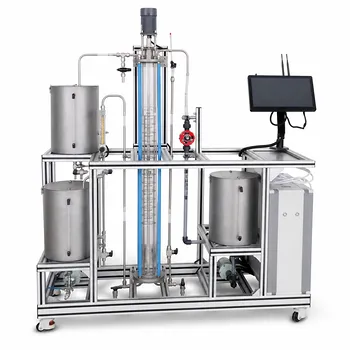
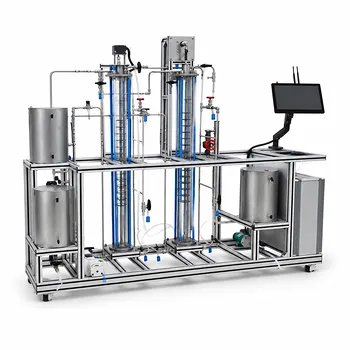
Our advanced distillation pilot plants feature precise control loops and transparent column sections, allowing operators to visually study and master complex hydrodynamic phenomena like weeping and entrainment.
Contact LABPARK today to discuss your laboratory requirements and receive a custom solution tailored to your curriculum or research needs!
Related Products
- Continuous Sieve-Plate Distillation Pilot Plant for Unit Operations Laboratory Education
- Multi-Functional Special Distillation Educational Pilot Plant
- Multi-Modal Distillation Unit Operations Training Pilot Plant
- Continuous Batch Extractive Distillation Educational Pilot Plant
- Dual-Mode Rectification Pilot Plant for Practical Training Unit Operations
People Also Ask
- Why is vacuum operation capability an essential feature for a distillation unit operations pilot plant? Unlock Efficiency
- How does catalyst water concentration affect distillation pilot plant design? Key separation train choices.
- How to select the right activity coefficient model (Wilson, NRTL, UNIQUAC) for distillation pilot plants?
- What are the primary reflux ratio control strategies? Master Distillation Unit Operations
- How can real-time carbon number prediction improve distillation pilot plants? Optimize control.