The real challenge isn’t just lowering the temperature—it’s preserving product integrity while breaking the tie of similar boiling points.
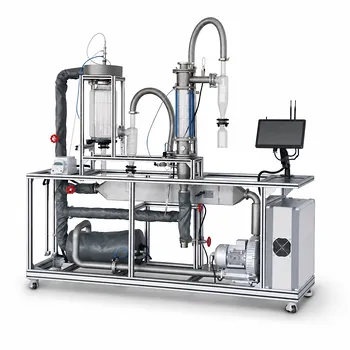
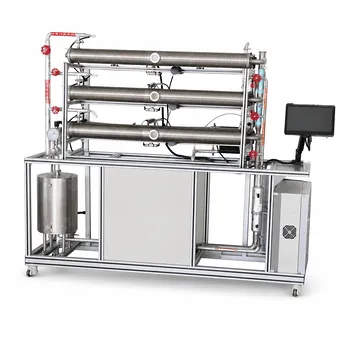
Unit operations pilot plants simulate the separation of heat-sensitive compounds with nearly identical boiling points by manipulating pressure, introducing selective solvents, or switching to non-thermal separation methods. They test vacuum distillation to lower the boiling point, extractive distillation to alter relative volatility with a solvent, steam distillation to co-distill with an immiscible phase, and membrane or liquid-liquid extraction to bypass the vapor phase entirely. By systematically varying pressure, temperature, solvent ratio, and residence time, researchers gather the data needed to scale up a process that prevents thermal degradation and achieves the required purity.
Separating heat-sensitive compounds with close boiling points is fundamentally a volatility problem, not just a temperature problem. Pilot plants prove that the answer is rarely “more heat” but rather a deliberate change in the physical environment—whether through vacuum, a third component, or a barrier-based approach—to create a safe separation window.
Why Simple Distillation Fails Heat-Sensitive, Close-Boiling Mixtures
The Thermal Degradation Trap
Heating a mixture to its boiling range often destroys the very molecules you want to recover. High temperatures can cause decomposition, polymerization, or oxidation, especially in pharmaceuticals, biomolecules, and specialty chemicals.
The Relative Volatility Problem
When boiling points are extremely close—like acrylonitrile (77.3 °C) and acetonitrile (81.6 °C)—the relative volatility approaches 1.0. Fractional distillation demands an impractical number of theoretical stages and long residence times, which exposes the heat-sensitive product to even more thermal stress in the reboiler. Simply adding more trays cannot solve the core issue.
The Pilot Plant Toolkit: Pressure-Based Strategies
Vacuum Distillation – Lowering the Boiling Gateway
Reducing the system pressure lowers the boiling point of every component. A pilot plant uses vacuum pumps and pressure controllers to distill at temperatures far below the normal boiling range, which prevents thermal degradation.
However, vacuum alone does not always increase relative volatility; for identical boiling-point differences, the separation factor may remain nearly unchanged. That makes vacuum distillation most effective when the primary concern is temperature sensitivity, not when additional volatility adjustment is needed.
Fractional Distillation with Precision Control
A modular pilot column equipped with high-resolution temperature probes, reflux ratio control, and structured packing can fine-tune separation at the edge of thermal limits. Researchers collect real-time data to find the maximum allowable reboiler temperature that still yields acceptable purity.
Yet, without altering activity coefficients, fractional distillation still struggles when compounds are true near-boilers, underscoring why pilot plants often pivot to extractive or azeotropic strategies.
Manipulating Volatility with Alternative Distillation Techniques
Extractive Distillation – Breaking the Volatility Tie
This is the workhorse for separating close-boiling pairs without high heat. A pilot plant feeds a high-boiling solvent (often water) near the top of the column. The solvent selectively alters the activity coefficients of the components, making the more soluble component drop to the bottom while the purified low-solubility product leaves the column top or side.
In training systems, a water-to-acrylonitrile ratio of 8–10 is tested to split acrylonitrile from acetonitrile. The solvent-to-feed ratio becomes a critical control parameter, and the pilot plant verifies the stage efficiency and thermal duty predicted by simulation programs like MMSP.
Steam Distillation – Using Immiscibility to Reduce Temperature
When a heat-sensitive organic is immiscible with water, the pilot plant injects live steam. The two-phase mixture boils at a temperature lower than the boiling point of the pure organic—for example, bromobenzene (bp 156 °C) co-distills with water at 95 °C.
The setup demonstrates how the vapor condenses and separates into distinct liquid phases, allowing product recovery without ever reaching the organic’s high boiling point. This method is ideal for compounds that have significant vapor pressure at steam temperature and are chemically stable in the presence of water.
Non-Thermal Separation Routes
Membrane Separations – A Cold Solution
Pilot plants using reverse osmosis, ultrafiltration, pervaporation, or nanofiltration avoid phase change entirely. They operate at ambient temperatures, protecting heat-sensitive biomolecules, and rely on selective barrier materials. Researchers test permeate flux, selectivity, and fouling behavior to scale the process. This approach is particularly valuable in bioprocessing and environmental applications.
Liquid-Liquid Extraction – Solubility Trumps Boiling Point
When thermal separation is destructive or energy-intensive, pilot-scale mixer-settlers or extraction columns separate based on partition coefficients. Antibiotic recovery (e.g., penicillin) famously uses this route: the target molecule moves into an organic solvent phase at low temperature, bypassing distillation entirely. The pilot plant allows systematic evaluation of solvent candidates, phase ratios, and mass transfer efficiency.
Crystallization – Solubility at Low Temperatures
For high-purity requirements and heat-sensitive solids, pilot plants leverage solubility differences. By carefully controlling cooling rates and supersaturation, they crystallize the target compound at temperatures well below decomposition limits. This method often supplements or replaces distillation when melt-sensitive materials are involved.
Understanding the Trade-offs
Energy and Added Complexity
Extractive distillation demands solvent recovery columns and additional reboilers. Vacuum systems add capital cost and can suffer from air leaks. Membrane plants require cleaning regimes and can lose flux over time. Each technique shifts the cost from thermal degradation risk to equipment complexity.
Product Suitability Constraints
Not every method works for every molecule. Steam distillation requires some vapor pressure at 100 °C and water immiscibility. Extractive distillation needs a solvent that alters relative volatility without reacting or forming hard-to-separate azeotropes. Membranes must withstand the chemical environment without swelling or fouling. The pilot plant’s job is to rule out unsuitable matches before scale-up.
Scale-Up Risks with Heat-Sensitive Streams
Data from a glass pilot column may not translate directly to an industrial stainless-steel plant. Wall effects, heat loss, and residence time distribution change at scale, so pilot runs must be coupled with rigorous simulation (e.g., MMSP, Aspen Plus) to model the commercial column. The same low temperature that protects the product at pilot scale can be lost if large reboilers create local hot spots—extra monitoring is essential.
How to Choose the Right Separation Strategy in a Pilot Plant
- If your primary focus is minimizing thermal exposure: Prioritize membrane separations or liquid-liquid extraction that operate at ambient temperatures and avoid boiling entirely.
- If your primary focus is separating close-boiling, miscible liquids: Turn to extractive distillation with a well-chosen solvent to magnify the volatility difference without pushing the reboiler into the danger zone.
- If your primary focus is a heat-sensitive, water-immiscible compound: Test steam distillation first; it frequently delivers the lowest effective distillation temperature.
- If your goal is to train operators and validate dynamic models: Use a modular, instrumented pilot plant that can host multiple column configurations and integrate simulation software so that every pump and valve setting is tied to fundamental mass and energy balances.
The true strength of a pilot plant is not any single technique—it is the ability to experimentally step through these options, collect hard data, and deliver a separation process that keeps your product intact and your scale-up on solid ground.
Summary Table:
| Separation Method | Primary Mechanism | Key Advantage | Major Limitation / Trade-off |
|---|---|---|---|
| Vacuum Distillation | Lowers system pressure to reduce boiling points | Prevents thermal degradation of sensitive molecules | Does not increase relative volatility on its own |
| Extractive Distillation | Adds a selective solvent to alter relative volatility | Separates close-boiling mixtures without high heat | Requires solvent recovery and complex equipment |
| Steam Distillation | Co-distills with steam (immiscible phase) | Operates below pure organic boiling point | Only works for water-immiscible compounds |
| Liquid-Liquid Extraction | Separates based on partition coefficients | Bypasses vapor phase and thermal stress entirely | Requires solvent selection and phase separation |
| Membrane Separation | Uses selective barriers (RO, UF, Pervaporation) | Non-thermal; ideal for biomolecules | Subject to membrane fouling and flux decline |
Bring Industrial-Scale Separation Strategies into Your Lab
Ready to optimize your separation processes and train the next generation of engineers? LABPARK designs and manufactures premium Educational and Vocational Unit Operations Pilot Plants tailored for chemical engineering, bioprocess & biotech, and environmental & water treatment.
Whether you represent a university, research institute, or industrial enterprise, our modular, highly instrumented systems provide the precise control needed to safely simulate complex separations.
Contact LABPARK today to request a quote or custom configuration!
Related Products
- General Purpose Cosmetics Production Unit Operations Training Pilot Plant
- Multi Pump Fluid Transport Process Piping Unit Operations Training Pilot Plant
- Multi-Functional Drying Educational Unit Operations Pilot Plant
- Fixed-Bed Chemical Reaction and Gas Dust Tar Removal Unit Operations Pilot Plant
- 100L Continuous Loop Hydrogenation Educational Unit Operations Pilot Plant
People Also Ask
- How do deviations in estimating latent heat impact pilot plant thermal systems? Avoid hardware mis-sizing.
- Why is the chemical plant startup schedule crucial? De-risk scale-up with pilot plants.
- When to transition from PID to adaptive control in pilot plants? Key process indicators.
- Why Compare Predicted and Experimental Excess Enthalpy? Key to Accurate Pilot Plant Scale-up
- Why Use PTFE & Hastelloy in Chemical Pilot Plants? Prevent Corrosion & Ensure Safety