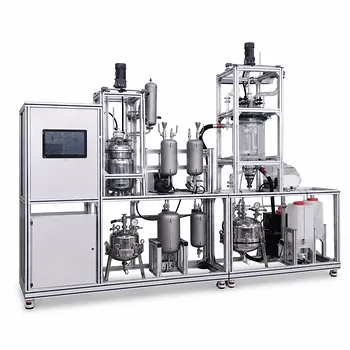
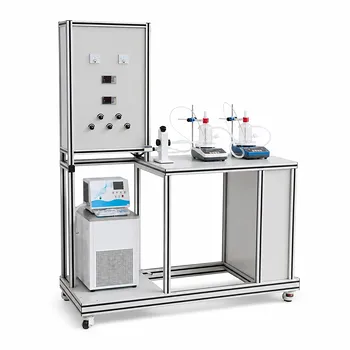
Solute transfer mechanisms fundamentally dictate every aspect of a vocational pilot plant’s design and operation. The mechanism—whether driven by physical solubility, a chemical reaction, or simply the ratio of solvent-to-feed flows—determines which equilibrium relationships govern the separation, what kinetic parameters must be measured, and how the pilot plant’s hardware must be configured. For physical extraction, the focus rests on interfacial area, mass transfer coefficients, and phase equilibria. For reactive extraction, reaction kinetics and phase contact efficiency become equally critical. The solvent-to-feed ratio, while often treated as an operational variable, acts as a direct lever on the driving force, shaping stage counts and column sizing. In a vocational setting, these distinctions guide the design of meaningful experiments: whether students measure distribution coefficients with simple ternary diagrams or characterize conversion in a reactive column, each mechanism leaves a unique fingerprint on data collection, equipment selection, and the resulting learning outcomes.
The solute transfer mechanism transforms a pilot plant from a generic separation device into a teaching instrument. Physical extraction trains operators in equilibrium-stage calculations and hydrodynamics, while reactive extraction layers on reaction engineering principles. The solvent-to-feed ratio provides a tangible handle for demonstrating how operating conditions shift away from equilibrium. Understanding these effects allows instructors to craft experiments that isolate exactly the concept they want students to master.
How the Three Mechanisms Shape Pilot Plant Operation and Experimental Design
The primary reference identifies three solute transfer mechanisms: physical solubility differences, solvent-to-feed flow rate ratios, and chemical reactions. Each forces a distinct operational and experimental logic onto the pilot plant.
Physical Solubility-Driven Transfer: The Foundation of Mass Transfer Training
Operation and equipment behavior. In physical extraction, the solute partitions between two immiscible phases solely because of its higher affinity for the solvent. The “like dissolves like” principle governs this, and the process is controlled by the overall mass transfer coefficient ($k_{OC}$), the specific interfacial area ($a$), and the driving concentration gradient ($c_A^* - c_A$). Consequently, pilot-plant operation becomes a study in generating and maintaining droplet population: agitation speed directly sets the Sauter mean diameter ($d_{32}$), while the dispersed phase holdup ($\phi_D$) responds to flow rates. The equation $a = 6\phi_D / d_{32}$ crystallizes this relationship. Operators quickly learn that flooding limits are a function of density difference, viscosity, and interfacial tension—low density difference or high viscosity leads to slow coalescence and potential entrainment. Experimental runs therefore revolve around manipulating agitation intensity and phase ratios while monitoring the interface level and pressure drop.
Experimental design and calculations. Vocational experiments typically center on two classical cases: completely immiscible and partially miscible systems. For immiscible carriers, mass flow rates remain constant through the stages, permitting straight operating lines on X‑Y diagrams: $Y_{i+1} = (B/S)X_i + (Y_1 - (B/S)X_F)$. Students can quickly change the solvent-to-feed ratio and see how the slope shifts, directly tying operating decisions to raffinate purity. For partially miscible systems, the change in raffinate and extract flow rates forces the use of ternary triangular diagrams and lever-rule calculations. A pilot plant deliberately operated across both regimes teaches how phase equilibrium data drives stage‑to‑stage composition predictions. Measurements of distribution coefficients at different temperatures, combined with activity coefficient estimation from excess properties, bridge thermodynamic theory and practical solvent selection.
Chemically Reactive Extraction: Where Kinetics Meets Mass Transfer
Operational demands. When a chemical reaction—such as acid‑base neutralization—consumes the transferring solute in the receiving phase, the driving force remains large and the extraction can achieve high single‑stage efficiencies. However, the pilot plant must now accommodate reaction kinetics. Residence time in each stage or column zone must be sufficient for the reaction to approach completion, but not so long that back‑mixing undermines the concentration profile. Phase contact efficiency becomes paramount: the reaction occurs at the interface, so droplet surface renewal rate and local mixing intensity directly influence the effective reaction rate. Unlike purely physical systems, where equilibrium sets an upper bound, reactive extraction can pull the solute concentration well below the physical equilibrium limit. This means that solvent regeneration downstream—reversing the reaction or stripping the solute—must be added to the experimental scope.
Experimental design implications. In a vocational pilot plant, reactive extraction experiments might compare a physical extraction baseline with a chemically enhanced run using the same equipment. Students measure not only the concentration profile along the column but also monitor pH, conductivity, or colorimetric indicators that track reaction progress. The equipment selection criteria shift: centrifugal extractors or specialized packed columns may be justified when residence‑time distribution and interfacial area must be precisely controlled. Training then expands to include reaction engineering concepts, such as Damköhler numbers, alongside the familiar mass transfer coefficients. The primary reference explicitly notes that such training helps students connect chemical bonding and mass flow rates to column sizing and stage efficiency, a linkage that is less tangible in purely physical systems.
Solvent-to-Feed Flow Rate Ratio: The Operational Lever as a Mechanism
A bridge between equilibrium and kinetic control. The primary reference treats the solvent-to-feed ratio as a distinct solute transfer mechanism. In practice, this ratio is not an independent thermodynamic driving force but a powerful operational parameter that alters the concentration gradient along the column. By varying the solvent rate, operators change the slope of the operating line in a McCabe‑Thiele diagram, effectively controlling the number of required theoretical stages for a given separation. At very high solvent ratios, the system approaches an infinite stripping condition, while at low ratios, pinch points may limit performance. The ratio therefore acts as if it were a mechanism because it determines how far the overall process deviates from equilibrium.
Pilot plant experiments. Vocational experiments that deliberately vary the solvent-to-feed ratio teach students the economic trade‑off between solvent consumption and capital investment (stages). A simple packed column can be run at multiple ratios while students record extraction yield and back‑calculate the height equivalent to a theoretical plate (HETP). Because the mass transfer equation $n_A = k_{OC} a (c_A^* - c_A)$ still governs the local rate, students see that the ratio’s effect is not through $k_{OC}$ or $a$, but through the average concentration driving force. This distinction—between altering intrinsic kinetics and altering the operating conditions—is a core lesson of unit operations education.
Practical Equipment and Measurement Constraints in a Vocational Setting
Selecting Equipment Based on the Transfer Mechanism
The choice from among mixer‑settlers, pulsed columns, rotating disc columns, or centrifugal extractors must align with the mechanism under study. For physical extraction, a simple pulsed column may suffice to demonstrate the influence of agitation on $d_{32}$ and $\phi_D$, while a mixer‑settler battery can illustrate stage‑by‑stage composition profiles. When reactive extraction is the focus, the equipment must guarantee sufficient residence time and high interfacial area—possibly a column with structured packing or a series of stirred contactors. Footprint and headroom constraints (as noted in the supplementary references) become secondary to the need for controlled phase contacting.
Measurement Infrastructure
Physical extraction experiments demand accurate measurement of flow rates, interface levels, temperatures, and droplet size distributions. For reactive systems, inline sensors for pH, conductivity, or spectrophotometric concentration probes become essential. The supplementary reference on thermodynamic equilibrium reminds us that predicting activity coefficients is necessary for designing experiments; in a vocational plant, however, students often measure partition coefficients directly rather than relying on predictive models, using gas chromatography or titration of samples taken from the active extraction zone. The experimental design must therefore incorporate sampling ports placed at strategic stage locations.
Understanding the Trade-offs
Physical vs. reactive extraction in a teaching plant. Physical extraction experiments are inherently safer and easier to set up—common non‑hazardous systems like water‑acetic acid‑ethyl acetate allow students to focus on fundamentals without complex reaction chemistry. The trade‑off is that they can feel simplistic, failing to illustrate the industrial reality where reactive extraction is common. Introducing a reactive component (e.g., extracting an acid with aqueous sodium hydroxide) adds realism but brings safety protocols, waste handling, and the need to clean equipment more rigorously between runs to avoid contamination. The vocational instructor must balance educational depth against operational simplicity.
Ideal vs. non‑ideal systems. Using ideal or well‑characterized partially miscible systems reduces the cognitive load for students, but they may graduate without an appreciation for excess properties and activity coefficients. The supplementary references highlight that studying these deviations—such as azeotrope‑like behavior in extraction—teaches the limits of ideal models. The trade‑off is that rigorous measurement of activity coefficients requires additional instrumentation (e.g., vapor‑liquid equilibrium stills or precision density meters) that may exceed a vocational plant’s budget. Simulations or pre‑prepared thermodynamic data can bridge this gap.
Column complexity vs. learning clarity. A sophisticated pulsed or rotating column offers fine control over droplet size and holdup, directly illustrating the $a = 6\phi_D / d_{32}$ relationship. But its mechanical complexity can divert student attention to troubleshooting the equipment rather than grasping mass transfer principles. A simpler packed column, while less efficient, often makes the cause‑and‑effect relationships more transparent. The same tension exists with mixer‑settlers: they are modular and visually instructive, but may suffer from emulsification issues that obscure the underlying extraction process.
Making the Right Choice for Your Pilot Plant’s Educational Goals
The design of experiments in a vocational unit operations pilot plant must be driven by the fundamental concept you aim to teach. Use the following guidelines to align the solute transfer mechanism with your training objectives.
- If your primary focus is on equilibrium‑stage calculations and McCabe‑Thiele construction: Choose a completely immiscible physical extraction system. Vary the solvent‑to‑feed ratio and have students track raffinate purity to verify the straight operating line. This isolates the effect of flow rates without the complication of changing stream compositions.
- If your primary focus is on mass transfer fundamentals and interfacial area control: Select a physical extraction with a higher viscosity or lower density difference, and run it in a well‑instrumented column where agitation speed can be systematically changed. Students will directly link droplet size (via Sauter mean diameter) and holdup to the overall mass transfer coefficient.
- If your primary focus is on industrial relevance and reaction engineering integration: Design a chemically reactive extraction, like acid extraction with a neutralizing agent. Use a mixer‑settler or pulsed column with residence‑time control, and add sensors to monitor reaction progress. This demonstrates how kinetics can beat equilibrium limits.
- If your primary focus is on thermodynamic non‑ideality and solvent selection: Use a partially miscible system and have students construct the full ternary diagram from experimental tie‑line measurements. They will confront activity coefficients and the lever rule directly, earning a deep understanding of why real systems deviate from simple X‑Y models.
The solute transfer mechanism you choose to demonstrate does not merely affect what you measure—it defines the entire pedagogical journey your students will take from raw phase equilibria to a fully operated pilot‑scale separation.
Summary Table:
| Mechanism | Operational Focus | Key Experimental Measurements |
|---|---|---|
| Physical Solubility | Interfacial area, agitation speed, droplet holdup, phase equilibria | Distribution coefficients, phase flow rates, Sauter mean diameter |
| Chemical Reaction | Reaction kinetics, residence time, interface renewal, regeneration | pH, conductivity, concentration profiles, conversion rate |
| Solvent-to-Feed Ratio | Operating line slope, concentration gradient, stage efficiency | Extraction yield, HETP, solute concentrations |
Bring Industrial-Scale Learning to Your Lab with LABPARK
Are you looking to enhance your curriculum or research with hands-on chemical engineering experience? LABPARK designs and manufactures state-of-the-art Educational and Vocational Unit Operations Pilot Plants tailored for universities, research institutes, and enterprises.
Whether you need to demonstrate complex liquid-liquid extraction mechanisms, bioprocess & biotechnology concepts, or advanced environmental & water treatment processes, our robust pilot plants bridge the gap between theory and practice.
Why Choose LABPARK?
- Tailored Educational Solutions: Systems custom-aligned with your specific teaching and research goals.
- Industrial-Grade Instrumentation: Real-world sensors for accurate, reliable data collection.
- Versatile Support: Helping students master unit operations with safe, durable, and curriculum-ready equipment.
Ready to upgrade your engineering lab? Contact LABPARK today to discuss your custom pilot plant requirements!
Related Products
- Educational Rotary Disc Liquid-Liquid Extraction Pilot Plant
- Comprehensive Liquid-Liquid Extraction Pilot Plant for Engineering Education
- Gallium and Indium Selective Extraction Educational Pilot Plant
- Ternary Liquid-Liquid Equilibrium Educational Pilot Plant
- Liquid-Liquid Mass Transfer Coefficient Determination Educational Pilot Plant
People Also Ask
- How do density and IFT affect liquid-liquid extraction pilot plants? Optimize Column Performance
- How to Estimate KD for Liquid-Liquid Extraction Pilot Plants Using Henry's Law when Lab Data is Limited
- In a liquid-liquid extraction pilot plant, how is a ternary-phase diagram utilized to determine solvent feed requirements?
- Why is the plait point a critical limit in liquid-liquid extraction pilot plants? Safe LLE Operation
- How to Select a Liquid-Liquid Extraction Pilot Plant with Space Constraints: Key Factors