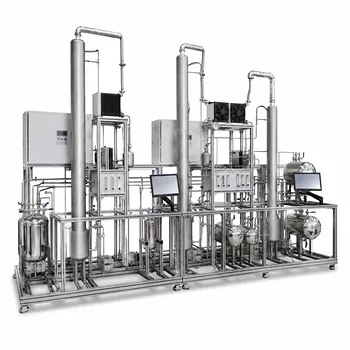
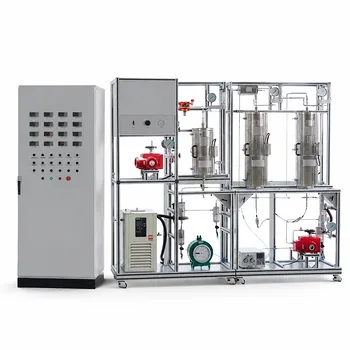
The number of degrees of freedom isn’t just theory—it’s the blueprint for your control system.
In a binary distillation pilot plant, a rigorous degrees-of-freedom analysis conclusively shows that the process has exactly 2 degrees of freedom. This means you can—and must—manipulate only two independent variables to fully specify the steady-state operation. In practice, those two control handles are always reflux flowrate and vapor boil-up rate (or reboiler duty). The entire control loop configuration is built around this constraint: two product-composition loops plus the essential, non-independent regulatory loops for pressure and liquid levels.
The mathematical reality of 2 degrees of freedom defines the control architecture. You can choose many valve positions, but only two can be set independently to fix the separation’s outcome. Understanding this prevents dangerous over-specification and guides students and researchers to focus their control experiments on the two variables that truly govern purity.
The Mathematical Truth Behind 2 Degrees of Freedom
Every tray in the column adds mass and energy balance equations, and counting those against the total number of variables (temperatures, flows, compositions) yields exactly 2 unconstrained remaining variables. This result is the theoretical backbone of the control system.
Why the Model Always Lands on Two
The primary analysis for a binary column gives 4Nt + 9 variables and 4Nt + 7 independent equations. Subtraction leaves 2.
No matter how complex the column looks, the underlying physics says you can only impose two independent specifications on the separation process. Any more would over-define the system and make it unsolvable.
What Those Two Variables Represent
The two remaining variables are not arbitrary; they map directly to energy input and internal reflux.
By convention and for physical realizability, we select reflux flowrate (R) and vapor boil-up (Y)—the two independent actuators that drive all composition profiles. Tray temperatures and product purities are consequences, not independent setpoints.
Translating Theory into a Real Pilot-Plant Control Configuration
A pilot plant has more than two valves. You’ll commonly see five control valves: feed, distillate, bottoms, cooling water, and steam. How do we reconcile that with only 2 degrees of freedom?
The Five Valves and the Hierarchy of Control
Only two valves directly exercise the degrees of freedom for product quality. The others serve regulatory needs that do not alter the steady-state separation.
The standard educational configuration allocates them as follows:
- One valve for column pressure (typically condenser cooling).
- Two valves for liquid inventory (reboiler sump level and reflux accumulator level).
- Two valves for the true degrees of freedom—reflux flow and boil‑up (or equivalently, one product stream flow ratio).
Inventory and Pressure Loops Are Necessary, Not Independent
These three regulatory loops eliminate drift and maintain safe operation.
They do not add independent specifications to the separation problem. In steady-state, the level controllers simply ensure that accumulated mass is zero. The pressure loop fixes a condition that might be considered an “implied” variable, but from a composition-control standpoint, it’s a prerequisite, not a new degree of freedom.
The Two Composition-Control Loops
Once pressure and levels are stabilized, you are left with exactly two manipulators to control product purities.
You can:
- Control both distillate and bottoms composition using R and Y (requires careful pairing to avoid severe interaction).
- Control only one purity (e.g., distillate) and let the other float, which often reduces loop interaction in a pilot-scale setup.
The Educational Power of This 2-Degree Architecture
Pilot plants exist to teach control principles, and the 2-degree-of-freedom constraint is the perfect framework. Students immediately see that they cannot arbitrarily set all flowrates and expect a stable, predictable separation.
Open-Loop vs. Closed-Loop Demonstration
With R and Y held constant (open-loop), the column finds its own steady-state compositions—perfect for observing natural stability and sensitivity to disturbances.
With a closed-loop configuration, students actively manipulate R or Y to meet a target purity, directly experiencing how one degree of freedom drives the top product while the other drives the bottom.
Material Balance Control Schemes
By dedicating the two product-composition loops to these variables, the pilot plant vividly illustrates material balance control. When a feed disturbance occurs, adjusting R or Y to hold a composition constant demonstrates how the energy input and reflux must shift to maintain the split. It’s a direct, tangible application of the 2-degree concept.
Understanding the Trade‑offs and Pitfalls
The neat 2-degree freedom analysis hides practical challenges that every pilot-plant operator must manage.
Loop Interaction Coupling
In a fully controlled dual-composition loop, the two loops interact strongly. Changing reflux affects both top and bottom purity almost instantly.
Solution: Apply optimal variable pairing (distillate composition ↔ reflux, bottoms composition ↔ boil‑up) or deliberately detune one loop. In teaching plants, often only one purity is controlled to let students safely explore this coupling without instability.
The Temptation to Over-Specify
It’s easy for newcomers to try controlling feed flowrate as an independent variable for quality.
But feed rate is a throughput, not a quality specification. Over-specifying it alongside R and Y would violate the 2-degree limit and lead to infeasible control requests. The degrees-of-freedom analysis acts as a sanity check that prevents you from asking the control system for the impossible.
Batch Distillation Extensions
A batch pilot plant introduces transient degrees of freedom because composition changes with time. The same principle applies: only two operating policies (e.g., constant reflux or constant distillate composition) can be specified at any instant. This makes the 2-degree rule a versatile teaching point for both continuous and batch operations.
Multicomponent and Sidestream Columns
When the plant includes sidestreams, the mathematical degrees of freedom increase to number of side streams plus two.
For a pure binary column (zero sidestreams), the formula simplifies back to exactly two. This general rule helps advanced students see the scalability of the concept without losing the fundamental insight learned on the simplest column.
Making the Right Choice for Your Pilot‑Plant Goal
Your control loop configuration must align with what you intend to demonstrate. The 2-degree framework gives you a structured way to decide.
- If your primary focus is teaching steady-state separation fundamentals: Configure the plant with two independent open-loop controllers for reflux and boil‑up. Let students manually map the effect of each variable on tray temperatures and purity.
- If your primary focus is demonstrating dual‑composition control: Implement two closed‑loop purity controllers paired with R and Y, but explicitly include a decoupling strategy or detuning exercise to show how the 2-degree interaction is managed.
- If your primary focus is material balance control and disturbance rejection: Set up a single‑purity control loop (e.g., distillate) and allow the bottoms to float. Use feed rate or composition disturbances to illustrate how the single degree of freedom adjusts to maintain the target.
- If your primary focus is batch distillation dynamics: Apply a constant reflux ratio policy or constant distillate composition policy—always respecting that only one independent manipulation is free at a time—and monitor how the instantaneous separation evolves.
Those two degrees of freedom define the playground. Mastering them turns a pilot plant from a piece of equipment into an exceptional tool for teaching process control.
Summary Table:
| Loop / Variable | Controlled Parameter | Role in Configuration |
|---|---|---|
| Reflux Flowrate (R) | Distillate Composition / Purity | True Degree of Freedom (Quality Control) |
| Vapor Boil-up Rate (Y) | Bottoms Composition / Purity | True Degree of Freedom (Quality Control) |
| Condenser Cooling | Column Operating Pressure | Regulatory Loop (Process Stability) |
| Distillate Flow | Reflux Accumulator Level | Regulatory Loop (Inventory Balance) |
| Bottoms Flow | Reboiler Sump Level | Regulatory Loop (Inventory Balance) |
Optimize Your Chemical Engineering Lab with LABPARK
Bring process control theory to life for your students and researchers. LABPARK provides state-of-the-art Educational and Vocational Unit Operations Pilot Plants across chemical engineering, bioprocess & biotech, and environmental & water treatment.
Designed specifically for universities, research institutes, and enterprises, our distillation pilot plants feature:
- Real-world hands-on learning of the 2-degrees-of-freedom control architecture.
- Flexible configurations to demonstrate both open-loop dynamics and complex closed-loop composition control.
- Industrial-grade instrumentation for precise data acquisition and safe operation.
Ready to upgrade your laboratory training systems? Contact our technical experts today to find the ideal pilot plant solution for your curriculum.
Related Products
- Dual-Mode Rectification Pilot Plant for Practical Training Unit Operations
- Continuous Sieve-Plate Distillation Pilot Plant for Unit Operations Laboratory Education
- Ethyl Acetate Synthesis Unit Operations Pilot Plant for Practical Training
- Green Anhydrous Ethanol Purification Extractive Distillation Unit Operations Training Pilot Plant
- Multi-Modal Distillation Unit Operations Training Pilot Plant
People Also Ask
- How does polyphosphate hydrolysis affect scale and corrosion in pilot plants? Essential Monitoring Guide
- How do predictive thermodynamic models integrate into pilot plants? Bridging Theory and Practice
- Which cross-validation strategy should be selected for pilot plant time-series & batch data? Avoid Data Leakage
- How can process control schemes be configured to teach basic and advanced control?
- Why Use Center Points in Process Analyzer Calibration? Key Benefits Explained