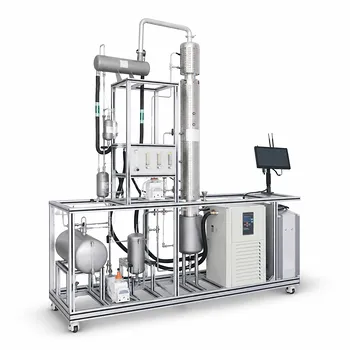
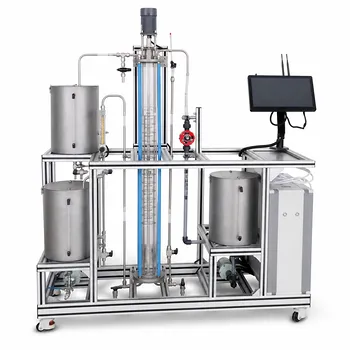
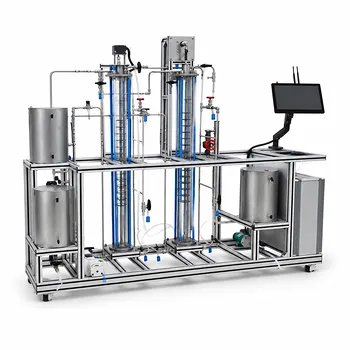
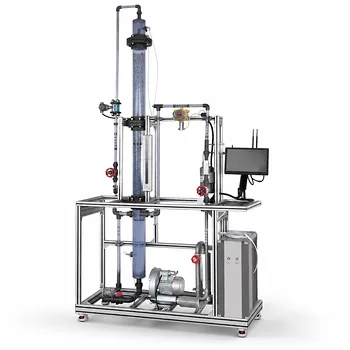
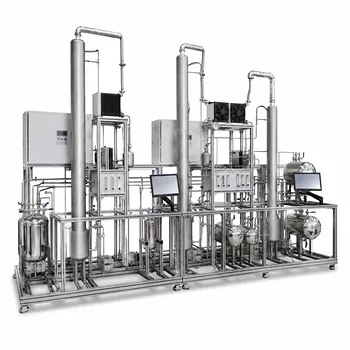
The phase envelope is not just a theoretical diagram; it is the precise thermal blueprint for your pilot-scale column. The bubble point and dew point define the absolute minimum and maximum operating temperatures at any given pressure, dictating exactly where phase change must occur. For a pilot unit, specifying the overhead temperature at the dew point directly determines the condenser's inlet condition, while the reboiler must operate near the bottoms product's bubble point to generate vapor without overheating. This thermodynamic boundary makes predictable, stable operation possible by turning the abstract concept of "separation" into a set of controllable, measurable temperature and pressure targets.
Understanding the phase envelope transforms pilot plant operation from trial-and-error into a predictable science. The bubble point is your reboiler's target, and the dew point is your condenser's immutable specification. Every action—from setting heater power to adjusting cooling water—is an attempt to precisely control enthalpy within the two-phase region defined by these boundaries.
The Phase Envelope as Your Pilot Plant’s Operating Manual
The phase envelope maps the exact thermodynamic territory where separation physics actually happen.
The Two-Phase Region Is Where the Work Gets Done
All mass transfer in a distillation column occurs exclusively within the two-phase region. Outside the bubble point curve, the mixture is a subcooled liquid. Beyond the dew point curve, it’s a superheated vapor.
The temperature gap between these two boundaries can be substantial. For a debutanizer feed at 34.7 psia, the bubble point might be 106°F while the dew point reaches 313°F. This 200°F range is the window where liquid and vapor coexist, and your column’s entire temperature gradient must fall within it.
Reading the Envelope’s Geometry for Control Logic
Inside the phase envelope, under constant pressure, temperature lines run horizontally. This is a critical insight for control. It means that as you add heat (changing enthalpy), the temperature barely changes within the two-phase zone—the energy goes into phase change, not sensible heating.
Outside the envelope, the lines become nearly vertical. Here, temperature changes dramatically with enthalpy input, but pressure has a negligible thermal effect. This explains why a loss of cooling in the condenser doesn't just change the temperature—it can rapidly push the overhead vapor into the superheated region, collapsing the reflux and destroying separation in seconds. The enthalpy change directly translates to a temperature spike.
Controlling the Column’s Ends: Dew Point and Bubble Point as Setpoints
The thermodynamic definitions of the mixture’s boundaries become the direct control setpoints for the pilot unit’s critical equipment.
The Condenser Must Target the Overhead Dew Point
The overhead vapor entering the condenser is, by definition, at its dew point. The condenser’s job is to remove precisely enough latent heat to collapse the vapor back into a liquid at its bubble point.
The thermal duty is calculated directly from the enthalpy difference between these two states. If the condenser outlet temperature drifts above this calculated bubble point, you will have incomplete condensation. This means vapor escapes with the reflux, leading to lost product, unpredictable reflux ratios, and significant safety concerns in a laboratory setting.
The Reboiler Operates at the Bottoms Bubble Point
The liquid leaving the bottom tray is a mixture with a specific composition. The reboiler must heat this liquid to its exact bubble point temperature to initiate boiling. The bubble-point pressure calculation is used beforehand to set the column’s operating pressure so that boiling occurs at your desired temperature.
Overheating the reboiler adds sensible heat above the bubble point, which is wasteful. It can drive heavier components into the vapor phase, contaminating the separation. The bubble point is your target floor for generating vapor; exceeding it does not increase boiling rate as efficiently as surface area does, and it degrades product purity.
Bridging Theory and Physical Operation Inside the Column
The space between the end boundaries must be managed to keep the column internals functioning properly.
Temperature Profiles Reveal Composition Gradients
Because bubble and dew points are composition-dependent, the temperature measured on each tray is a direct proxy for the local mixture composition. A flat temperature profile in the rectifying section suggests an impurity in the overhead, while a rapid change near the bottom indicates the stripping action is working. The entire profile is constrained by the overall column pressure and the mixture's phase envelope.
Preventing Hydraulic Failure Modes
Staying within the vapor-liquid region isn’t enough; the fluid dynamics must also be controlled. Two common failures are directly tied to the vapor flow rate, which is set by the reboiler’s heat input relative to the bubble point:
- Weeping occurs when vapor velocity is too low, allowing liquid to fall through the tray holes. This breaks the mass-transfer contact and plummets plate efficiency.
- Entrainment occurs when vapor velocity is too high, physically carrying liquid droplets to the tray above. This backmixing reverses the separation work.
Both failure modes destroy the staged equilibrium that the bubble and dew point calculations assume.
The Critical Subcooling Step
A practical detail often overlooked in theory is pump protection. If the condensed liquid must be moved by a pump, it must be cooled below its own bubble point. This subcooling prevents the liquid from flashing into vapor at the pump suction—a condition called cavitation that will quickly destroy the pump. This requires an additional sensible heat duty calculation beyond the condensation duty.
Understanding the Trade-offs
Operating a pilot unit strictly by theoretical bubble and dew points requires acknowledging real-world limitations.
The limitation of calculation accuracy: These calculations depend on equilibrium constants (K-values) from equations of state. For polar or highly non-ideal mixtures, these models can be wrong. A calculated dew point might be off by several degrees, leading to an undersized condenser. Lab operators must validate these points with experimental data.
The danger of extreme purity goals: Pushing for ultra-high purity in either product forces the top or bottom of the column to operate at a point on the phase envelope where composition changes are almost zero for large temperature changes. This makes the column extremely sensitive and difficult to control, often leading to cycling behavior.
Pressure drop obscures the single pressure assumption: The phase envelope assumes a constant pressure. A real column has a pressure drop from bottom to top. This means the "constant pressure" envelope shifts slightly from tray to tray. In a pilot unit with many theoretical stages or high liquid loads, failing to account for this can mislead your interpretation of the temperature profile, making the bottom seem cooler than the theoretical bubble point suggests.
Making the Right Choice for Your Operational Goal
You control the column by manipulating thermal duties to hit the phase boundaries specific to your target compositions.
- If your primary focus is achieving high-purity overhead product: You must set your condenser temperature slightly below the bubble point of the purest achievable distillate composition. Focus on controlling the reflux ratio to push the rectifying section’s temperature profile down toward the pure component’s boiling point.
- If your primary focus is energy-efficient operation of the pilot plant: Minimize subcooling in the condenser to save on cooling utility and in the reflux liquid to reduce reboiler duty. Pinpoint the dew and bubble points so you add no more thermal energy than required to just complete each phase change.
- If your primary focus is operational stability and preventing column upset: Do not operate too close to the critical point where the bubble and dew point lines meet, as small pressure or temperature fluctuations can cause the liquid and vapor phases to collapse into a single, un-separable phase. Maintain a comfortable pressure below the mixture’s cricondenbar.
The phase envelope is the master specification sheet for your distillation column. Every setpoint you tune, from the steam valve to the cooling water flow rate, is simply an attempt to match the real enthalpy of your mixture to a specific point on that thermodynamic blueprint.
Summary Table:
| Key Concept | Role in Distillation Control | Operational Impact (If Ignored) |
|---|---|---|
| Bubble Point | Reboiler temperature target; defines liquid boundary. | Sensible heat waste; heavy component contamination. |
| Dew Point | Condenser temperature target; defines vapor boundary. | Incomplete condensation; lost product; venting issues. |
| Phase Envelope | Maps two-phase region for mass transfer. | Process instability; phase collapse near critical point. |
| Subcooling | Cools condensate below bubble point for pumping. | Pump cavitation and physical damage. |
Bring Thermodynamic Precision to Your Lab
Optimizing pilot-scale distillation requires both theoretical accuracy and robust hardware. LABPARK provides premium Educational and Vocational Unit Operations Pilot Plants in chemical engineering, bioprocess & biotech, and environmental & water treatment.
Designed specifically for universities, research institutes, and enterprises, our pilot plants deliver the precise control, reliable sensor integration, and industrial-grade durability needed to bridge the gap between theory and practice.
Ready to elevate your research or training capabilities? Contact LABPARK today to discuss your project requirements and receive a customized solution!
Related Products
- Continuous Sieve-Plate Distillation Pilot Plant for Unit Operations Laboratory Education
- Multi-Functional Special Distillation Educational Pilot Plant
- Multi-Modal Distillation Unit Operations Training Pilot Plant
- Continuous Batch Extractive Distillation Educational Pilot Plant
- Dual-Mode Rectification Pilot Plant for Practical Training Unit Operations
People Also Ask
- Why is vacuum operation capability an essential feature for a distillation unit operations pilot plant? Unlock Efficiency
- How does catalyst water concentration affect distillation pilot plant design? Key separation train choices.
- What are the primary reflux ratio control strategies? Master Distillation Unit Operations
- How can real-time carbon number prediction improve distillation pilot plants? Optimize control.
- How to select the right activity coefficient model (Wilson, NRTL, UNIQUAC) for distillation pilot plants?