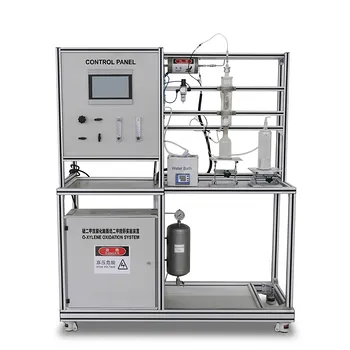
Temperature is the master variable that simultaneously accelerates how fast you make product and dictates how much product you can ultimately make.
In a chemical reactor pilot plant, raising the temperature always increases the rate of reaction—molecules collide more often and with more energy, surmounting activation barriers faster. At the same time, temperature shifts the chemical equilibrium: for exothermic reactions, higher temperature cuts your maximum possible yield; for endothermic reactions, it boosts both rate and yield. The core operational challenge is to balance these opposing forces so you achieve a practical production rate without sacrificing too much thermodynamic conversion.
Pilot plants expose the fundamental tug-of-war between kinetics and thermodynamics. While heating a reactor speeds up the reaction, for exothermic reversible processes it also shrinks the thermodynamic ceiling. Effective pilot-plant operation therefore hinges on finding an optimized temperature window—often with the aid of a catalyst—that delivers commercially viable rates while preserving sufficient equilibrium conversion.
The Two-Fold Effect of Temperature in a Pilot Plant
Temperature does not act on a single lever; it pulls two distinct ones. Understanding each independently is the first step toward mastering reactor performance.
Kinetics: The Speed of the Reaction
Kinetics answers the question “how fast?” The reaction rate constant (k) obeys the Arrhenius equation, meaning it increases exponentially with temperature.
- A few degrees can halve or double the time needed to reach a given conversion.
- Higher temperatures give molecules more kinetic energy, raising the fraction of collisions that exceed the activation energy (E_a).
- In pilot plants, this sensitivity is used to quantify (E_a) itself—steady, precise temperature control is essential to avoid distorting the (\ln k) vs. (1/T) plot.
The immediate benefit is clear: turn up the heat, and the reactor delivers product faster, improving throughput and shortening experimental campaigns.
Equilibrium: The Thermodynamic Ceiling
Thermodynamics answers the question “how far?” The equilibrium constant (K) follows the van’t Hoff relationship:
[ \left(\frac{\partial \ln K}{\partial T}\right)_p = \frac{\Delta H_R}{R T^2} ]
- For exothermic reactions ((\Delta H_R < 0)), (K) decreases as temperature rises—your maximum achievable conversion drops.
- For endothermic reactions ((\Delta H_R > 0)), increasing temperature raises (K)—higher temperatures push the equilibrium toward products.
- This behavior is a direct consequence of Le Chatelier’s principle: adding heat to an exothermic system shifts the balance back toward reactants.
In pilot-plant terms, temperature sets a hard thermodynamic ceiling. No matter how fast you run, you cannot surpass the conversion that (K) allows at that temperature.
The Conflict for Exothermic Reversible Reactions
When a reaction is both reversible and exothermic, temperature becomes a double-edged sword. This conflict defines how pilot plants are designed and operated.
Why You Can’t Just Crank Up the Heat
Fast kinetics tempt you to run hot. Yet every degree increase for an exothermic equilibrium erodes the maximum yield.
- The classic industrial example is ammonia synthesis: (N_2 + 3H_2 \rightleftharpoons 2NH_3), (\Delta H_R < 0).
- At 298 K, (K_p^\ominus \approx 5.8 \times 10^5); at 673 K, it plummets to (5.9 \times 10^{-4}).
- Running purely at low temperature would give superb equilibrium conversion but a reaction so slow it is industrially useless.
This is why pilot plants do not simply seek the hottest or coldest setting—they hunt the optimum temperature profile that gives a practical rate with an acceptable equilibrium penalty.
The Role of Catalysts and Product Removal
Two strategies resolve the kinetics–thermodynamics deadlock:
- Catalysts lower the activation energy, enabling a high rate at moderate temperatures where equilibrium is still favorable.
- Continuous product removal shifts the reaction quotient (Q) below (K), pulling the reaction forward even when the equilibrium constant itself is modest.
Pilot plants that incorporate membrane separation, condensation, or reactive distillation demonstrate these principles at bench scale, teaching operators how to manipulate both the rate and the apparent equilibrium.
Understanding the Trade-offs in Pilot Plant Operations
Temperature control is never a single-objective problem. Pilot plants expose the full operational envelope, including the hidden costs and risks.
Thermal Runaway vs. Starved Kinetics
Precise temperature control is the pilot plant’s primary safety and performance tool.
- In exothermic systems, overheating can trigger thermal runaway where reaction rate accelerates uncontrollably, overwhelming cooling jackets.
- In endothermic systems, insufficient heating starves the kinetics, causing poor conversion and misleading scale-up data.
- Jacketed reactors with PID controllers allow operators to map safe operating limits, crucial for later industrial design.
Every temperature ramp or hold step in a pilot plant generates data that feeds directly into the runaway risk assessment and the heat-exchange sizing for full-scale reactors.
Data Integrity for Kinetic Studies
Pilot plants often serve as experimental platforms for determining activation energies. Here, temperature stability is non-negotiable.
- Fluctuations as small as ±0.5°C can smear the linear relationship in an Arrhenius plot.
- Best practices include pre-equilibrating reactants in a constant-temperature bath before mixing, and using thermowells placed directly in the reaction zone.
- The primary reference underscores that operators must perform optimization calculations that weigh kinetic gains against equilibrium losses—data quality determines whether those calculations are meaningful.
Energy Cost and Throughput Economics
Temperature choices carry an energy bill. Running hotter consumes more utilities, and cooling large exothermic reactors at high throughput demands substantial CAPEX.
- Pilot plants let you test whether a 10°C increase—which may double the rate but halve the equilibrium conversion—actually improves plant-wide economics.
- They also reveal whether the catalyst’s activity declines at elevated temperatures, a phenomenon that cannot be predicted solely from thermodynamic and kinetic equations.
How to Apply This to Your Pilot Plant
The right temperature strategy depends on what you are optimizing. Use the following goal-based guide to navigate your experiments.
If your primary focus is a reversible exothermic reaction: Find the temperature window where rate and equilibrium yield cross over to meet your economic target. Introduce a catalyst and continuously remove product to push the equilibrium while maintaining moderate temperatures.
If your primary focus is an endothermic reaction: Operate as hot as safely possible, limited only by material constraints, side-reaction thresholds, and energy costs—here, kinetics and thermodynamics pull in the same direction.
If your primary focus is measuring kinetic parameters: Enforce strict isothermal conditions. Pre-thermostat all feeds, use high-gain temperature control, and validate that temperature drift is negligible throughout the run—otherwise your (E_a) values will be unreliable.
If your primary focus is scale-up safety: Deliberately explore the temperature boundaries. Map the heat generation rate as a function of temperature to design cooling systems that prevent thermal runaway at production scale.
Temperature is never just a setpoint. It is the crossroads where kinetics, thermodynamics, safety, and economics meet—and the pilot plant is where you learn to manage that intersection with precision.
Summary Table:
| Reaction Type | Effect of Temp Rise on Kinetics (Speed) | Effect of Temp Rise on Equilibrium (Yield) | Key Operational Strategy |
|---|---|---|---|
| Exothermic ($\Delta H_R < 0$) | Increases reaction rate | Decreases maximum yield | Use catalysts; implement continuous product removal; find optimal temp window |
| Endothermic ($\Delta H_R > 0$) | Increases reaction rate | Increases maximum yield | Run at the highest safe and energy-efficient temperature |
Enhance Your Engineering Lab & Research with LABPARK
Translating complex reaction kinetics and thermodynamics into hands-on learning or reliable scale-up data requires precise control. LABPARK designs and manufactures high-performance Educational and Vocational Unit Operations Pilot Plants in chemical engineering, bioprocess & biotech, and environmental & water treatment.
Whether you are equipping a university lab, a vocational training center, or an industrial research institute, our robust pilot plants provide the accuracy and safety features needed for advanced experimentation.
Contact LABPARK Today to discuss your laboratory requirements and find the perfect pilot scale solution!
Related Products
- Fixed-Bed Chemical Reaction and Gas Dust Tar Removal Unit Operations Pilot Plant
- Fixed Bed Gas Solid Catalytic Reaction Educational Pilot Plant
- 100L Continuous Loop Hydrogenation Educational Unit Operations Pilot Plant
- Multi-Reactor Educational Pilot Plant for Reaction Engineering Unit Operations
- Residence Time Distribution and Reactor Flow Characteristics Determination Educational Pilot Plant
People Also Ask
- When to transition from PID to adaptive control in pilot plants? Key process indicators.
- How do deviations in estimating latent heat impact pilot plant thermal systems? Avoid hardware mis-sizing.
- Why Compare Predicted and Experimental Excess Enthalpy? Key to Accurate Pilot Plant Scale-up
- Why are particle density, bulk density & voidage critical in pilot plants? Master Bed Fluid Dynamics
- How can chemical engineering students use unit operations pilot plants to study kinetics? Master reactor scale-up!