Optimal H₂S scrubbing in a pilot reformate stream is a balancing act between thermal activation and the poisoning effect of water vapor.
For low-temperature ZnO/Carbon sorbents, raising the operating temperature from 25 °C to 100 °C extends the breakthrough time from roughly 7.8 to 9.5 hours and boosts ZnO utilization from 30 % to 39 %. Moisture plays a non‑linear role: a modest 5 % H₂O concentration is essential for the reaction pathway, but a high 30 % H₂O level actually depresses capacity, cutting breakthrough back to about 8 hours at 70 °C with only 32 % zinc utilization.
The core takeaway: Temperature and moisture must be controlled together. Warmer beds accelerate the solid‑gas reaction and utilization, but excessive steam reverses the equilibrium, while a small amount of humidity is required to maintain the chemistry. Pilot‑plant designers guard against H₂S slip by coupling a moderate temperature rise with tight water‑vapor limits.
How Temperature Accelerates Solid‑Sorbent Performance
Increasing the temperature inside a guard bed does far more than simply warm the gas—it fundamentally speeds up the multi‑step process that traps H₂S.
Faster Surface Reaction Kinetics
The reaction ZnO + H₂S → ZnS + H₂O becomes kinetically favored as the temperature climbs from ambient to 100 °C.
At 25 °C, the rate‑limiting step at the ZnO crystallite surface is sluggish; by 100 °C the same sites convert H₂S far more rapidly.
This directly translates into a longer breakthrough time—the bed stays active before sulfur slips past.
Improved Solid‑State Diffusion
The conversion of a ZnO particle is not just a surface event.
Once a ZnS shell forms, sulfide ions must diffuse inward to reach fresh oxide.
That solid‑state diffusion is exponentially faster at 100 °C than at room temperature, allowing a deeper fractional utilization of the zinc inventory (39 % vs. 30 %).
Pilot‑Plant Evidence
With 5 % moisture present, the jump from 25 °C to 100 °C added nearly 2 hours of effective bed life.
This gain is large enough to reduce the frequency of sorbent change‑outs or cut the guard‑bed volume in a continuous pilot campaign.
Moisture: The Delicate Double‑Edged Sword
Water vapor is simultaneously a reactant surrogate, a product, and a competitor on the sorbent surface. Its concentration must be managed with precision.
Why Some Water Is Necessary
The ZnO + H₂S → ZnS + H₂O reaction requires a hydroxylated surface to initiate.
In completely dry gas, the reaction can stall because the initial adsorption step needs surface –OH groups.
A background 5 % H₂O level maintains this active surface hydration without overwhelming the system.
High Moisture as a Reaction Inhibitor
When the steam level climbs to 30 %, water becomes a product in large excess.
Le Chatelier’s principle then shifts the equilibrium backward—the formation of ZnS is thermodynamically suppressed.
Simultaneously, abundant H₂O molecules block active sites that would otherwise bind H₂S, further lowering capacity.
At 70 °C, this effect trims the breakthrough time from a projected ~9 hours (extrapolating the 5 % H₂O trend) down to only 8 hours.
The Resulting Performance Cliff
Moving from 5 % to 30 % H₂O at 70 °C costs about 7 percentage points of ZnO utilization.
For a pilot plant running around the clock, that difference can mean an extra sorbent change every few days and higher cumulative operating cost.
Understanding the Trade‑offs
Even beneficial variables carry penalties, and what works for a solid sorbent is often the opposite of what works in a conventional gas‑liquid scrubber.
Thermal Activation vs. Energy Cost
Pushing the bed to 100 °C requires steam tracing or electrical heating.
The added energy input must be justified by the longer cycle life or a smaller guard vessel.
Beyond 100 °C, the incremental gain in utilization may not pay for the extra heat duty, and the sorbent’s carbon support can begin to degrade.
Moisture Control Complexity
Maintaining exactly the right amount of steam is an operational challenge in a pilot plant.
Reformate gas often leaves the shift reactor carrying 20‑30 % water; knocking it down to 5 % demands a pre‑cooler and knock‑out drum.
If the steam‑to‑carbon ratio of the upstream reformer drifts, the guard bed sees moisture swings that directly alter H₂S removal efficiency.
Why Solid Sorbents Defy “Standard” Absorption Logic
In traditional gas‑liquid absorption, lower temperatures increase solubility—Henry’s law governs.
A student running a CO₂‑scrubber pilot sees better mass transfer at 10 °C than at 40 °C.
With a ZnO‑based solid sorbent, however, kinetics and solid‑state diffusion dominate, so the performance trend is reversed: higher temperature helps, not hurts.
This fundamental difference explains why reactor design for solid‑phase desulfurization must not borrow blindly from wet‑scrubbing textbooks.
Making the Right Choice for Your Pilot‑Plant Goal
Temperature and moisture set‑points are levers that serve different objectives. The following recommendations help you align operation with your primary target.
- If your primary focus is maximizing sorbent utilization and minimizing bed volume: Run the guard bed near 100 °C and rigorously de‑humidify the feed to ≤5 % H₂O. This combination delivers the longest breakthrough time per kilogram of ZnO.
- If your primary focus is simplifying the process and reducing pre‑treatment equipment: Accept a moderate moisture level (e.g., the native 10‑15 % after a single knock‑out) but compensate with a slightly larger bed or more frequent change‑outs. A small temperature boost still helps, but don’t chase the last 10 °C if it requires a complex heating loop.
- If your primary focus is quick screening of sorbent candidates at realistic reformer conditions: Test at two fixed moisture points—5 % and 30 %—across a 25–100 °C range. This uncovers whether a new formulation is unusually moisture‑tolerant and where its temperature optimum truly lies.
By treating temperature as a performance accelerator and moisture as a make‑or‑break variable, you can confidently size a guard bed that protects downstream catalysts without wasting sorbent or energy.
Summary Table:
| Operating Temp (°C) | Moisture Content ($H_2O$) | Approx. Breakthrough Time (hrs) | ZnO Sorbent Utilization | Core Process Impact |
|---|---|---|---|---|
| 25 °C | 5% | 7.8 | 30% | Sluggish surface kinetics at room temperature |
| 100 °C | 5% | 9.5 | 39% | Enhanced solid-state diffusion & fast kinetics |
| 70 °C | 30% | 8.0 | 32% | High moisture shifts equilibrium & blocks active sites |
Scale Up Your Research with LABPARK Pilot Plants
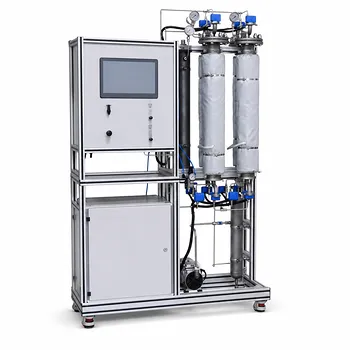
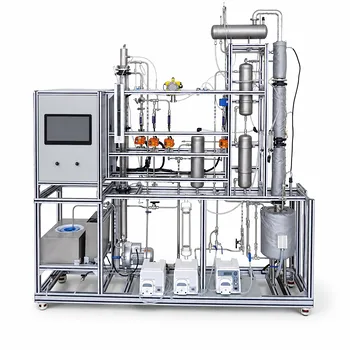
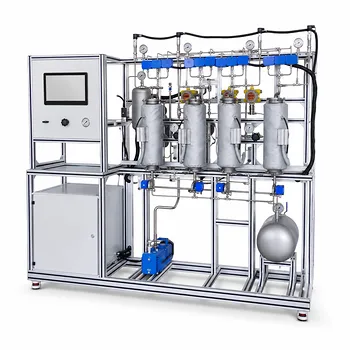
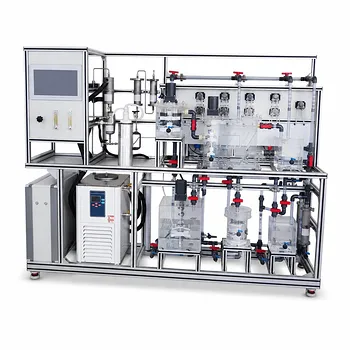
Achieving precise control over critical reaction parameters like temperature and moisture is key to successful process scale-up. LABPARK designs and manufactures high-performance Educational and Vocational Unit Operations Pilot Plants tailored for chemical engineering, bioprocess & biotech, and environmental & water treatment applications.
We empower universities, research institutes, and enterprises to:
- Conduct precise, real-world simulations of gas purification and absorption dynamics.
- Elevate hands-on training with industry-grade automation and control systems.
- Accelerate process optimization and sorbent material testing.
Ready to transform your laboratory capabilities? Contact LABPARK today to discuss your custom pilot plant configuration!
Related Products
- Low Concentration Carbon Dioxide Capture Pressure Swing Adsorption Educational Pilot Plant
- Carbon Dioxide Absorption and Desorption Educational Pilot Plant for Carbon Capture Studies
- Dual-Mode Gas Absorption and Desorption Unit Operations Training Pilot Plant
- Carbon Dioxide Adsorption and Capture Educational Unit Operations Pilot Plant
- Thermal Desorption Exhaust Gas and Tail Water Treatment Educational Pilot Plant
People Also Ask
- How does operating pressure influence the transition between absorption and desorption in a CO2 pilot plant?
- What unit operations are critical for CCUS training pilot plants? Build hands-on engineering expertise.
- How can pilot plants show tail gas vs flue gas CO2 capture differences? Key educational insights.
- What are the differences between post- and pre-combustion carbon capture training pilot plants?
- How do temperature variations affect CO2 transport models in pilot plants? Model vs Reality