Radiation heat transfer laws aren’t just theory—they are the experimental blueprint.
Stefan-Boltzmann and Planck’s laws directly shape how thermal radiation is studied in unit operations pilot plants. Planck’s law defines the spectral distribution of a blackbody’s emission, explaining why energy shifts to shorter wavelengths as temperature rises and underpinning sensor selection. Stefan-Boltzmann’s law—the total emissive power scaling with the fourth power of absolute temperature—becomes the core quantitative target that students verify by measuring heat flux at varying emitter temperatures and by isolating the emissivity of real surfaces.
The two laws together transform radiation from an abstract concept into a measurable, design-relevant quantity. Experiments leverage the T⁴ relationship for total power measurements, while Planck’s spectral insight guides everything from pyrometer calibration to the analysis of non-grey gases in fired heaters.
Why Planck’s Spectral Foundation Matters in the Lab
The Distribution That Drives Detector Choice
Planck’s law shows that a blackbody’s monochromatic emissive power is a strong function of wavelength and temperature. At the modest temperature range of many educational pilot plants (a few hundred to over 1000 K), the peak emission falls in the infrared. This single fact justifies the use of broadband thermopile radiometers—their response captures the bulk of the emitted energy—and explains why optical pyrometers must be selected with the right spectral sensitivity.
From Spectral Curves to Total Power
Integrating Planck’s law over all wavelengths yields the Stefan-Boltzmann law. Students don’t need to perform this integration in the lab, but understanding it resolves a key point: the total flux measured by a radiometer is the area under the spectral curve. That connection turns the blackbody into a reference standard, anchoring all subsequent emissivity and heat-flux measurements in a universally accepted physical relationship.
Verifying Stefan-Boltzmann’s Law with a Pilot-Plant Blackbody
The Standard Experimental Setup
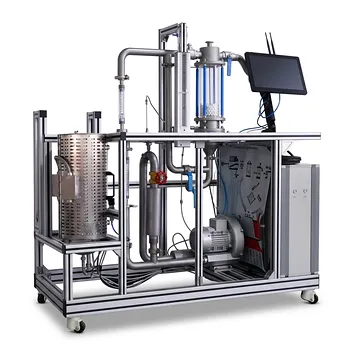
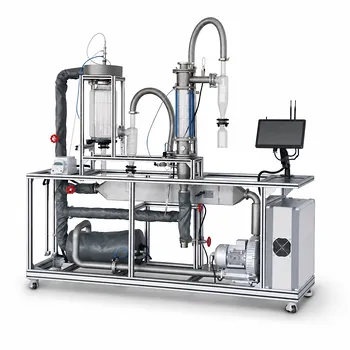
A typical pilot plant features a heated blackbody source, a thermopile radiometer, and an array of interchangeable target plates. The blackbody is brought to a series of steady temperatures, and the radiometer records the incident heat flux at a fixed distance. Because the radiometer output is proportional to total radiative power, the experiment becomes a direct test of the (E_b = \sigma T^4) law.
Quantifying the T⁴ Relationship
Students plot the measured heat flux against the fourth power of the absolute temperature. A straight-line fit confirms the proportionality, and the slope can be compared to the theoretical Stefan-Boltzmann constant after accounting for the radiometer’s view factor and any background radiation. Minor deviations immediately spark discussion about non-ideal blackbody behavior, ambient reflections, or sensor limitations—teaching the gap between ideal theory and real measurement.
Unlocking Material Emissivity with the Grey Body Approach
The Emissivity Measurement Procedure
To determine a material’s emissivity (\epsilon), a test plate is heated to the same temperature as the reference blackbody. The radiometer measures its emissive power (E). Since both surfaces are at temperature (T), Planck’s law guarantees that the spectral distribution of the blackbody is identical at that temperature. The ratio (\epsilon = E / E_b) therefore yields the total hemispherical emissivity, provided the test plate behaves as a grey body—an assumption that holds well for many oxidized metals and common engineering materials in the infrared pilot plant range.
Why This Matters for Industrial Processes
Emissivity is not a footnote; it directly determines how efficiently a surface radiates heat. In fired heaters, higher tube-wall emissivity increases heat absorption for the same flame temperature, directly affecting process throughput. By measuring (\epsilon) in a controlled pilot plant, students connect material selection to the overall heat transfer coefficient of real exchangers and furnaces.
Extending the Laws to Complex Geometries: The Fired Heater
A Modified Stefan-Boltzmann Equation for Furnaces
Industrial radiation sections are far from the ideal blackbody cavity. In a pilot-scale fired heater, the radiative heat transfer (Q_r) is expressed as: [ Q_r = \sigma (\alpha A_{cp}) F (T_g^4 – T_t^4) ] Here, (\alpha) is the absorption factor (0.7–1.0 depending on tube spacing), (A_{cp}) the cold plane area, and (F) the exchange factor. The Stefan-Boltzmann law provides the fundamental temperature-to-power relationship; the additional factors correct for geometry and the non-black nature of both tubes and combustion gases.
Where Planck’s Law Re-enters: Non-Grey Gas Radiation
Combustion gases such as CO₂ and H₂O emit and absorb radiation only in specific spectral bands—their emissivity is not constant. Planck’s law defines the spectral baseline against which these bands are located. The exchange factor (F) therefore depends on the partial pressures of these gases and their mean beam length. Understanding this link helps students see why flue gas composition (typically 20–25 % CO₂ + H₂O) and excess air control directly affect the radiant section’s heat flux, which in educative pilot plants often ranges from 20 to 40 kW/m².
Understanding the Trade-offs
Idealisation vs. Engineering Reality
Even a carefully designed blackbody source has an effective emissivity slightly below 1. The grey-body assumption used in emissivity measurements breaks down for polished metals or selective surfaces, introducing systematic errors. Every educational pilot plant must trade perfection for practicality—the goal is to reveal the core physics, not to replicate a metrology laboratory.
Total vs. Spectral Information
Broadband radiometers integrate all wavelengths, losing the detail that Planck’s law describes. This speeds up experiments and keeps data analysis straightforward but obscures interesting spectral effects. If the educational objective includes advanced topics like selective solar coatings or gas radiation, a supplementary spectral measurement becomes necessary, adding complexity and cost.
Sensor and Background Challenges
Thermopile radiometers and thermocouples both require careful calibration; stray reflections from room-temperature surroundings can bias flux readings. Ambient radiation and air convection around the heated source further complicate the tight control required to confirm a T⁴ dependence. Recognising these sources of uncertainty is itself a key learning outcome.
Making the Right Choice for Your Educational Goal
- If your primary focus is teaching fundamental radiation principles: Emphasise the blackbody experiment with a high-quality source and a wide range of temperatures. A clean T⁴ plot builds confidence in the underlying physics.
- If your primary focus is material characterisation: Use isothermal target plates and a reference blackbody to extract emissivity. Compare multiple materials (oxidised copper, painted steel, ceramic) to illustrate how surface condition changes radiative efficiency.
- If your primary focus is industrial fired-heater design: Move to the modified Stefan-Boltzmann equation. Vary excess air, tube spacing, or fuel composition to observe shifts in the exchange factor and overall heat flux.
By treating both Planck’s and Stefan-Boltzmann’s laws as living experimental tools rather than textbook equations, pilot plants transform radiation heat transfer into a tangible, tunable, and industrially relevant science.
Summary Table:
| Law | Physical Principle | Pilot Plant Application | Key Lab Equipment |
|---|---|---|---|
| Planck's Law | Spectral distribution of blackbody emission over wavelengths | Guides sensor selection (IR range) & pyrometer calibration | Infrared radiometers, optical pyrometers |
| Stefan-Boltzmann Law | Total emissive power scales with absolute temperature ($T^4$) | Verifies heat-flux proportionality & determines surface emissivity | Heated blackbodies, target plates, thermopiles |
Bring Thermal Radiation Theory to Life with LABPARK
Are you looking to bridge the gap between textbook physics and practical engineering? LABPARK provides premium Educational and Vocational Unit Operations Pilot Plants across chemical engineering, bioprocess & biotech, and environmental & water treatment.
Specifically engineered for universities, research institutes, and enterprises, our pilot plants empower students and researchers to conduct precise, hands-on experiments in radiation heat transfer, thermodynamics, and fluid dynamics.
Boost your lab's training and research capabilities today—contact our engineering team now to find the ideal pilot plant solution!
Related Products
- Comprehensive Multi-Modal Heat Transfer Unit Operations Pilot Plant for Engineering Training
- Dual Mode Heat Transfer Pilot Plant for Unit Operations Training
- Potassium Salt Thermal Dissolution and Crystallization Separation Educational Unit Operations Pilot Plant
- Three-Tube Heat Transfer Educational Pilot Plant for Unit Operations Training
- Hot Filtration Educational Unit Operations Pilot Plant Laboratory System
People Also Ask
- When is ε-NTU preferred over LMTD in pilot plants? Predict heat exchanger performance without iteration.
- How does thermal conductivity affect pilot plant performance? Optimize heat transfer & accuracy
- Why is emissivity critical in heat transfer pilot plants? Bridge the Gap Between Theory & Industrial Design
- How does cascade control achieve superior disturbance rejection in heat transfer pilot plants?
- How to Verify Air-Side Heat Transfer Coefficient with a Pilot Plant? Practical Lab Guide