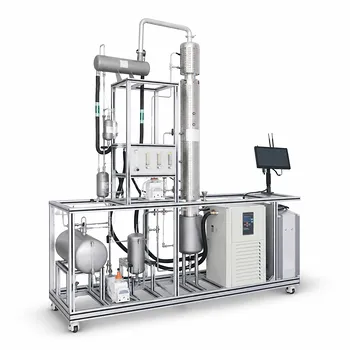
**The separation configuration for your reactive distillation pilot plant hinges on a single, predictive question from the residue curve map: is your desired reaction product a volatile Unstable Node or a heavy Stable Node? If RCM analysis identifies the target product as an Unstable Node (UN)—the lowest-boiling component that all residue curves move away from—you must select a batch rectifier. If it identifies the product as a Stable Node (SN)—the highest-boiling sink where all residue curves terminate—you require a batch stripper. This thermodynamic rule eliminates guesswork and grounds your pilot-plant design in the fundamental phase behavior of the reacting mixture.
Residue curve maps serve as a pre-experimental blueprint. They classify reaction products by their distillation boundaries and node types. A batch rectifier continuously removes a light Unstable Node product overhead, while a batch stripper continuously removes a heavy Stable Node product from the bottom. Matching the column configuration to this node type is the single most effective way to ensure feasible separation before a single experiment is run.
Understanding Residue Curve Maps in Reactive Distillation
Residue curve maps (RCM) are thermodynamic roadmaps. They trace the liquid‑composition path of a simple, open distillation process under total reflux. For a ternary reactive system, these maps reveal which pure components can be reached and which are blocked by distillation boundaries.
The Language of Nodes: Sinks, Sources, and Saddles
Every residue curve map is defined by its fixed points. Unstable Nodes (UN) are composition sources from which residue curves originate—they correspond to the most volatile species. Stable Nodes (SN) are composition sinks into which all curves eventually flow—they are the least volatile species. Saddles (S) are intermediate points that curves approach but never reach. In a reactive system, the reaction equilibrium manifold further constrains these paths, but the classification of products as UN or SN remains the decisive factor.
Why Nodes Dictate Column Configuration
Batch reactive distillation works by preferentially removing one product to drive the reaction forward. If you remove the component that acts as a UN, you are constantly stripping the lightest material from the top. If you remove the component that acts as a SN, you are constantly draining the heaviest material from the bottom. A residue curve map instantly shows which removal strategy is thermodynamically viable.
Applying RCM to Select Your Pilot Plant Configuration
The primary reference gives a crisp rule: match the column to the product’s node type. Here is how that rule translates into hardware and operation.
When to Choose a Batch Rectifier
A batch rectifier is the correct choice when the target reaction product is an Unstable Node (UN) that can be reached by non‑reactive distillation from the relevant distillation region. The light product is continuously vaporized and withdrawn at the top, while the heavier components, including the catalyst or unconverted reactants, remain in the reboiler. This shifts the chemical equilibrium by Le Chatelier’s principle.
Classic educational examples include ethanol dehydration, where water (a UN) is distilled overhead to produce dry ethanol, and tert‑butyl alcohol decomposition, where isobutylene is the light UN product. In each case, the RCM confirms that the product of interest is the source of all residue curves and can be separated without crossing a boundary.
When to Choose a Batch Stripper
A batch stripper is symmetrically designed for products that are Stable Nodes (SN). Here the heavy product is continuously removed from the bottom of the column, while lighter reactants and any inhibitory components are retained in the upper column and reboiler loop. The RCM shows the product as the inevitable sink of all distillation trajectories.
This configuration is the workhorse for etherification reactions. The production of TAME, ETBE, and MTBE all yield heavy ethers that are stable nodes. By stripping the ether from the bottom, you continuously pull the reaction toward completion. In a teaching pilot plant, observing the stripper configuration reinforces the relationship between boiling-point rank and product withdrawal location.
The Critical Role of Distillation Boundaries
A node classification alone is not enough; the product must also be reachable from the reaction region. RCMs are partitioned by distillation boundaries that can isolate nodes. If a boundary separates your reaction composition from the UN or SN product, a simple rectifier or stripper will fail. For example, a saddle product trapped between two boundaries cannot be isolated by either conventional configuration. This insight pushes students beyond cookbook procedures, forcing them to check whether the feed’s composition lies in the same distillation region as the desired node.
Understanding the Trade-offs
The RCM-based rule is powerful, but its blind application carries risks. Here are the common pitfalls and limitations you must manage.
Saddle products will defeat both rectifier and stripper. If your target product is a saddle point, neither overhead nor bottom removal is feasible because the composition path cannot terminate there. In such cases, a batch rectifier or stripper will only produce a mixture. The correct solution is a Batch Reactive Extractive Distillation (BRED) column, which adds an entrainer to break the azeotropes. Misreading a saddle as a node is the most costly mistake in pilot-plant design.
Reactive equilibrium manifolds complicate reachability. In reactive distillation, the reaction creates its own composition constraint. A UN or SN must not only exist on the pure-component RCM but also be reachable from the reaction manifold without crossing a boundary. You must overlay the reaction locus on the map to confirm that the distillation path and reaction path can intersect favorably.
Dynamic operation amplifies the need for accurate maps. Unlike a continuous column, a batch column operates in transient state. The residue curve map is, by definition, a dynamic trajectory. A pilot-plant experiment that fails to pre-plot the RCM will waste time chasing an unreachable composition, while students will miss the critical lesson: thermodynamics sets the ultimate limits, not operating variables.
Making the Right Choice for Your Pilot Plant
Every reactive distillation system presents a unique RCM. Your decision between a batch rectifier and a batch stripper must flow directly from the map’s node structure. Use these goal‑oriented guidelines to translate RCM analysis into hardware selection.
- If your primary goal is to isolate a low‑boiling, volatile reaction product (UN): Select a batch rectifier and confirm on the RCM that the UN is not isolated by a distillation boundary from the reaction mixture.
- If your primary goal is to recover a high‑boiling, heavy reaction product (SN): Select a batch stripper and verify that the SN is the stable sink reachable from the reaction equilibrium manifold.
- If your primary goal is an educational demonstration of dynamic VLE and reaction coupling: Use the RCM to pre‑select a classic rectifier case (e.g., ethanol dehydration) or stripper case (e.g., MTBE synthesis) so students can visually trace composition paths and compare experimental data against the predicted map.
- If your RCM reveals that the target product is a saddle point: Do not attempt to force a rectifier or stripper. Redesign the experiment as a batch reactive extractive distillation (BRED) or modified column, using the map to identify a suitable entrainer that breaks the boundary.
A residue curve map transforms an overwhelming ternary phase diagram into a clear binary choice. Let the thermodynamics show you the way before you build the column.
Summary Table:
| Target Product Node Type | Recommended Configuration | Separation Mechanism | Classic Application Examples |
|---|---|---|---|
| Unstable Node (UN) | Batch Rectifier | Volatile product is removed continuously from the column overhead | Ethanol dehydration, tert-butyl alcohol decomposition |
| Stable Node (SN) | Batch Stripper | Heavy product is drained continuously from the column bottom | Etherification reactions (TAME, ETBE, MTBE) |
| Saddle Point (S) | BRED Column (Extractive) | Requires an entrainer to cross existing distillation boundaries | Azeotropic systems where conventional methods fail |
Bring Thermodynamic Precision to Your Lab
Designing the right reactive distillation setup requires perfect alignment between thermodynamic theory and physical hardware. LABPARK provides high-quality Educational and Vocational Unit Operations Pilot Plants in chemical engineering, bioprocess & biotech, and environmental & water treatment, specifically designed for universities, research institutes, and enterprises.
Whether you need a versatile batch rectifier, a robust batch stripper, or a custom reactive distillation system, our equipment helps students and researchers visualize residue curve trajectories and master complex phase behaviors.
Ready to elevate your chemical engineering laboratory? Contact our engineering experts today to find the perfect pilot plant solution for your institution.
Related Products
- Multi-Functional Special Distillation Educational Pilot Plant
- Continuous Sieve-Plate Distillation Pilot Plant for Unit Operations Laboratory Education
- Multi-Reactor Educational Pilot Plant for Reaction Engineering Unit Operations
- Dual-Mode Rectification Pilot Plant for Practical Training Unit Operations
- Multi-Modal Distillation Unit Operations Training Pilot Plant
People Also Ask
- Why does simple distillation yield higher efficiency than flash distillation? Key thermodynamic differences.
- How does double temperature difference control improve distillation pilot plants? Stabilize purity.
- Why is the acentric factor important in pilot plants? Fluid property prediction.
- How to Integrate Spectroscopy in Distillation Pilot Plants for Advanced Process Control
- How to Verify Distillation Boundary Lines & Composition Regions with Pilot Plants