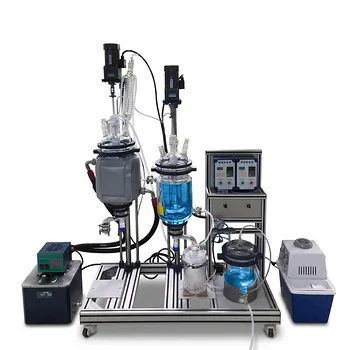
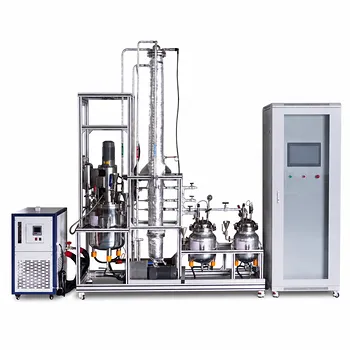
The core of your question is about control. In a chemical engineering polymerization pilot plant, the final polymer product distribution—its molecular weight distribution (MWD), composition, and chain architecture—is directly governed by the interplay between reactor configuration and operating parameters. A change in reactor type (batch vs. continuous) or a shift in mixing intensity or temperature uniformity will fundamentally alter the residence-time experience of the reacting species, and thus the final polymer properties.
The molecular weight distribution and chemical composition of your polymer are not just a recipe outcome; they are a fingerprint of the reactor's fluid dynamics and thermal history. In a pilot plant, mastering the relationship between configuration (batch, CSTR, loop) and parameters (mixing, heat transfer, residence time) is the key to scaling up with reproducible quality.
Why Reactor Configuration Dictates the Product's DNA
The choice between reactor configurations isn't just about throughput; it fundamentally changes the reaction pathway. In a batch reactor, all polymer chains grow together in a closed system, experiencing a uniform and changing chemical environment. In a continuous stirred-tank reactor (CSTR) , newborn chains are immediately mixed with older chains and exposed to a constant, average composition. This difference creates a stark divergence in the final product distribution.
The Residence-Time Lottery: How Long a Chain Lives Matters
Denbigh's rule provides a critical framework here. It states that when the mean lifetime of a growing polymer chain is long compared to the mean residence time in a CSTR, the reactor produces a broader MWD than a batch reactor. This happens because the continuous outflow acts as an artificial termination step, randomly cutting chains short while others stay longer, widening the spread of chain lengths. This is typical for step-growth and living anionic polymerizations.
However, the rule inverts for systems with very short chain lifetimes, like free-radical polymerization. In a batch reactor, the monomer concentration drops over time, causing a drift in the MWD and often broadening it. Moving to a CSTR provides a steady-state, constant-low monomer environment, which can actually narrow the MWD by eliminating this temporal drift.
Morphology Control Through Backmixing
Configuration also determines selectivity for complex reaction networks. If your polymerization has a desired intermediate product R that can react further to form an unwanted byproduct S (a series reaction), you must minimize backmixing. Reactors like plug flow, spray towers, or venturi loop reactors excel here because they tightly control contact time and prevent R from re-entering the reaction zone. For parallel side reactions that are slow, a reactor with low liquid holdup (like a spray tower) suppresses the side reaction by minimizing the time available for it to occur.
The Operating Parameters That Steer the Distribution
Even with a fixed reactor type, operating parameters act as fine-tuning knobs. Poor control here can override the benefits of an ideal configuration, leading to off-spec polymer.
The Thermal Tightrope: Heat Transfer and the Gel Effect
Polymerization reactions are highly exothermic. In bulk polymerization, as conversion rises, viscosity skyrockets. This restricts the mobility of macroradicals, inhibiting the termination reaction while propagation continues unabated. This auto-acceleration, known as the gel effect, causes a rapid, dangerous heat release.
Without precise heat removal via jackets or coils, you get local overheating. This leads to a broadened MWD, branching, gel formation, or even thermal runaway. Pilot plant reactors therefore demand highly responsive cooling systems and safety interlocks to mimic safe industrial conditions.
Mixing: The Hidden Architect of Uniformity
As viscosity builds, the fluid often becomes non-Newtonian. Agitator design and power input become everything. Poor mixing in a stirred tank creates stagnant zones and temperature gradients. A chain growing in a hot spot will terminate differently than one in a cool zone, directly resulting in a non-uniform product distribution. In pilot plants, impeller choice (e.g., anchor, helical ribbon) is not a minor detail; it is the primary tool to ensure that every molecule sees the same thermal and chemical history.
The Scale-Up Disconnect
When moving from a lab bench to a pilot plant, "scale-up effects" appear. The fluid flow and mixing in a larger stirred tank are entirely governed by the impeller's movement. A parameter like tip speed that worked at small scale may fail to provide uniform mass transfer at pilot scale. This discrepancy can lead to an unexpected drift in MWD or composition, making pilot-scale validation indispensable.
Understanding the Trade-offs
No single configuration or parameter set is perfect. An objective view reveals clear trade-offs you must navigate:
- Batch vs. CSTR for Narrow MWD: A batch reactor often yields a narrower MWD for long-lived chains, but requires precise temporal control and has downtime between batches. A CSTR offers continuous production and a steady-state product, but its inherent RTD may broaden the distribution unless dealing with very fast-terminating free-radical systems.
- Cost of Suppressing Side Reactions: Plug-flow or spray towers give excellent selectivity but can struggle with high-viscosity, fouling polymer melts that are easily handled in a continuously scraped CSTR.
- Heat Removal vs. Mixing Complexity: Efficient jacketed cooling combined with high-torque agitation solves the gel effect problem, but increases capital and maintenance costs. This is the price of preventing a runaway reaction and ensuring product consistency.
Making the Right Choice for Your Pilot Plant Goal
Your optimal reactor setup depends entirely on what you are trying to learn or produce. Here’s how to prioritize:
- If your primary focus is understanding intrinsic kinetics and producing a tight MWD under transient conditions: Prioritize a well-characterized batch reactor with precise temperature control. It gives you the cleanest, drift-based data for modeling.
- If your primary focus is simulating industrial, high-volume free-radical production with a consistent, narrow MWD: Use a CSTR operated at steady state. Eliminating temporal monomer drift can be your biggest tool for narrowing the distribution.
- If your primary focus is synthesizing a valuable intermediate in a series reaction network or minimizing a slow side reaction: Choose a plug-flow or spray tower reactor with minimal backmixing and controlled, short residence times.
- If your primary focus is scaling up a viscous bulk polymerization safely: Invest in a reactor with a specialized high-torque agitator and a high-capacity cooling system. The hardware becomes as critical as the chemistry to manage the gel effect and ensure product uniformity.
Ultimately, a pilot plant is a laboratory for learning the cause-and-effect chain. By methodically varying configuration and parameters, you translate a chemical recipe into a predictable, scalable manufacturing process.
Summary Table:
| Reactor Configuration / Parameter | Impact on Polymer Distribution (MWD) | Best Use Case / Mitigation |
|---|---|---|
| Batch Reactor | Narrower MWD for long-lived chains; subject to temporal drift in free-radical systems. | Kinetic studies & transient condition modeling. |
| CSTR | Broader MWD due to RTD (except for fast-terminating free-radical polymerizations). | Continuous steady-state simulation. |
| Plug Flow / Loop | Narrower MWD by preventing backmixing and suppressing side reactions. | Series reactions and intermediate synthesis. |
| Mixing & Heat Control | Poor control causes local hot spots, the gel effect, and broadened MWD. | High-torque agitators & high-capacity cooling systems. |
Scale Up Your Polymerization Research with LABPARK
Ready to master reactor control and optimize polymer product distribution? LABPARK provides advanced Educational and Vocational Unit Operations Pilot Plants in chemical engineering, bioprocess & biotech, and environmental & water treatment.
Designed specifically for universities, research institutes, and enterprises, our pilot plants enable precise control over mixing, temperature, and residence times to ensure successful scale-up.
Contact LABPARK today to discover how our custom pilot systems can elevate your research and vocational training.
Related Products
- Polymerization Granulation and Pellet Processing Educational Unit Operations Pilot Plant
- Ethyl Acetate Synthesis Unit Operations Pilot Plant for Practical Training
- Methanol Synthesis and Catalyst Performance Evaluation Educational Unit Operations Pilot Plant
- Bio-fermentation Ethanol Production Practical Training Unit Operations Pilot Plant
- Multi Functional Membrane Crystallization Educational Unit Operations Pilot Plant
People Also Ask
- How do educational unit operations pilot plants bridge theory and design? Bridge the Engineering Gap
- How do educational unit operations pilot plants address safety and waste management when scaling up?
- Why Compare Predicted and Experimental Excess Enthalpy? Key to Accurate Pilot Plant Scale-up
- When to transition from PID to adaptive control in pilot plants? Key process indicators.
- Why Use PTFE & Hastelloy in Chemical Pilot Plants? Prevent Corrosion & Ensure Safety