The success of your pilot plant run begins long before you turn the first valve.
Process simulation convergence methods, particularly Bounded Wegstein and Newton-based solvers, are the mathematical engines that determine whether a simulation of your pilot plant’s recycle loops will provide stable, realistic predictions or crash into an error. In the design and operation of chemical engineering unit operations pilot plants, these methods directly translate into accurate design parameters, safe operating setpoints, and reliable experimental data.
The choice of convergence method is a critical design decision. Bounded Wegstein offers fast, robust convergence for standard single-loop recycles, while Newton-based methods are essential for handling the highly non-linear, multi-variable interactions in complex pilot systems like multiple interconnected recycles or integrated distillation columns.
The Digital Twin of a Pilot Plant
Before a physical pilot plant processes any material, its entire process flow must be modeled to predict behavior and establish safe operating boundaries. This is where convergence methods become indispensable.
Replicating Industrial Reality in Modular Form
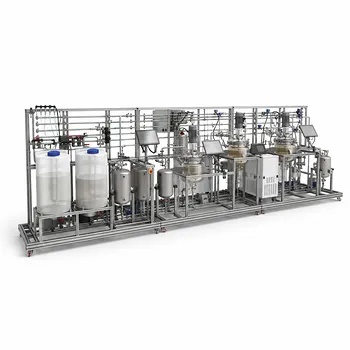
Educational and research pilot plants typically assemble modular unit operations—reactors, separators, and recycle streams—that mirror industrial setups. These systems often include critical recycle loops to recover unreacted materials or reuse solvents, just as in full-scale plants.
The Simulation as a Pre-Laboratory Requirement
Running a steady-state simulation is the first experiment. It allows engineers to explore “what-if” scenarios, estimate material and energy balances, and screen for potentially hazardous conditions before committing physical resources.
The Convergence Bottleneck Introduced by Recycles
A recycle stream creates a circular calculation dependency: the outlet of a downstream unit feeds back into an upstream unit, which in turn changes that downstream outlet. The process simulator must iteratively guess the recycle stream values (known as a tear stream) and continuously recalculate until the loop satisfies all material and energy balances. This iterative solving is convergence, and the method you choose dictates whether—and how quickly—you get a usable answer.
The Convergence Engine: Wegstein vs. Newton Methods
Your choice of convergence method directly shapes how your pilot plant's simulation handles this circular logic, impacting both the speed of your design iterations and the plausibility of the final results.
Bounded Wegstein: The Workhorse for Standard Recycles
The Bounded Wegstein method is prized for its robustness and speed when dealing with typical, single-tear recycle loops. It works by making a bounded extrapolation of the tear variable between successive iterations, effectively damping oscillations. For a pilot plant with a straightforward recycle of unreacted reactants back to a reactor, Bounded Wegstein often delivers a converged solution in just a few iterations, making it ideal for rapid design cycles.
Newton Methods: Taming Non-Linearity in Complex Units
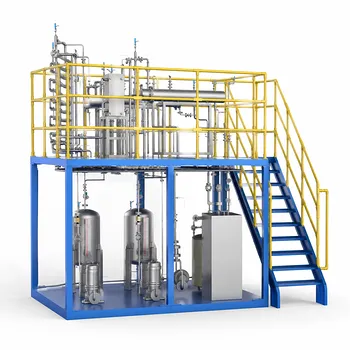
For pilot systems featuring highly non-linear interactions, such as multiple interconnected recycle loops or an integrated distillation column where vapor-liquid equilibrium tightly couples material and energy balances, Newton or Quasi-Newton methods become essential. These methods use derivative information (the Jacobian matrix) to solve all variables simultaneously, navigating the highly coupled, non-linear problem space where Wegstein’s simpler approach may oscillate wildly or completely fail. When your pilot plant is a complex, tightly integrated miniaturization of a full process, Newton-based methods provide the accuracy needed for a credible design basis.
Selecting the Right Tool for the Job
In practice, the selection is pragmatic. A pilot plant designed for simple educational reaction-and-separation experiments can rely on Bounded Wegstein for fast, trouble-free simulations. A research pilot exploring a novel process with multiple recycles and a reactive distillation column will likely fail to converge without switching to a Newton-based solver. The method is not a purely academic choice; it is the factor that determines whether your digital design basis is trustworthy.
Understanding the Trade-offs and Pitfalls
Convergence methods bring inherent trade-offs, and treating a converged simulation as an infallible prediction is a dangerous oversight in pilot plant work.
The Limits of Robustness
While Bounded Wegstein is fast, it can stall or diverge when recycles are strongly coupled. For example, if the recycle composition significantly alters the reactor temperature, which in turn affects the separation and the recycle composition, the method’s bounded extrapolation may not be able to find a consistent solution, silently producing a physically meaningless result.
The Cost of Precision
Newton-based methods demand high-quality initial guesses and significantly more computational effort. A poorly initialized simulation of a complex pilot plant can crash or converge to a non-physical local minimum. This requires the user to have a deeper understanding of the process, making it less “plug-and-play” than Wegstein.
Convergence Is Not Validation
The most critical pitfall is separating mathematical closure from physical reality. Even a perfectly converged simulation relies on simplified models (such as an Equation of State) that may inadequately capture real-world fouling, heat loss, or non-ideal fluid dynamics. Your converged simulation generates a hypothesis, not a certainty. The entire purpose of the physical pilot plant is to validate that hypothesis against empirical data.
From Converged Simulation to Safe, Meaningful Operation
A well-converged steady-state simulation becomes the cornerstone for safe and effective pilot plant operation, bridging theory and practice.
Setting the Stage for Physical Experiments
The converged values for flow rates, temperatures, and pressures become the initial setpoints for the pilot plant’s control system. This ensures the physical plant starts up in a region verified to be safe and theoretically optimal, minimizing wasted materials and time.
Providing a Baseline for Dynamic Analysis
While steady-state convergence methods are the focus, the resulting model serves as the launching point for dynamic simulation. This virtual counterpart lets you simulate time-dependent events—startup, grade transitions, emergency shutdowns—by comparing simulated dynamic responses against real-time pilot plant sensor data. This practice is essential for teaching control loop tuning and safely rehearsing emergency procedures long before any physical equipment is at risk.
Enabling Rigorous Scale-up and Model Refinement
The pilot plant generates real-world data on performance, cycle times, and equipment constraints. By comparing these empirical results with the original converged simulation, researchers can identify and quantify discrepancies caused by oversimplifications. This feedback loop refines the model’s assumptions, creating a validated digital twin that can be used to confidently design a commercial-scale facility.
Making the Right Choice for Your Pilot Plant
The selection of a convergence method should be guided by your specific experimental context and the dominant risks you face.
- If your primary focus is rapid design iterations on a standard educational pilot plant with a single recycle: Rely on Bounded Wegstein. Its unmatched speed and robustness for simple loops will keep your design process moving.
- If your primary focus is a complex, multi-recycle research pilot plant with an integrated distillation or reactive separation unit: Transition to a Newton or Quasi-Newton method immediately. The accuracy required for a credible design basis in such a tightly coupled system justifies the additional computational cost and setup effort.
- If your primary focus is troubleshooting a non-converging simulation: First, check your initial guesses and the physical consistency of your specifications. A common failure is expecting a perfect solution from an inappropriate method—switching from Wegstein to a Newton-based solver for a highly non-linear problem is often the solution, not an admission of defeat.
Your pilot plant is only as insightful as the simulation that precedes it. Choosing the right convergence method is the first, non-negotiable step toward transforming a mathematical abstraction into a reliable, safe, and instructive physical experiment.
Summary Table:
| Convergence Method | Best Used For | Key Advantages | Typical Pitfalls |
|---|---|---|---|
| Bounded Wegstein | Simple, single-tear recycle loops in educational setups | Fast, robust, and easy to set up | Can stall or diverge with strongly coupled recycles |
| Newton / Quasi-Newton | Complex, multi-variable, highly non-linear systems | High accuracy; solves all variables simultaneously | Requires high-quality initial guesses; computationally intensive |
Ready to Bridge the Gap Between Simulation and Physical Operations?
At LABPARK, we help universities, research institutes, and enterprises transition seamlessly from digital models to physical reality. We provide high-quality Educational and Vocational Unit Operations Pilot Plants across chemical engineering, bioprocess & biotech, and environmental & water treatment.
Whether you are validating process simulations or training the next generation of engineers, our custom-engineered pilot systems ensure reliable, safe, and scale-up ready data.
Contact LABPARK today to discuss your unit operations requirements and get a tailored solution for your facility!
Related Products
- General Purpose Cosmetics Production Unit Operations Training Pilot Plant
- Multi-Functional Drying Educational Unit Operations Pilot Plant
- Multi Pump Fluid Transport Process Piping Unit Operations Training Pilot Plant
- Fixed-Bed Chemical Reaction and Gas Dust Tar Removal Unit Operations Pilot Plant
- 100L Continuous Loop Hydrogenation Educational Unit Operations Pilot Plant
People Also Ask
- How do deviations in estimating latent heat impact pilot plant thermal systems? Avoid hardware mis-sizing.
- Why is the chemical plant startup schedule crucial? De-risk scale-up with pilot plants.
- When to transition from PID to adaptive control in pilot plants? Key process indicators.
- Why Compare Predicted and Experimental Excess Enthalpy? Key to Accurate Pilot Plant Scale-up
- Why Use PTFE & Hastelloy in Chemical Pilot Plants? Prevent Corrosion & Ensure Safety