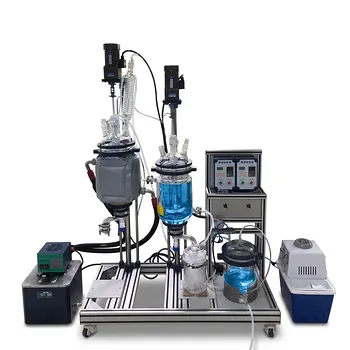
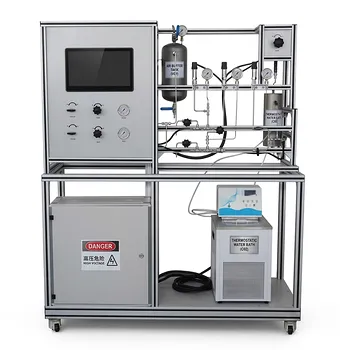
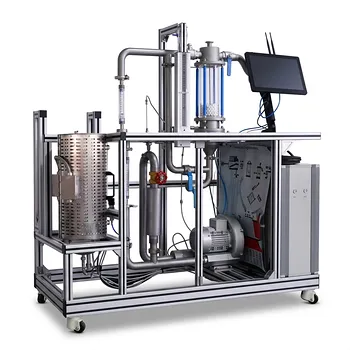
Prandtl and Nusselt numbers provide complementary information: the Prandtl number (Pr) describes how a fluid’s momentum diffuses relative to heat, while the Nusselt number (Nu) measures the strength of convective heat transfer relative to conduction across a fluid layer. In thermal unit operation pilot plants, engineers vary flow conditions, measure temperatures and heat fluxes, and use these dimensionless numbers—usually with the Reynolds number—to develop correlations such as Nu = f(Re, Pr) for scale-up and equipment design.
Pr tells you how the fluid forms its thermal and velocity boundary layers; Nu tells you how effectively heat is transferred. Together, they convert pilot-plant measurements into transferable design relationships for heat exchangers, reactors, and other thermal systems.
What the Prandtl Number Reveals
Comparing Momentum and Thermal Diffusion
The Prandtl number is defined as:
[ Pr = \frac{\mu c_p}{\lambda} = \frac{\nu}{a} ]
where (\mu) is dynamic viscosity, (c_p) is specific heat capacity, (\lambda) is thermal conductivity, (\nu) is kinematic viscosity, and (a) is thermal diffusivity.
A low Prandtl number means heat diffuses relatively quickly compared with momentum. A high Prandtl number means momentum diffuses more readily than heat.
Relating Boundary-Layer Thicknesses
Pr indicates the relative thickness of the velocity and thermal boundary layers near a heated or cooled wall.
For high-Pr fluids such as heavy oils and polymer solutions, thermal diffusion is slow. The thermal boundary layer is therefore much thinner than the velocity boundary layer, concentrating the temperature gradient close to the wall.
Connecting Fluid Properties to Pilot-Plant Behavior
Because Pr is calculated from measurable fluid properties, it helps engineers distinguish whether heat-transfer behavior is dominated by viscosity, thermal conductivity, or heat capacity.
This is important in pilot plants because process fluids can differ substantially from water. A correlation developed with a low-viscosity fluid may not apply directly to viscous oils or non-Newtonian solutions.
What the Nusselt Number Reveals
Measuring Convective Heat Transfer
The Nusselt number is commonly written as:
[ Nu = \frac{hL}{\lambda} ]
where (h) is the convective heat-transfer coefficient and (L) is a characteristic length.
An equivalent wall-based form is:
[ Nu = \frac{q_w L}{\lambda (T_w-T_\infty)} ]
where (q_w) is wall heat flux, (T_w) is wall temperature, and (T_\infty) is the bulk-fluid temperature.
Comparing Convection with Conduction
Nu compares actual convective heat transfer with heat transfer that would occur by conduction across a fluid layer of characteristic length.
A value near unity indicates that conduction is the dominant reference mechanism. Larger values indicate stronger convective enhancement caused by fluid motion, mixing, turbulence, or boundary-layer development.
Converting Measurements into Design Parameters
Once Nu is known, the heat-transfer coefficient can be obtained from:
[ h = \frac{Nu \lambda}{L} ]
This coefficient is directly useful for estimating heat-transfer area, required heating or cooling duty, outlet temperatures, and equipment performance.
How Pilot Plants Use Pr and Nu Together
Varying the Reynolds Number
The Reynolds number describes the relative importance of inertial and viscous forces:
[ Re = \frac{\rho v L}{\mu} ]
Pilot plants can vary flow rate to test laminar, transitional, and turbulent regimes. For each operating condition, engineers calculate Re and Pr, then measure heat flux and wall-to-bulk temperature differences to determine Nu.
Building Dimensionless Correlations
The measured data can be fitted to a relationship such as:
[ Nu = f(Re, Pr) ]
These correlations summarize how geometry, flow regime, and fluid properties affect convective heat transfer. They are more useful for scale-up than isolated temperature or heat-flux measurements because they can be applied across different sizes and operating conditions within the validated range.
Evaluating Heat Exchangers and Reactors
In shell-and-tube and plate heat-exchanger pilot units, Nu helps quantify the local or average heat-transfer coefficient. In reactor thermal-control studies, it helps predict wall heat removal and temperature gradients that influence reaction safety and product quality.
Demonstrating Boundary-Layer Effects
Pilot measurements can show how increasing flow rate changes Nu through boundary-layer disruption and turbulence. They can also show how increasing Pr makes the thermal boundary layer thinner and changes the wall temperature gradient.
High-Prandtl-Number Fluids
Why Viscous Fluids Behave Differently
For high-Pr fluids, the thermal boundary layer remains within the near-wall region where the velocity profile is approximately linear.
This makes wall shear stress and near-wall fluid properties especially important. The core turbulence structure may have less direct influence on the dominant thermal resistance than the wall region.
The High-Prandtl-Number Scaling
Under selected high-Prandtl-number conditions, asymptotic analysis gives a relationship in which:
[ Nu \propto Pr^{1/3} ]
For example, one flat-plate constant-wall-temperature relation is:
[ \frac{Nu}{Re^{1/2}} = 0.339 Pr^{1/3} ]
This type of expression can help estimate heat-transfer behavior for viscous process fluids, provided the geometry, boundary condition, and flow regime match the correlation’s assumptions.
Using Wall-Based Measurements
For highly viscous fluids, wall-based correlations can relate heat transfer primarily to wall shear stress and fluid properties.
This can simplify analysis in teaching and research pilot plants, but the result still requires validation against the particular equipment geometry and operating range.
Turbulent Flow and Thermal Diffusivity
The Turbulent Prandtl Number
In turbulent flow, engineers may also use the turbulent Prandtl number:
[ Pr_t = \frac{\nu_t}{a_t} ]
where (\nu_t) is turbulent eddy viscosity and (a_t) is turbulent thermal diffusivity.
Experimental modeling often treats (Pr_t) as approximately constant, with a value near 0.87 for many turbulent flows and molecular Prandtl numbers above about 0.5. This is a modeling approximation, not a universal fluid property.
Separating Core Mixing from Wall Resistance
Turbulent eddies dominate much of the thermal transport in the flow core. However, the final temperature drop often occurs in the thin near-wall region, where molecular thermal diffusivity and Pr strongly affect resistance.
Pilot-plant data helps determine whether a constant-(Pr_t) model is adequate or whether more detailed treatment is required.
Interpreting Turbulent Pipe Results
In turbulent internal flows, increasing Pr generally makes the thermal boundary layer thinner relative to the momentum boundary layer and can increase Nu.
This behavior differs from the fully developed laminar case, where certain idealized boundary conditions produce a Nu that is independent of Pr. The distinction matters when interpreting pilot data across different flow regimes.
Understanding the Trade-offs
Correlations Are Not Universal
A Nu correlation is valid only within the geometry, surface condition, flow regime, property range, and thermal boundary conditions used to develop it.
A correlation from a smooth circular tube should not automatically be applied to a plate heat exchanger, packed bed, particle suspension, or reactor coil.
Average Values Can Hide Local Hot Spots
An average Nu or heat-transfer coefficient may conceal local regions with poor heat transfer, fouling, flow maldistribution, or excessive wall temperature.
Pilot plants should therefore use local measurements where thermal gradients or safety constraints are important.
Fluid Properties Change with Temperature
Viscosity, thermal conductivity, density, and heat capacity can vary significantly across a heated or cooled process stream. Using properties at only the inlet temperature may produce an inaccurate Prandtl number and therefore an inaccurate Nu correlation.
Property evaluation should match the convention used by the selected correlation, such as bulk temperature, wall temperature, or a suitable film temperature.
High-Viscosity Fluids Increase Pressure-Drop Costs
Increasing flow rate may improve Nu by increasing Re, but it also increases pumping requirements and may create high pressure drops for viscous fluids.
The best operating point is therefore a thermal-economic compromise between heat-transfer performance, energy consumption, residence time, and equipment constraints.
Making the Right Choice for Your Goal
Use Pr and Nu as part of a measured, dimensionless characterization process rather than as isolated numbers.
- If your primary focus is heat-exchanger sizing: Measure or estimate Nu, convert it to (h), and use the coefficient with the required heat duty and temperature driving force to determine area.
- If your primary focus is scale-up: Collect pilot data across the relevant Re and Pr ranges, then develop or validate a correlation such as (Nu=f(Re,Pr)) for the target geometry.
- If your primary focus is processing viscous oils or polymer solutions: Give particular attention to high-Pr behavior, near-wall temperature gradients, wall shear stress, and temperature-dependent viscosity.
- If your primary focus is turbulent-flow modeling: Use a suitable turbulent Prandtl-number assumption, but verify it against measured heat fluxes and temperature profiles.
- If your primary focus is thermal safety or product quality: Evaluate local as well as average Nu values so that hot spots, cold spots, and flow maldistribution are not hidden by bulk averages.
Pr describes the fluid’s diffusion behavior, Nu quantifies the resulting convective performance, and pilot-plant measurements connect both to reliable thermal equipment design.
Summary Table:
| Dimensionless number | What it indicates | Pilot-plant application |
|---|---|---|
| Prandtl (Pr) | Relative momentum and thermal diffusion; boundary-layer behavior | Select fluid-property models and assess viscous-fluid heat transfer |
| Nusselt (Nu) | Convective heat transfer relative to conduction | Calculate heat-transfer coefficients and required equipment area |
| Reynolds (Re) | Relative inertial and viscous forces | Classify flow and validate operating-regime correlations |
| Turbulent Prandtl (Prₜ) | Ratio of turbulent momentum to thermal diffusivity | Model heat transport in turbulent-flow systems |
| Nu = f(Re, Pr) | Combined flow and fluid-property relationship | Support scale-up of heat exchangers, reactors, and thermal units |
Need reliable thermal data for scale-up or equipment design? Contact LABPARK to discuss your project. LABPARK provides Educational and Vocational Unit Operations Pilot Plants for chemical engineering, bioprocess and biotechnology, and environmental and water treatment applications. Our systems help universities, research institutes, and enterprises measure heat flux, temperature profiles, flow behavior, Prandtl and Nusselt numbers, and heat-transfer coefficients under controlled conditions. Use validated pilot-plant data to size heat exchangers, evaluate reactor thermal control, study viscous fluids, improve process safety, and develop correlations for dependable scale-up.
Related Products
- Comprehensive Multi-Modal Heat Transfer Unit Operations Pilot Plant for Engineering Training
- Dual Mode Heat Transfer Pilot Plant for Unit Operations Training
- Potassium Salt Thermal Dissolution and Crystallization Separation Educational Unit Operations Pilot Plant
- Hot Filtration Educational Unit Operations Pilot Plant Laboratory System
- Three-Tube Heat Transfer Educational Pilot Plant for Unit Operations Training
People Also Ask
- Why is the study of thermal boundary layers and Prandtl numbers critical in heat transfer unit operations pilot plants?
- When is ε-NTU preferred over LMTD in pilot plants? Predict heat exchanger performance without iteration.
- How is the effective thermal conductivity of a dilute particle suspension calculated? A Pilot Plant Guide
- Why monitor temperature correction factor (Ft) in pilot plants? How to handle values below 0.75
- How to Verify Air-Side Heat Transfer Coefficient with a Pilot Plant? Practical Lab Guide