The real lesson isn’t just cleaning—it’s seeing a liability transform into an asset through applied physics. These pilot plants bridge the gap between theoretical thermodynamics and the operational reality of industrial symbiosis. By physically separating dust from a valuable gas stream and then measuring its calorific recovery potential, students move from abstract chemical equations to a tangible understanding of mass and energy balance, learning to optimize a system where safety, efficiency, and profitability intersect.
Blast furnace gas is simultaneously a pollution hazard and a premium fuel. Cyclone and gas purification pilot plants demystify this duality by letting students directly control the separation process—manipulating velocity to see the immediate trade-off between cleaning efficiency and energy cost, before quantifying exactly how much thermal energy the recovered carbon monoxide can provide.
The Complete Process Loop: From Waste to Resource
The educational power of a pilot plant lies in its ability to compress a sprawling industrial process into a single, observable system. For high-CO off-gas, this loop has two critical stages: separating the hazardous dust and utilizing the clean energy potential.
Why Blast Furnace Gas Demands Immediate Attention
In industrial operations, the gas leaving the top of a furnace is a chaotic mixture. It contains roughly 22% to 25% combustible carbon monoxide but is laden with abrasive, hazardous dust.
The dust must be removed first. Without this step, the gas would destroy compressor blades, clog burner nozzles, and create explosive fine-particle risks.
The CO cannot be wasted. In a modern ironmaking facility, this gas isn't a byproduct—it's a primary energy source for the hot blast stoves, a massive heat exchanger that preheats the air being forced into the furnace.
The Pilot Plant as a Teaching Reactor
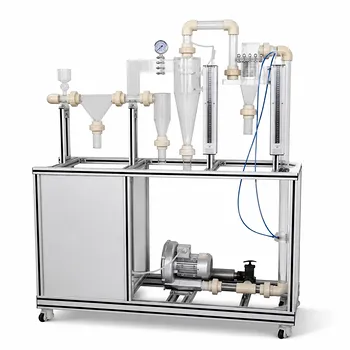
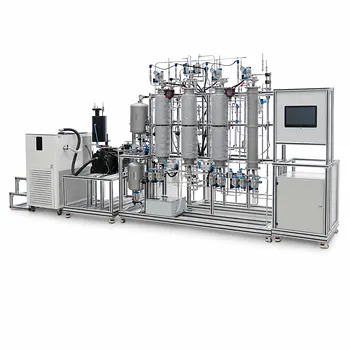
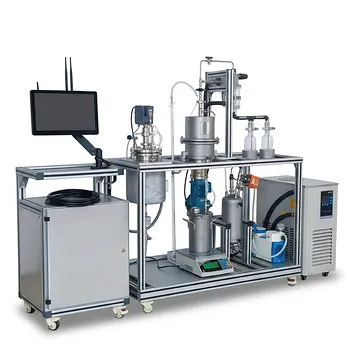
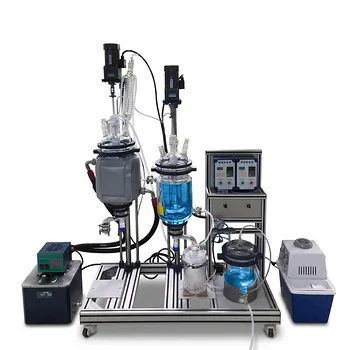
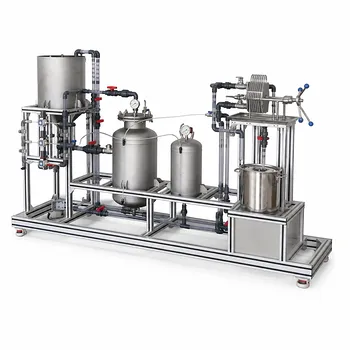
A unit operations pilot plant replicates this exact loop on a scale that fits in a laboratory. Students physically pipe a simulated dusty gas stream through a cyclone separator and then analyze the clean gas composition.
This moves the learning from a textbook diagram to a physical troubleshooting exercise. They can film particle trajectories with high-speed cameras, measure the actual dust load caught in the collection hopper, and directly compare the inlet and outlet concentrations.
The Cyclone Separator: Teaching the Optimization Problem
The centerpiece of this hands-on learning is the cyclone separator. It’s a brilliantly simple device—no moving parts—but its operation provides a masterclass in the physics of gas-solid separation and the engineering of cost.
Decoding the Grade Efficiency Curve
The primary pedagogical tool is the grade efficiency curve. By sampling particle size distribution at the inlet, outlet, and the dust hopper, students plot separation efficiency as a function of particle diameter.
This single graph exposes the two most critical performance parameters. The cut size ((d_{50})) reveals the particle diameter at which 50% of the particles are collected. The critical size ((d_c)) defines the theoretical limit of what the cyclone can capture under specific conditions. These metrics teach students to predict gas cleanliness with precision.
The Inescapable Relationship of Velocity and Pressure
This is where the "aha" moment often occurs. Students operate the pilot plant at varying inlet gas velocities and measure the static pressure drop ((\Delta p)) between the inlet and outlet.
Increasing velocity dramatically boosts centrifugal force, sending more particles toward the cyclone wall and improving efficiency. The separation curve shifts favorably, and even smaller particulates are captured.
However, this performance gain is not free. A higher gas velocity creates a significantly higher pressure drop. The logic is unforgiving: to push gas faster through a constricted, spiraling path, you must expend significantly more electrical energy on the upstream fans or compressors. The lesson becomes a clear optimization problem—finding the "sweet spot" where the gas is "clean enough" for downstream use without incurring wasteful energy costs.
Ensuring Gas Quality for Safe Utilization
Once the bulk dust is removed, the educational focus shifts to the fuel's end-use. The pilot plant system allows students to close the loop on the concept of energy balance.
Connecting Purity to Thermal Performance
The value of high-CO off-gas is its calorific value, which can be pre-calculated and then empirically verified by feeding the pilot plant's output to a small combustion unit or analyzing it via gas chromatography.
Students can quantify how much energy is lost if combustion air preheaters must be taken offline for cleaning due to incomplete dust removal. They learn a fundamental principle of industrial ecology: a stable, clean gas supply directly translates to a predictable and efficient thermal cycle for hot blast stoves.
Bridging Solid Separation and Gas Absorption
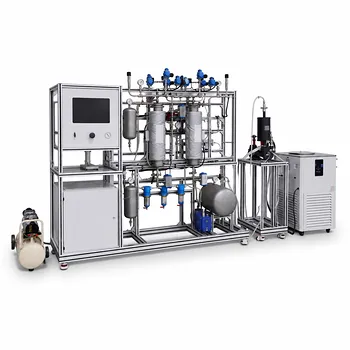
While cyclone pilot plants handle the dust, gas purification columns extend the teaching into the realm of mass transfer. Supplementary systems using absorption columns can demonstrate the removal of gaseous contaminants that cyclones leave behind.
Using solvent-based absorption, students investigate how gas-liquid contact area, temperature profiles, and flow ratios remove acid gases. This builds a complete picture: physical separation (cyclones) handles particulates, while chemical purification (absorbers) conditions the gas to prevent corrosion in the distribution piping and combustion equipment.
Understanding the Necessary Trade-offs
A responsible education in process engineering means confronting the inherent compromises of any technology. These pilot plants make those compromises impossible to ignore.
The Cost of Effective Cleaning
The most immediate lesson is the direct operational expenditure (OPEX) incurred by over-cleaning a gas. The pressure drop measured across a cyclone is a direct, parasitic loss of energy that must be paid for at the meter.
The data makes a powerful argument against perfectionism. A grade efficiency curve that captures 95% of particles might cost only half the pressure drop of one that captures 99.9%. Students learn to evaluate when marginal improvements in separation yield diminishing returns that are financially and energetically unjustifiable.
Erosion, Maintenance, and Turndown Ratio
Pilot plants also provide a safe environment to study a cyclone’s physical weaknesses. Operating at excessively high velocities to chase efficiency can induce severe erosion at the cyclone inlet, teaching a visceral lesson about balancing performance against equipment lifespan.
Furthermore, student experiments can test the concept of turndown ratio—how low the inlet flow can drop before the centrifugal field collapses and efficiency plummets. This is critical training for understanding how full-scale industrial plants behave during startup, shutdown, or reduced-production scenarios.
How to Apply This to Your Engineering Training
The goal of this educational equipment is not simply to demonstrate a unit operation, but to forge an engineer’s intuition for energy and resource recovery. Your focus should depend on your specific career path or research objective.
- If your primary focus is process design and resource efficiency: Concentrate on the energy balance. Use the pilot plant data to build a complete Sankey diagram of energy flows, directly linking cyclone pressure drop to the net caloric value of the recovered fuel gas.
- If your primary focus is research and development of separation technologies: Focus on manipulating variables to alter the cut size ((d_{50})). Investigate how modifications to the vortex finder or the use of staged cyclones in series can shift the grade efficiency curve to capture sub-micron particles without incurring an unsustainable pressure penalty.
- If your primary focus is environmental compliance and industrial operations: Use the pilot unit to develop a "control strategy." Explore the relationship between inlet dust loading and outlet emissions, understanding exactly how tight process control must be to meet a specific stack opacity or particulate matter limit.
The true lesson of the high-CO off-gas pilot plant is that waste is an artifact of an incomplete design. By learning to reconcile the physics of separation with the economics of energy, these systems prepare engineers not just to operate equipment, but to design the integrated, zero-waste industrial systems of the future.
Summary Table:
| Parameter / Concept | Industrial Relevance | Educational Value for Students |
|---|---|---|
| Grade Efficiency ($d_{50}$) | Predicts dust separation performance | Teaches how to analyze and plot particle capture limits |
| Pressure Drop ($\Delta p$) | Measures fan/compressor energy costs | Demonstrates the trade-off between clean gas and energy cost |
| Gas Purification | Prevents downstream equipment corrosion | Explains chemical absorption and mass transfer principles |
| Calorific Recovery | Reclaims CO off-gas as fuel source | Connects physical separation directly to energy balances |
Ready to elevate your engineering curriculum or research capabilities? LABPARK provides state-of-the-art Educational and Vocational Unit Operations Pilot Plants in chemical engineering, bioprocess & biotech, and environmental & water treatment. Designed specifically for universities, research institutes, and enterprises, our pilot plants bridge the gap between classroom theory and real-world industrial operations—helping your students and researchers master optimization, energy recovery, and process safety.
Explore our range of customizable systems and enhance your lab's hands-on training today—contact us now to get started!
Related Products
- Gas-Solid Heterogeneous Separation Demonstration Educational Unit Operations Pilot Plant
- Bench Scale Dual Column Gas Separation and Capture Educational Pilot Plant
- Multifunctional Membrane Separation Educational Pilot Plant with Ultrafiltration, Nanofiltration, Reverse Osmosis
- Multi-Functional Membrane Separation Educational Pilot Plant for Unit Operations Lab
- Carbon Material Thermal Pretreatment Multiphase Separation Educational Pilot Plant
People Also Ask
- Why is pressure drop characterization critical in separation pilot plants? Key operational insights.
- What are the key thermodynamic considerations for gas mixture modeling? Expert Guide
- What are the primary operational objectives and physical requirements when running heterogeneous separation pilot plants?
- What are the material limitations of gas separation pilot plants? Key factors to consider.
- What are the trade-offs in olefin-paraffin separation? Optimize Pilot Plant Performance