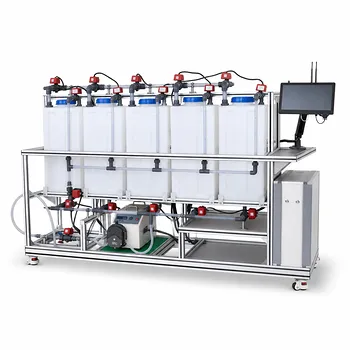
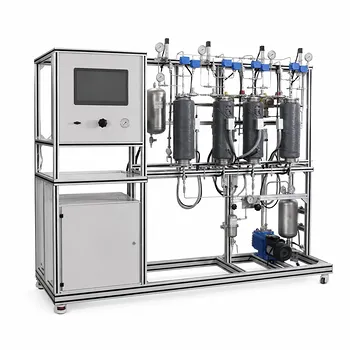
Here’s the reality: Pilot plants transform Life Cycle Assessment from a theoretical exercise into an evidence-based science by providing the empirical data that computer simulations alone cannot reliably generate.
LCA models are only as good as the data fed into them. Environmental pilot plants provide the direct measurements of real energy consumption, waste stream composition, and water usage under controlled, scalable conditions. This closes the dangerous gap between idealized lab chemistry and the complex, loss-prone reality of industrial operations, enabling researchers to perform cradle-to-grave assessments with genuine engineering rigor.
Why Empirical Data is the Backbone of a Realistic LCA
A Life Cycle Assessment cannot be accurate if its inventory data is rooted in guesses. Pilot plants turn those guesses into measurements.
The Limitations of Purely Theoretical Models
Process simulators rely on mathematical models for mass and energy balances. While cost-effective, these models often oversimplify reality.
They can miss critical losses from fluid dynamics, fouling, or heat loss. For a wastewater treatment step, a simulation might assume perfect separation, but a real ion-exchange column or membrane unit behaves differently. Without physical verification, the LCA will systematically underestimate the true environmental burden.
From Lab Bench to Pilot Scale: Closing the Data Gap
Bench-scale chemistry proves a reaction is possible. It tells you nothing about the process efficiency at scale.
A pilot plant replicates the actual unit operations—distillation, adsorption, filtration, or incineration—in a controlled but scalable system. This is where you capture the genuine material inputs, step durations, and operational waste that a lab beaker simply cannot reveal. The empirical data collected here becomes the validated inventory input for your LCA, bridging the gap between a mere possibility and a practical, assessable process.
The Critical Measurements Only a Pilot Plant Can Provide
What data points make pilot plants indispensable? They turn implied environmental costs into quantified realities.
Quantifying Real-World Energy and Material Flows
An LCA’s energy-impact category depends entirely on accurate consumption data. A pilot plant allows you to directly meter the electrical and thermal energy required for each unit operation.
You can measure the exact chemical consumption and regeneration cycles for ion-exchange resins or the frequency of membrane replacement due to fouling. These are recurring, operation-dependent drains that a theoretical model frequently ignores but which dominate the long-term environmental footprint.
Characterizing Waste Streams and Emissions
The difference between a design on paper and a running plant is the unexpected waste.
By running a pilot distillation column or an adsorption system, researchers can physically sample the real effluent streams. They can run breakthrough curves to determine when a treatment medium is spent, and analyze the resulting toxic load of the spent material. This generates empirical emission factors for the LCA, replacing generic database values with specific, process-driven data.
Validating Treatment Efficiency Under Dynamic Conditions
Real plants face upsets. A pilot plant allows you to safely introduce these process variations.
You can test how temperature, pressure, or flow rate fluctuations impact separation efficiency and pollutant reduction rates. This reveals not just the steady-state performance, but the robustness of the treatment system. For an LCA, this means you can assess the environmental consequences of off-spec operations and regeneration cycles, identifying process bottlenecks that would spike the ecological impact.
Understanding the Trade-offs and Pitfalls
While essential, pilot plant studies are not a magic wand. Their value depends on how you use them.
The Cost and Complexity of Pilot Plant Studies
This level of data collection is resource-intensive. It requires capital for modular equipment, skilled operators, and significant time to reach steady state for each test configuration.
For early-stage research, the cost might seem prohibitive compared to a purely simulation-based LCA. The key is to deploy pilot plants precisely where the scale-up behavior is complex—reactors, extraction units, and solids handling almost always justify the investment, while simple single-phase fluid flow rarely does.
The Risk of Misinterpreting Scale-Up Data
A pilot plant is still a scaled-down version of reality. The results give you a verified trend, not a carbon copy of a 10,000-liter reactor’s behavior.
Extrapolating without accounting for differences in surface-to-volume ratios or heat loss scaling can inject error. The data must be used to validate the mathematical model (the real goal), which is then responsibly scaled. Blindly inputting raw pilot-scale data into an LCA model for a full-scale factory creates a false sense of accuracy.
Avoiding Over-Reliance on a Single Operating Condition
A single experimental run under ideal conditions is only slightly better than a theory. The real power comes from a multivariate experimental design.
Without testing a range of flow rates, influent concentrations, or fouling conditions, you might miss a failure mode that causes a catastrophic environmental release. A robust LCA requires data that captures the envelope of normal and upset operation, reflecting the true lifecycle variability.
How to Apply This to Your LCA Project
Your approach must match your specific LCA goal. Pilot plant data is the tool; start with the question you’re trying to answer.
- If your primary focus is identifying environmental hotspots in a novel process: Use the pilot plant to conduct a full mass balance. Measure every input and output stream, including cleaning solvents and regeneration chemicals, to find the unexpected dominant impacts.
- If your primary focus is accurate reporting of water and energy footprints: Install precise metering on the pilot plant’s heating/cooling and pumping systems. Prioritize long-duration steady-state runs to capture the true, averaged utility consumption rather than a snapshot.
- If your primary focus is validating the feasibility of a waste treatment or recovery system: Run the pilot unit to failure. Push the adsorption column to breakthrough, foul the membrane intentionally, and measure the regeneration efficiency. This honest data on operational limits makes your LCA a genuine risk-assessment tool.
The goal is never just to collect data; it is to measure the gap between the ideal and the real, and to build your environmental assessment on the bedrock of that measured truth.
Summary Table:
| Parameter | Theoretical Models (Simulations) | Pilot Plant Empirical Data |
|---|---|---|
| Energy & Material Flows | Idealized estimates; misses heat/fluid losses | Directly metered electrical & thermal consumption |
| Waste & Effluents | Assumed perfect separation and emissions | Physical analysis of real effluents & toxic loads |
| Dynamic Operations | Steady-state assumptions only | Tested under pressure, temperature, & flow fluctuations |
| Equipment Wear | Ignores membrane fouling or resin decay | Quantifies actual regeneration and replacement cycles |
Bridge the Gap Between Theory and Reality with LABPARK
Accurate Life Cycle Assessments require real-world empirical data. LABPARK provides state-of-the-art Educational and Vocational Unit Operations Pilot Plants in chemical engineering, bioprocess & biotech, and environmental & water treatment designed specifically for universities, research institutes, and enterprises.
Equip your facility with the physical systems needed to validate scale-up models, measure exact utility consumption, and characterize real waste streams.
👉 Contact LABPARK today to discuss your research requirements and request a customized pilot plant solution!
Related Products
- Electrochemical Water Treatment Educational Unit Operations Pilot Plant
- Dual-Mode Rectification Pilot Plant for Practical Training Unit Operations
- Ion Exchange Water Purification Educational Pilot Plant for Engineering Unit Operations
- Multi-Functional Membrane Separation Educational Pilot Plant for Unit Operations Lab
- Solid Waste Pyrolysis and Refining Educational Pilot Plant for Unit Operations
People Also Ask
- What design features do educational electrochemical pilot plants utilize to manage gas liberation and water loss?
- How can unit operations pilot plants show lead-acid concentration vs state of charge? Real-time monitoring guide.
- How do educational electrochemical pilot plants scale up electrolysis? Master industrial engineering.
- How to Estimate Sulfate in Water Treatment Pilot Plant Deposits: Gravimetric Guide
- How can foaming be managed during steam generation experiments in water treatment unit operations pilot plants? Tips