Knowledge Chemical Engineering Education How do educational pilot plants eliminate manual mixing & dosing errors? Achieve precise kinetic data.
Author avatar

Tech Team · LABPARK

Updated 1 month ago

How do educational pilot plants eliminate manual mixing & dosing errors? Achieve precise kinetic data.


Manual beaker-scale kinetic experiments are a breeding ground for error. The simple act of adding a reactant in the wrong order or stirring with a glass rod can create localized concentration gradients that corrupt your entire dataset. Educational pilot-scale unit operations plants eliminate these mixing and dosing errors by integrating three engineered systems: baffled reactor vessels and variable-speed mechanical agitators that enforce rapid, uniform mixing, and automated dosing pumps that deliver reactants at precise volumetric rates. This design physically prevents the human inconsistencies that plague manual methods, ensuring highly reproducible kinetic data.

While beaker-scale experiments are ridden with operator-dependent variability, educational pilot plants lock in hydrodynamic consistency and dosing precision. The core insight is that these units don't just scale up size—they engineer out the root causes of human error by replacing a glass rod and a watchful eye with controlled, repeatable mechanical processes.

The Hidden Pitfalls of Manual Beaker-Scale Kinetics

Even a careful chemist introduces flaws when working at the bench. The errors are not just about sloppiness; they stem from fundamental physical limitations.

The Illusion of Homogeneity with a Glass Rod

Swirling a beaker or using a glass rod feels thorough, but it generates chaotic, unpredictable flow patterns. Reactants pool near the addition point before slowly dispersing. This creates localized concentration spikes that accelerate side reactions or distort the true rate of the main reaction.

The Critical Impact of Addition Order

Which reactant meets what first can radically alter the kinetic profile. In a manual setup, the sequence is often determined by convenience or habit, not by a strict protocol designed to maximize uniformity. Even a few seconds of delay can lead to a measurable bias in the rate constant.

Measurement Inaccuracies from Visual Cues

Manual experiments rely on the operator judging endpoints or taking samples from a potentially non-homogeneous mixture. If the solution is not perfectly mixed, the sample you pull represents only one pocket of the reaction, not the global state. Your data then reflects a local anomaly, not the real kinetics.

How Pilot Plant Design Tackles These Errors

Educational pilot units are not just bigger beakers. They are deliberately engineered to strip away these operator-dependent sources of error.

Baffled Vessels and Mechanical Agitation for Rapid Homogeneity

Baffles break up swirling flow and promote top-to-bottom turnover. Combined with a variable-speed mechanical agitator—typically a pitched-blade turbine or marine propeller—these vessels create a well-mixed zone in seconds. The chaotic but statistically uniform turbulence eliminates dead spots. You are no longer hoping for a good swirl; you are guaranteeing a homogeneous environment where every molecule has an equal chance to react.

Automated Dosing Pumps Enforce Precision

Replace the pouring graduate cylinder with a peristaltic or syringe pump, and you replace guesswork with exactitude. The pump delivers reactants at a known, steady volumetric rate, often at a submerged point below the agitator. This instantaneous dispersion into a turbulent zone prevents local accumulation. The addition order is programmed, not memorized, and the delivery rate remains constant from run to run, slashing human-induced variability.

Understanding the Trade-offs

While these systems excel at eliminating manual error, they are not a panacea. Recognizing their limits maintains scientific rigor.

The Loss of 'Feel' for Real-World Variation

A fully automated pilot plant can shield students from the very messiness that teaches process sensitivity. The manual beaker experiment, for all its flaws, forces you to confront how poor mixing destroys data. Skipping that lesson may produce clean numbers but a less-inquisitive engineer.

Complexity and Maintenance Overhead

Baffled vessels and pumps require calibration, cleaning, and troubleshooting. A clogged dosing line or a misaligned agitator can introduce its own systematic error that is harder to spot than a simple spill. The system’s precision depends on your diligence in maintaining it.

Not Always a Perfect Shrunk-Down Plant

An educational pilot plant may not perfectly mimic the macro-mixing and heat transfer of a production reactor. Extrapolating kinetics from a 10-liter baffled vessel to a 10,000-liter unit still requires careful scale-up considerations. The data is cleaner, but the jump to industry is not automatic.

Making the Right Choice for Your Educational Goal

The decision between manual beaker experiments and a pilot plant should hinge on what you aim to teach or investigate.

  • If your primary focus is illustrating the consequences of poor mixing: Start with a manual beaker experiment to let students see the gradient-induced errors, then contrast it with the pilot plant’s clean data to drive the lesson home.
  • If your primary focus is generating kinetic data for reactor design or scale-up: Rely on the pilot plant’s baffled, mechanically agitated system with automated dosing to ensure your numbers are not corrupted by operator technique.
  • If your primary focus is resource-constrained fundamental pedagogy: Use beaker-scale work but complement it with simulations that demonstrate how the pilot plant’s engineered mixing and dosing would alter the results, building intuition without hardware.

The core truth is that pilot plants don’t just make experiments bigger; they make them bulletproof against the human hand, giving you the confidence to trust your kinetics and focus on the chemistry, not the choreography.

Summary Table:

Feature Manual Beaker-Scale Educational Pilot Plants
Mixing Method Glass rod or manual swirling (creates concentration gradients) Baffled vessels & variable-speed mechanical agitators (uniform mixing)
Dosing Control Manual pouring (inconsistent rates and sequence) Automated dosing pumps (precise, programmed volumetric rates)
Data Quality High operator-dependent variability and error rate High reproducibility and standardized kinetic data

Enhance Engineering Education and Research with LABPARK

Stop letting manual mixing and dosing errors compromise your kinetic data. LABPARK delivers industry-grade Educational and Vocational Unit Operations Pilot Plants tailored for chemical engineering, bioprocess & biotech, and environmental & water treatment.

Designed specifically for universities, research institutes, and enterprises, our pilot plants replace manual inconsistencies with automated, precise, and repeatable mechanical processes to prepare the next generation of engineers.

Contact LABPARK today to discover how our pilot-scale solutions can transform your laboratories and training programs.

Related Products

People Also Ask

Related Products

Multi-Reactor Educational Pilot Plant for Reaction Engineering Unit Operations

Multi-Reactor Educational Pilot Plant for Reaction Engineering Unit Operations

Integrated bench-scale educational pilot plant for chemical engineering teaching featuring fixed bed fluidized bed and stirred tank reactors with web-based digital twin controls and safety interlocks for hands-on unit operations and reaction engineering comparative studies in one compact system.

Polymerization Granulation and Pellet Processing Educational Unit Operations Pilot Plant

Polymerization Granulation and Pellet Processing Educational Unit Operations Pilot Plant

Integrated pilot plant for teaching polymer processing from polymerization to pelletizing. Includes 30L reactor, hydrolyzer, extruder-granulator, vibration dryer, crusher, and sieve. Atmospheric pressure operation for safety, corrosion-resistant SS, customizable for chemical and polymer engineering education. Ideal for university labs.

Multi-Functional Drying Educational Unit Operations Pilot Plant

Multi-Functional Drying Educational Unit Operations Pilot Plant

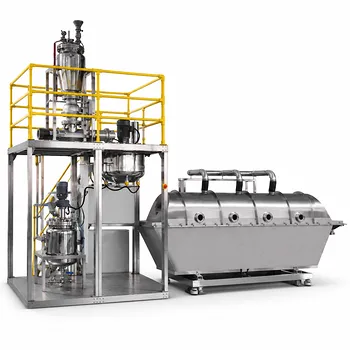
Versatile multi-functional drying educational unit operations pilot plant integrating tunnel, fluidized bed, and spray drying. Enables hands-on study of drying curves, psychrometry, and gas-solid separation for chemical engineering curriculum in higher education labs.

Comprehensive Fluid Mechanics Educational Unit Operations Pilot Plant

Comprehensive Fluid Mechanics Educational Unit Operations Pilot Plant

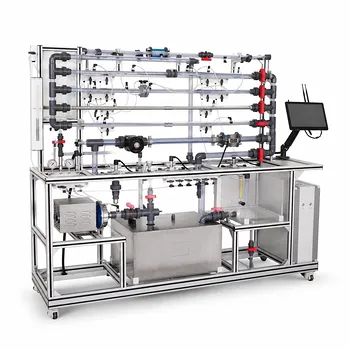
Hands-on fluid mechanics pilot plant for engineering education covering over 13 principles including pipe flow, minor losses, flowmeter calibration, and pump performance with industrial-grade components, smooth and rough piping, venturi and orifice flowmeters, and centrifugal pump testing and analysis.

Electrolytic Hydrogen Production Educational Unit Operations Pilot Plant

Electrolytic Hydrogen Production Educational Unit Operations Pilot Plant

Bench-scale electrolytic hydrogen production pilot plant designed for university engineering labs. Provides hands-on training in water electrolysis, gas-liquid separation, and process safety. Fully customizable system with digital PID control, corrosion-resistant components, and hydrogen gas detector. Ideal for chemical engineering curricula.

Educational Unit Operations Pilot Plant for Intraparticle Diffusion Effective Factor Measurement

Educational Unit Operations Pilot Plant for Intraparticle Diffusion Effective Factor Measurement

Designed for chemical engineering university labs, this pilot plant allows hands-on determination of catalyst particle intraparticle diffusion effective factors and gas-solid reaction kinetics using a fixed-bed tubular reactor with industrial touchscreen control, bridging theory and practical reactor design.

Fixed-Bed Chemical Reaction and Gas Dust Tar Removal Unit Operations Pilot Plant

Fixed-Bed Chemical Reaction and Gas Dust Tar Removal Unit Operations Pilot Plant

Integrated educational pilot plant for studying catalytic gas-solid reactions and downstream gas purification. Features dual fixed-bed reactor, three-stage heating, and touchscreen control for hands-on engineering training. Ideal for chemical and environmental engineering curricula.

Two-Dimensional Fluidization Hydrodynamics Educational Pilot Plant for Unit Operations Training

Two-Dimensional Fluidization Hydrodynamics Educational Pilot Plant for Unit Operations Training

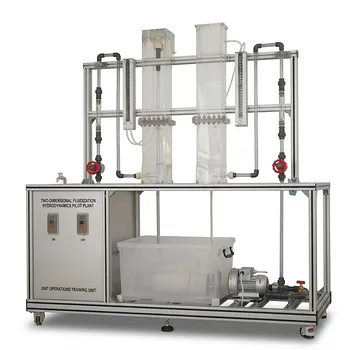
Explore gas-solid and liquid-solid fluidization hydrodynamics with our transparent 2D educational pilot plant. Ideal for chemical engineering unit operations labs, it demonstrates fixed to fluidized bed regimes, measures pressure drop, and integrates QR-code digital learning for enhanced student training.

Solid Waste Pyrolysis and Refining Educational Pilot Plant for Unit Operations

Solid Waste Pyrolysis and Refining Educational Pilot Plant for Unit Operations

This pilot plant for solid waste pyrolysis and refining integrates pyrolysis, separation, distillation, and catalytic hydrogenation into one educational unit. It provides visual process observation, smart data logging, and industrial safety for hands-on learning of engineering unit operations.

Rising and Falling Film Evaporation Educational Unit Operations Pilot Plant

Rising and Falling Film Evaporation Educational Unit Operations Pilot Plant

Hands-on educational pilot plant for studying rising and falling film evaporation, flow regimes, and heat transfer. Customizable for university labs with industrial instrumentation and data acquisition. Enables comparative evaluation of evaporation modes and energy efficiency.

100L Continuous Loop Hydrogenation Educational Unit Operations Pilot Plant

100L Continuous Loop Hydrogenation Educational Unit Operations Pilot Plant

This 100L continuous loop hydrogenation pilot plant is designed for chemical engineering education, featuring 316 stainless steel construction, advanced gas-liquid mass transfer components, explosion-proof safety systems, and a 15.6-inch touchscreen with 5G connectivity, cloud data logging, bridging theory and industry.

Tubular Reactor Flow Characteristics Determination Educational Unit Operations Pilot Plant

Tubular Reactor Flow Characteristics Determination Educational Unit Operations Pilot Plant

Educational pilot plant for investigating tubular reactor flow characteristics and residence time distribution Features adjustable recycle for plug flow and backmixing studies industrial touchscreen interface and real-time data acquisition Ideal for chemical engineering unit operations laboratory training and education

Quantitative Dosing and Liquid Flow Control Educational Unit Operations Pilot Plant

Quantitative Dosing and Liquid Flow Control Educational Unit Operations Pilot Plant

Explore industrial fluid transport and automated process control with this quantitative dosing and liquid flow control educational pilot plant, featuring local and remote control cabinets, variable speed metering pump, high-precision flow sensors, and PLC-based SCADA integration for engineering students.

Multi Functional Catalytic Reaction and Reactor Evaluation Educational Unit Operations Pilot Plant

Multi Functional Catalytic Reaction and Reactor Evaluation Educational Unit Operations Pilot Plant

Bench-scale educational pilot plant for catalytic reaction and reactor evaluation, integrating fixed bed, fluidized bed, and stirred tank reactors. Students compare reactor designs, evaluate catalysts, and study reaction kinetics and hydrodynamics. Perfect for unit operations labs in chemical engineering curricula.

Multi-Functional Special Distillation Educational Pilot Plant

Multi-Functional Special Distillation Educational Pilot Plant

Versatile multi-functional special distillation pilot plant for chemical engineering education. Supports continuous, vacuum, azeotropic, reactive, extractive distillation. Transparent glass columns enable real-time visual observation of hydrodynamics and separation processes.

Multimodal Absorption and Desorption Pilot Plant for Unit Operations Training

Multimodal Absorption and Desorption Pilot Plant for Unit Operations Training

Multimodal absorption and desorption pilot plant for higher education labs. Bridges theory and industrial practice with transparent packed columns, three operational modes (real-material, simulated, semi-physical), and SCADA control. Students explore mass transfer, column hydraulics, and process control. Customizable.

Multi Pump Fluid Transport Process Piping Unit Operations Training Pilot Plant

Multi Pump Fluid Transport Process Piping Unit Operations Training Pilot Plant

Industrial-scale multi-pump pilot plant for unit operations training in fluid transport and process piping, featuring real-material and semi-physical simulation modes, comprehensive pump and flowmeter calibration, and safety-enhanced two-tier platform, bridging academic theory and industrial practice for chemical engineering education.

Natural Product Extraction Unit Operations Training Pilot Plant

Natural Product Extraction Unit Operations Training Pilot Plant

Integrated natural product extraction pilot plant for chemical engineering training bridges theory and industrial practice with modular extraction and evaporation/concentration units, hybrid touchscreen and manual control, realistic process simulation, and self-contained softened water and vacuum utilities.

High-Gravity Emulsification and Mass Transfer Educational Pilot Plant

High-Gravity Emulsification and Mass Transfer Educational Pilot Plant

This integrated educational pilot plant utilizes rotating packed bed technology to demonstrate high-gravity emulsification and mass transfer, providing engineering students with hands-on experience in process intensification and unit operations through a modular, customizable design with digital monitoring.

Dual Mode Heat Transfer Pilot Plant for Unit Operations Training

Dual Mode Heat Transfer Pilot Plant for Unit Operations Training

Engineering-scale dual-mode heat transfer pilot plant for hands-on unit operations training in chemical engineering. Features real and simulated modes, multiple heat exchanger types, comprehensive coefficient determination, and advanced process control with data acquisition for engineering students and researchers.


Leave Your Message