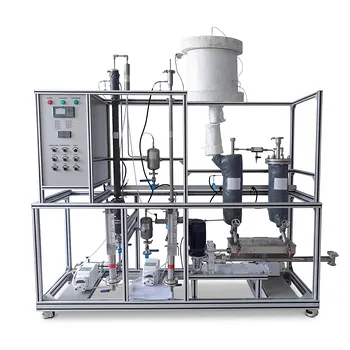
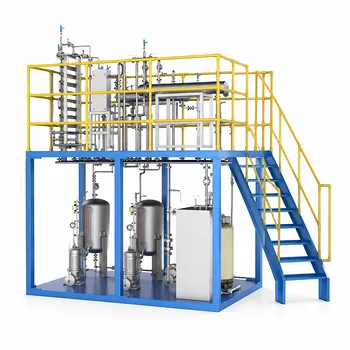
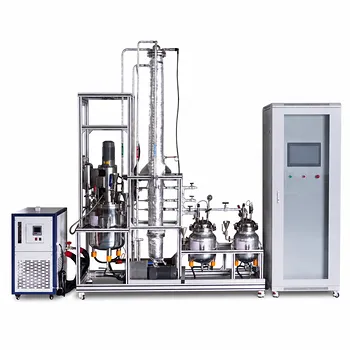
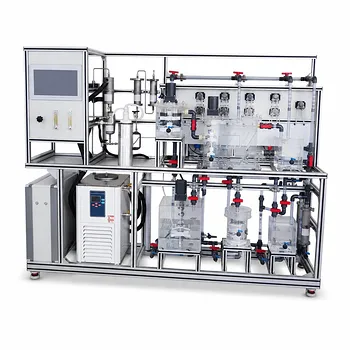
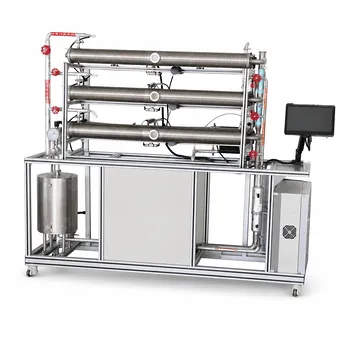
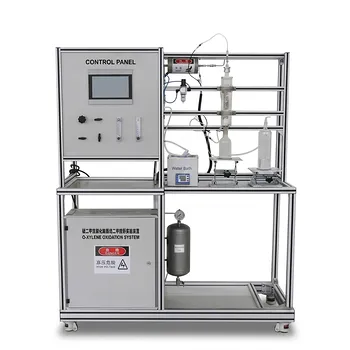
Hands-on pilot plant systems allow students to directly observe how autothermal reforming couples exothermic partial oxidation with endothermic steam reforming to achieve thermal self-sufficiency. By adjusting feed ratios and monitoring real-time temperature profiles across integrated reactors and heat exchangers, learners see exactly how heat generated in one zone drives the reaction in another. This practical approach transforms abstract energy balance equations into tangible cause-and-effect relationships, cementing a deep understanding of heat integration and process optimization.
Educational pilot plants physically simulate ATR’s thermal coupling, demonstrating how the exothermic combustion of a portion of the feed provides the instantaneous heat required for the reforming reaction. This direct, instrumented feedback loop turns the reactor itself into a living textbook on heat integration, energy efficiency, and the practical limits of process design.
The Core Principle: Coupling Endothermic and Exothermic Reactions
Autothermal reforming’s efficiency rests on a simple but powerful idea: pair a reaction that desperately needs heat with one that releases it. A pilot plant makes this coupling concrete.
The ATR Reaction as a Thermal Balancing Act
Steam reforming is highly endothermic — it absorbs a massive amount of heat to convert methane and steam into syngas. In a traditional steam reformer, this heat must be supplied externally by burning fuel in a furnace. ATR replaces that external furnace with an internal one.
In an ATR, a portion of the methane feed is partially oxidized (combusted) with pure oxygen at the top of the reactor. This reaction is exothermic and generates extreme temperatures — upwards of 2200 K in the combustion zone. The hot gases then pass through a catalyst bed where the remaining methane undergoes steam reforming, absorbing exactly the heat that was just released.
Why This Integration Matters for Process Efficiency
From an energy perspective, this coupling nearly eliminates the need for external heat input. The thermal self-sufficiency means no large fired heater is required, drastically reducing fuel consumption and the associated carbon footprint of the plant.
For students, this is a revelation: the reactor vessel itself becomes a perfectly synchronized heat exchanger. The pilot plant makes this visible by showing how a drop in oxygen flow instantly cools the reforming zone, collapsing syngas output — a lesson in both thermodynamics and process dynamics no simulation can deliver as powerfully.
How a Pilot Plant Physically Demonstrates the Heat Integration
A well-designed educational pilot plant translates the ATR principle into a measurable, controllable learning environment. It’s not just a smaller reactor; it’s a sensor-rich, configurable heat flow laboratory.
Instrumentation: Seeing the Invisible Heat Flow
The setup includes precise temperature sensors at multiple axial points inside the reactor, mass flow controllers on all feed lines (methane, steam, oxygen), and often a downstream heat exchanger network. Every watt of energy has a digital signature. By logging temperatures during operation, a student can literally trace the heat pulse from the combustion zone into the reforming zone.
Manipulating Feed Ratios to Map the Energy Balance
The core pedagogical exercise involves adjusting the methane-to-steam-to-oxygen ratio. Increasing oxygen flow raises the combustion zone temperature and shifts more heat into the reforming section — visible as a steeper temperature gradient and higher syngas output. Reducing oxygen starves the heat source, and the reforming temperature plateaus or falls. This hands-on parametric sweep teaches heat integration control as a direct tactile skill, not just a set of equations.
The Gas-Heated Reformer: A Concrete Lesson in Convective Heat Recovery
Many educational pilot plants extend the concept by pairing the ATR with a Gas-Heated Reformer (GHR). In this configuration, the hot, partially reformed gas exiting the ATR flows through a shell-and-tube heat exchanger where it donates its remaining high-grade heat to preheat and reform a secondary feed stream in the GHR. Students measure inlet/outlet temperatures on both sides, calculate heat duties, and see how convective heat recovery boosts overall efficiency without an extra burner. The pilot plant becomes a physical embodiment of a combined reactor-heat exchanger network.
Connecting the Lab to Industrial Practice: Pinch Analysis and Networks
Beyond the reactor itself, a pilot plant’s heat exchanger network teaches the broader discipline of process integration. This is where the deep need — mastering not just ATR but energy-efficient design — gets fully addressed.
From Pilot Plant Data to Pinch Targets
Pinch analysis identifies the theoretical minimum energy requirement for a process. In the pilot plant, students use real-time temperature and flow data from multiple streams — hot syngas leaving the ATR, cold feeds being preheated, product coolers — to construct composite curves and calculate the pinch temperature. They then compare the calculated minimum utility targets against the actual utility consumption they measure. Discrepancies become learning opportunities: where is heat being lost? Is a temperature cross occurring in a heat exchanger? The pilot plant validates the theory.
Configuring Heat Exchanger Networks for Maximum Recovery
Physical units like preheaters, condensers, and reboilers can be rearranged. Students experiment with series and parallel stream configurations, observing how a simple topology change alters the amount of external heating or cooling required. They can simulate batch scheduling challenges, using thermal storage or intermediate utility loops to recover heat from one process step for use in another. This directly ties the ATR’s core principle — internal heat integration — to the plant-wide energy optimization strategy that defines modern, efficient chemical manufacturing.
Understanding the Trade-offs and Challenges
No technology is a panacea. ATR’s thermal elegance comes with real-world drawbacks that a pilot plant can also starkly illustrate, building the critical thinking skills of a professional engineer.
The Hidden Cost: Oxygen Supply
ATR requires a stream of pure oxygen, not air, to avoid diluting the syngas with nitrogen. This demands a cryogenic air separation unit (ASU) , which carries enormous capital and operating costs. While the pilot plant itself may use bottled oxygen, an instructor can ask the class to calculate the energy penalty of producing that oxygen at industrial scale. The lesson: thermal self-sufficiency in the reactor doesn’t mean zero energy input to the overall system. This trade-off against a simpler steam reformer with a furnace is a classic total-cost-of-ownership problem.
Operating Windows and Material Limits
Because the ATR reactor is refractory-lined rather than relying on metal catalyst tubes, it can tolerate the extreme combustion zone temperatures (up to 2200 K) that would quickly melt a conventional reformer’s alloy tubes. However, the pilot plant’s safety interlocks and material limits teach another lesson: high temperature enables higher pressure and a lower H2/CO ratio (desirable for certain downstream syntheses), but it also requires robust control systems to prevent thermal runaway or refractory damage during transient operations, such as startup and oxygen flow interruptions.
Complexity in Control and Safety
Precisely balancing two competing reactions — one exothermic and explosive, the other endothermic and catalyst-dependent — within a single vessel demands sophisticated ratio control and emergency shutdown logic. The pilot plant, with its oxygen sensors, flame arrestors, and automated safety sequences, demonstrates why ATR units demand more advanced instrumentation and operator training than a simple furnace-heated reformer. The heat integration that makes it efficient also makes it intrinsically more process-sensitive.
Making the Right Choice for Your Educational Goal
Your specific learning objective will determine how you should utilize the pilot plant’s capabilities to teach ATR heat integration. Focus your experiments and inquiry according to your primary goal.
- If your primary focus is teaching fundamental heat integration principles: Use the basic ATR reactor to map temperature profiles at varying oxygen-to-methane ratios. Demonstrate the direct link between exothermic heat release and endothermic reaction rate.
- If your primary focus is process design and energy optimization: Employ the ATR-GHR coupled configuration to conduct a pinch analysis exercise. Have students reconfigure the heat exchanger network and measure the resulting change in utility consumption.
- If your primary focus is industrial-scale economics and feasibility: Conduct a comparative analysis. Run the ATR system, then calculate the energy required for an equivalent steam reformer plus the hypothetical ASU load. Quantify the trade-off between reduced furnace fuel and increased electricity/investment for oxygen.
- If your primary focus is control and safety engineering: Design transient experiments. Induce a step change in oxygen flow and observe the cascade of temperature and pressure effects, analyzing the response time required to maintain safe auto-thermal operation.
By transforming the elegant thermal balance of autothermal reforming into a physical, interactive experience, an educational pilot plant imprints the core principles of process intensification more deeply than any textbook or software simulation ever could.
Summary Table:
| Educational Focus | Key Demonstration Method | Practical Learning Benefit |
|---|---|---|
| Thermal Coupling | Adjusting O2/CH4 feed ratios and measuring axial reactor temp | Observe the balance between exothermic oxidation and endothermic reforming |
| Heat Recovery | Integrating ATR with a Gas-Heated Reformer (GHR) | Calculate convective heat transfer efficiency and pinch analysis targets |
| System Control & Safety | Managing transient states and safety interlock triggers | Understand real-world operating windows, thermal runaway limits, and O2 supply costs |
Bring Industrial Process Realism to Your Lab
Accelerate engineering education and research capabilities with LABPARK. We provide advanced Educational and Vocational Unit Operations Pilot Plants in chemical engineering, bioprocess & biotech, and environmental & water treatment designed specifically for universities, research institutes, and enterprises.
Our highly instrumented pilot systems translate complex thermodynamics—like ATR heat integration—into tangible, hands-on experience for future engineers.
Contact LABPARK today to find or customize the perfect pilot plant solution for your institution!
Related Products
- Steam Methane Reforming Hydrogen Production and Purification Educational Pilot Plant
- Dual Mode Heat Transfer Pilot Plant for Unit Operations Training
- Carbon Material Thermal Pretreatment Multiphase Separation Educational Pilot Plant
- Dual-Mode Rectification Pilot Plant for Practical Training Unit Operations
- Thermal Desorption Exhaust Gas and Tail Water Treatment Educational Pilot Plant
People Also Ask
- How Do Temp, Pressure & S:C Ratio Affect Methane Reforming? Optimize Your Pilot Reactor
- What are the differences between steam reforming and ATR in pilot plants? Key Design Guide
- How to Integrate WGS & Purification in Steam Reforming Pilot Plants to Protect Fuel Cells from CO Poisoning
- How is carbon deposition controlled in steam reforming? The Critical Role of S/C Ratio
- What is the difference between allothermal and autothermal steam reforming in pilot plants?