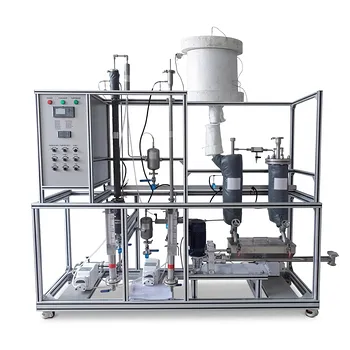
High-temperature catalysis in educational reactor pilot plants demands precise temperature profiling, yet irregular catalyst supports often block sensor access. To overcome this, these pilot plants employ one of two specialized strategies: either they position moveable thermocouples inside the inert zones adjacent to the catalyst bed, or they substitute the catalyst support with an extruded alumina monolith that allows direct insertion of temperature sensors into the active reaction zone. Both methods let students map axial temperature gradients under realistic operating conditions—often exceeding 900°C—without compromising the physical integrity of the reactor or the validity of the experimental data.
The core insight: Educational pilot plants designed for high-temperature catalysis tackle the sensor-placement problem head-on. When foam monoliths prevent internal measurement, they measure axial profiles in adjacent non-catalytic zones with sliding thermocouples. Alternatively, they switch to a structured, straight-channeled alumina support that permits direct in-bed thermocouple measurement, making heat integration and hot-spot verification a hands-on exercise.
The Challenge of Measuring Temperature in High-Temperature Catalytic Reactors
Why Standard Temperature Probes Fall Short
High-temperature catalytic reactions often rely on catalyst supports with irregular internal structures—such as foam monoliths. These porous, tortuous networks deliver high surface area but make it physically impossible to insert a thermocouple directly into the catalyst bed without damaging the support or creating bypass channels.
Without direct access, the true temperature at the active sites remains hidden. Students need to see the axial temperature distribution to understand heat integration, identify potential hot spots, and evaluate the coupling between reaction kinetics and heat transfer.
The Educational Imperative for Direct Profile Measurement
In a teaching environment, the goal is not merely to collect data but to visualize and verify fundamental concepts. A reactor system that only reports an inlet and outlet temperature would obscure crucial internal thermal gradients. Educational pilot plants must therefore bridge the gap between theoretical reactor models and real-world thermal behavior by providing measurable, interpretable temperature profiles along the reactor axis.
Two Primary Approaches in Educational Pilot Plants
Moveable Thermocouples in the Inert Zones
When using a foam monolith or similarly intrusive catalyst support, the primary measurement strategy is to place a moveable thermocouple in the pre- and post-catalyst inert zones. This probe can slide along the reactor axis, recording the temperature at multiple axial positions immediately before and after the catalyst bed.
While this does not give the exact point-of-reaction temperature, students can infer the thermal profile and heat transfer effectiveness by measuring how the gas temperature evolves across the catalyst section. The method is simple, robust, and avoids disturbing the catalyst structure.
This approach also teaches a critical engineering practice: when direct measurement is impossible, indirect inference from strategically placed sensors remains a reliable diagnostic.
Direct Measurement with Extruded Alumina Monoliths
For a more explicit temperature mapping, educational pilot plants can replace the foam monolith with an extruded alumina monolith. These supports consist of straight, parallel channels that allow a thin thermocouple sheath to be inserted directly into the catalyst bed without blockage.
With the thermocouple positioned inside an active channel, students can record the true temperature at multiple axial depths within the catalyst zone. This unlocks direct verification of heat integration efficiency, including how effectively the reaction front is exchanging heat with incoming feed or a cooling jacket.
The extruded alumina route transforms the pilot plant into a visual and quantitative learning platform. It reveals phenomena like the light-off location, the axial extent of the hot zone, and the damping effect of thermal conduction along the monolith walls.
Understanding the Trade-offs
Accuracy vs. Practicality
The moveable inert-zone thermocouple method is operationally simpler and compatible with any catalyst shape. However, it provides only an indirect temperature profile; students must apply heat balances to estimate the catalyst bed’s internal thermal state.
The extruded alumina monolith method delivers direct, in-bed measurements with high spatial resolution. The trade-off is that you must accept a simplified catalyst support geometry that may not fully represent industrial foam or pellet-based reactors. The kinetics will be similar, but the transport phenomena (especially radial heat transfer) will differ.
Sensor Placement and Safety Considerations
Both methods require careful attention to thermal expansion and sealing at the reactor’s high operating temperatures. In educational systems, safety interlocks—such as automatic feed shutoff when a critical temperature is exceeded—protect students from runaway scenarios while allowing them to observe parametric sensitivity in a controlled manner.
Accurate profiling also supports broader learning: by coupling temperature data with online gas analysis, students can calculate conversions, enthalpies, and heat release rates and see how these relate to the measured thermal profile.
Making the Right Choice for Your Learning Goal
How you facilitate temperature profile measurement should align with the core educational objective. Here’s a practical decision guide:
- If your primary focus is teaching heat integration concepts with any catalyst support: Use the moveable thermocouple in the inert zone approach. It works universally and forces students to think critically about inferring internal bed behavior.
- If your primary focus is visualizing the exact thermal landscape within the catalyst bed: Choose the extruded alumina monolith method. It gives students direct, high-resolution data that makes the connection between kinetics and heat transport immediate and tangible.
- If your goal is to safely demonstrate hot spot formation and runaway behavior: Combine either method with multi-zone temperature sensors, cooling jackets, and automated safety interlocks, allowing students to explore parametric effects without risk.
The right configuration turns the temperature measurement challenge from a mere instrumentation problem into a core lesson in reaction engineering—and that’s exactly what a well-designed educational pilot plant delivers.
Summary Table:
| Feature | Moveable Thermocouples (Inert Zones) | Extruded Alumina Monoliths (Direct) |
|---|---|---|
| Measurement Type | Indirect (inferred from boundary zones) | Direct (measured inside the catalyst bed) |
| Catalyst Support | Irregular supports (e.g., foam monoliths) | Structured supports (straight-parallel channels) |
| System Complexity | Low (simple, robust sensor movement) | Medium (requires thermocouple sheath alignment) |
| Primary Learning Goal | Inferring thermal profiles & heat balance | Visualizing hot spots & kinetic light-off |
Bring Industrial-Scale Learning to Your Lab with LABPARK
At LABPARK, we empower universities, research institutes, and enterprises to bridge the gap between academic theory and real-world chemical engineering. We provide state-of-the-art Educational and Vocational Unit Operations Pilot Plants specializing in:
- Chemical Engineering & Catalysis (including high-temperature reactors)
- Bioprocess & Biotech
- Environmental & Water Treatment
Equipped with advanced safety features and versatile temperature profiling options, our pilot plants deliver hands-on learning that prepares students for the future of industry.
Ready to upgrade your lab's capabilities? Contact LABPARK today to discuss your custom pilot plant configuration.
Related Products
- Multi-Reactor Educational Pilot Plant for Reaction Engineering Unit Operations
- Fixed-Bed Chemical Reaction and Gas Dust Tar Removal Unit Operations Pilot Plant
- Fixed Bed Gas Solid Catalytic Reaction Educational Pilot Plant
- Micro-Scale Gas-Solid Catalytic Reaction Educational Pilot Plant
- Fluidized Bed Gas Solid Catalytic Reaction Educational Pilot Plant
People Also Ask
- How do reactor pilot plants define QbD design space? Master chemical process scale-up.
- When configuring a reactor unit operations pilot plant for highly exothermic reactions, how to prevent thermal runaway?
- How do metal ion-catalyzed reaction mechanisms inform chemical engineering pilot plant design? From kinetics to scale-up
- What role do educational pilot plants play in scaling green chemistry? Bridging the Lab-to-Industry Gap
- What are the barriers to process intensification & how do pilot plants help?