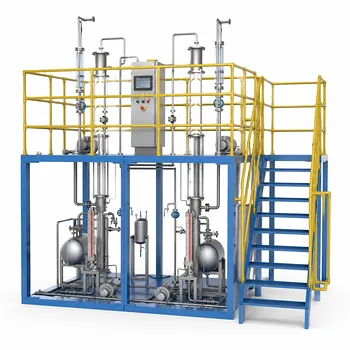
Distillation boundaries act as invisible walls in ternary azeotropic systems, partitioning the phase diagram into regions that a simple mass balance cannot cross. If your feed lies on one side of a boundary, conventional rectification cannot yield a pure product that resides on the other side. This article explains how those limits arise and details the pilot‑scale configurations that allow you to experimentally overcome them.
Distillation boundaries restrict product separation by creating composition regions that are thermodynamically unreachable with simple distillation. To cross those boundaries in a pilot plant, you must introduce a selective third agent—a solvent, entrainer, or salt—or integrate additional unit operations like decanters or membranes that shift or bypass the azeotropic tie-lines.
The Thermodynamic Lock of Distillation Boundaries
A distillation boundary is not a physical barrier; it is a consequence of phase equilibrium. Understanding how it forms is the first step to breaking through it.
How Boundaries Define Feasible Product Regions
The mass balance line connecting feed, distillate, and bottoms cannot intersect a distillation boundary. This forces a feed located in one compartment to produce only compositions that lie inside that same compartment. If the pure product you want sits in a different region, you hit a thermodynamic wall.
The Role of Azeotropes and Residue Curves
Azeotropes—both binary and ternary—create the ridges that become these boundaries. In a pilot plant, running under total reflux and sampling tray liquid compositions generates experimental distillation curves. When plotted on a triangular diagram, these curves show exactly where the boundaries sit and why a pot residue, for example, gets trapped at a saddle azeotrope rather than pure component.
Pilot Plant Strategies to Cross the Boundaries
Once the boundary is mapped, you can design a unit‑operations pilot plant that breaks the deadlock. The key is to change the phase equilibrium itself or to exploit a second physical separation step.
Modifying Relative Volatility with an Entrainer
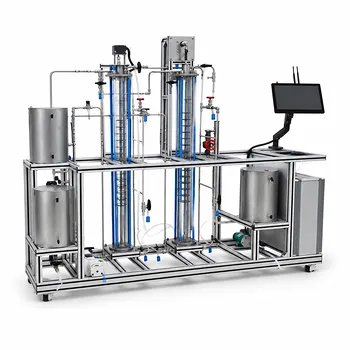
Adding an entrainer forms a new, lower‑boiling azeotrope that pulls water overhead. A classic educational demo uses benzene to break the ethanol–water azeotrope. In a three‑column pilot plant, the first column produces pure ethanol at the bottom while the ternary vapor is condensed and sent to a decanter. The solvent‑rich phase recycles, and the water‑rich phase is stripped in the subsequent columns to recover the entrainer. This replicates commercial‑scale azeotropic distillation in a lab footprint.
Harnessing Liquid–Liquid Phase Splitting
For systems like ethyl acetate–ethanol–water, the vapor distillate forms two liquid phases upon condensation. A pilot plant with a transparent decanter makes this visually obvious. The organic‑rich top phase feeds a rectification column to produce 99.5 % ethyl acetate, while the aqueous bottom phase is recycled to recover ethanol. This heterogeneous azeotropic distillation sidesteps the boundary by exploiting the miscibility gap, not by erasing it.
Integrating Membrane Separation
A hybrid pilot plant couples a distillation column with a pervaporation or vapour‑permeation unit. When the column head composition approaches an azeotrope, the vapor is passed over a membrane that selectively permeates water. The dehydrated retentate returns to the column, effectively pulling the composition past the azeotropic point. This setup can increase throughput by up to 40 % and demonstrates how membrane technology can augment classical distillation.
Overcoming Physical Constraints with a Dual‑Column Series
When the number of stages needed exceeds the ceiling height, the column can be split into two sections in series. The bottoms of the first column are pumped to the top of the second, while vapour from the second is sent back to the first. This configuration reduces column pressure drop, making it particularly valuable for vacuum distillation pilot plants where minimizing reboiler temperature is critical to avoid thermal degradation.
Understanding the Trade‑offs
Every method that crosses a distillation boundary adds complexity. Being aware of the downsides prevents pilot‑scale results from misleading you about full‑scale viability.
- Entrainer recovery costs: Adding a solvent or entrainer means you must install and operate at least one extra distillation column. The energy and capital cost can outweigh the advantage if the entrainer selection is not optimal.
- Liquid‑liquid equilibria sensitivity: Decanter‑based separations are highly temperature and composition‑dependent. Small shifts in the feed can collapse the two‑phase region and destroy separation performance.
- Membrane fouling and lifespan: Hybrid membrane‑distillation systems suffer from gradual fouling and membrane degradation, requiring careful pretreatment and ongoing monitoring that a simple distillation column avoids.
- Educational vs. industrial applicability: Pilot plants are often run at total reflux for mapping boundaries. Real‑world columns operate at finite reflux ratios and face dynamic disturbances, so the clean boundaries observed in a teaching pilot may blur under industrial conditions.
Applying the Right Configuration to Your Pilot Plant
Your choice of pilot‑plant arrangement should be driven by the specific learning or research objective. The same ternary system can be approached in several ways depending on what you need to prove.
- If your primary focus is mapping thermodynamic limits: Run a simple glass column under total reflux and sample tray compositions. Plotting experimental residue curves is the best way to visualize azeotropic boundaries and the butterfly regions they create.
- If your primary focus is demonstrating industrial azeotropic separations: Build a multi‑column setup with a decanter and recycle streams. This showcases entrainer selection, VLLE, and the full mass balance of a heteroazeotropic process.
- If your primary focus is evaluating process intensification: Integrate a pervaporation membrane module with the column. This hybrid configuration shows how to beat a binary azeotrope without a third chemical agent and highlights the synergy between separation technologies.
- If your primary focus is studying vacuum or heat‑sensitive separations: Use a split‑column series to keep reboiler temperatures low. This arrangement teaches the practical link between pressure drop, thermal degradation, and column hydraulics.
Every distillation boundary can be crossed when you replace a single‑column mindset with a unit‑operations ensemble tailored to the phase equilibrium. The pilot plant becomes not just a scaled‑down copy of industry but a discovery tool that reveals which boundary‑breaking method best fits the chemistry at hand.
Summary Table:
| Configuration Strategy | Mechanism to Cross Boundary | Key Application & Benefit |
|---|---|---|
| Entrainer Addition | Modifies relative volatility to form new azeotropes | Replicates commercial-scale multi-column distillation |
| Liquid-Liquid Decanting | Exploits miscibility gap and phase splitting | Separates heterogeneous systems like ethyl acetate-water |
| Membrane Integration (Hybrid) | Pervaporation selectively permeates water | Bypasses azeotropes without chemical solvents, boosting throughput |
| Dual-Column Series | Splits column into two sections in series | Lowers pressure drop and reboiler temperature for vacuum systems |
Optimize Your Separation Processes with LABPARK
Are you looking to demonstrate complex thermodynamic concepts or scale up your separation processes? LABPARK provides premium Educational and Vocational Unit Operations Pilot Plants in chemical engineering, bioprocess & biotech, and environmental & water treatment for universities, research institutes, and enterprises.
Our customizable pilot systems help you visualize residue curves, test hybrid membrane-distillation processes, and safely overcome complex distillation boundaries.
Ready to elevate your research and training capabilities? Contact our expert team today to find the perfect pilot plant configuration for your lab!
Related Products
- Multi-Functional Special Distillation Educational Pilot Plant
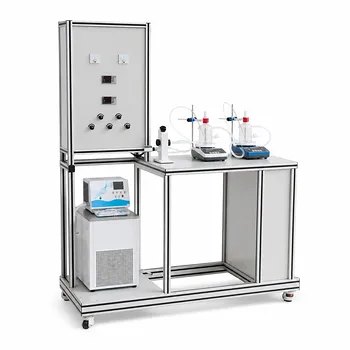
- Ternary Liquid-Liquid Equilibrium Educational Pilot Plant
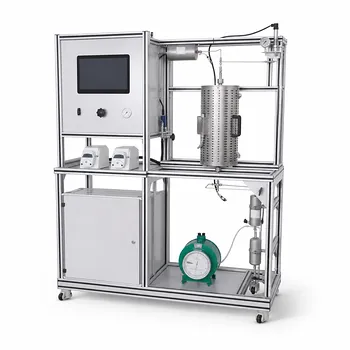
- Continuous Batch Extractive Distillation Educational Pilot Plant
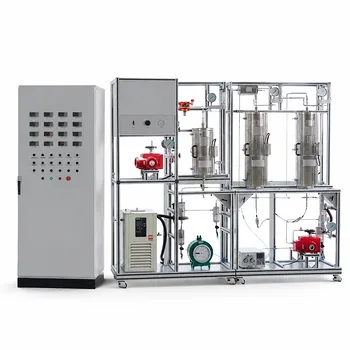
- Continuous Sieve-Plate Distillation Pilot Plant for Unit Operations Laboratory Education
- Ethyl Acetate Synthesis Unit Operations Pilot Plant for Practical Training
People Also Ask
- Why does simple distillation yield higher efficiency than flash distillation? Key thermodynamic differences.
- How does double temperature difference control improve distillation pilot plants? Stabilize purity.
- How to Integrate Spectroscopy in Distillation Pilot Plants for Advanced Process Control
- Why is the acentric factor important in pilot plants? Fluid property prediction.
- How Batch vs Continuous Configuration Affects Distillation Pilot Plant Versatility & Footprint